Establishing secure connection…Loading editor…Preparing document…

Alabama Petition for Rule Nisi

This template is fully customizable. Edit the text, fill out the fields, and send it for signature. Give it a try!
Alabama Petition for Rule Nisi

What the Alabama Petition for Rule Nisi Is and When It’s Used

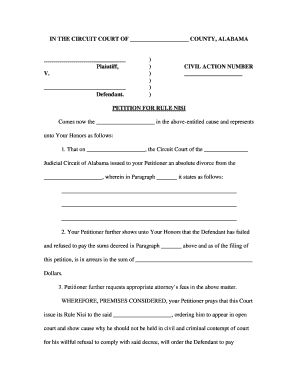
An Alabama Petition for Rule Nisi is a court filing that asks the judge to issue a rule nisi — a conditional order requiring a named party to show cause why the court should not take a proposed action. Common uses include motions to enforce prior orders, requests for contempt hearings, and petitions to compel performance where immediate relief is not yet final. The petition frames the facts, cites legal authority, requests specific relief, and asks the court to set a return date and hearing so the respondent can respond under oath or appear in court.

Why a Rule Nisi Petition Matters in Alabama Proceedings

A Petition for Rule Nisi creates a formal judicial process that compels a response and schedules a hearing, preserving notice and procedural due process for the parties involved.

Why a Rule Nisi Petition Matters in Alabama Proceedings

Who Typically Prepares or Files a Rule Nisi Petition

Attorneys and self-represented litigants commonly file Rule Nisi petitions to enforce orders, pursue contempt, or require a party to appear and explain noncompliance.

  • Civil litigants and plaintiffs seeking enforcement or contempt remedies in state court; petitions start formal adjudication.
  • Family law attorneys and custodial parties when a court order for custody or support needs enforcement.
  • Court clerks and administrative counsel who process scheduling and return dates after the petition is filed.

Use a Rule Nisi petition when you need a court-ordered opportunity to show cause, obtain a hearing date, and preserve the record for enforcement action.

Step-by-step: Preparing and Filing the Petition

Follow a consistent sequence: draft the petition, attach supporting affidavits, serve the respondent, and obtain a hearing date from the court calendar.

  • 01
    Draft: State caption, facts, authority, relief requested, and proposed order.
  • 02
    Affidavit: Attach sworn statements and exhibits that support the factual allegations.
  • 03
    Service: Serve the petition per Alabama Rules of Civil Procedure and local rules.
  • 04
    Return: Request a return date and hearing to allow the respondent to appear.

Essential Parts of a Professional Rule Nisi Petition

A polished petition is clear, well-supported, and procedurally complete so the court can set a return date without additional directive.

Caption

Court name, parties, and cause number. The caption must match the underlying case to ensure the filing attaches to the correct docket and avoids clerical rejection.
Statement of Facts

Concise chronology of relevant events with dates and exhibit references. Facts should be precise enough to establish a basis for relief without argumentative language.

Legal Basis

Cite the statute, rule, or prior order being enforced. Tie each requested remedy to a specific rule or prior judgment to support the court's authority.

Relief Sought

Specify the exact remedy—contempt hearing, sanctions, compliance order, or other relief—and describe the form of order requested.

Verification/Affidavit

Attach a sworn affidavit from a competent affiant verifying facts and authenticity of exhibits; include notarization where required by local rule.

Certificate of Service

Describe how and when the respondent was served, including method of service and date, to comply with due process requirements and local rules.

Process Flow: From Filing to Hearing

The petition initiates an ordered sequence: filing, service, scheduling, response, and an evidentiary or status hearing as set by the court.

  • Prepare: Draft petition, attach affidavit and exhibits, and prepare proposed order.
  • File: Submit documents to the clerk by e-file or in-person according to local rules.
  • Serve: Effect personal or substituted service per Alabama Rules and file proof of service.
  • Hearing: Attend the return date and present evidence or request further scheduling as the judge directs.

Setting Up an Online Workflow for the Petition

Configure a digital workflow to assemble exhibits, collect e-signatures where allowed, and create a compliant packet for filing and service.

Field Configuration
Document Format PDF/A preferred for court filings; maintain original file attachments.
Authentication Choose signer verification (email, SMS code, or stronger) for affidavit signers.
Service Method Record method of service for certificate (personal, mail, e-service if authorized).
Repository Store a signed, timestamped copy with audit trail for the official record.

Technical Requirements for Digital Preparation and eSubmission

Use a platform that supports PDF, Word, and secure attachments, and that captures a detailed audit trail and signer attribution.

  • File Types: PDF, DOCX, and image attachments supported for exhibits.
  • Integrations: Connectors for case management and cloud storage like Salesforce, NetSuite, Microsoft 365, and Google Workspace.
  • Authentication: Email, SMS, or advanced signer authentication options for affidavits and verifications.

Ensure the chosen platform provides tamper-evident signed PDFs, audit logs, and export formats required by your court or e-filing system.

Typical Deadlines and Timing Expectations

Timing varies by county and judge, but common milestones include prompt service, a short return period, and hearing scheduling dependent on court calendars.

File Date:

Date you submit the petition to the clerk; starts the administrative timeline.

Service Deadline:

Serve the respondent promptly—often at least several days before the return date per local rules.

Return Date:

Judge sets a date for the respondent to show cause or answer.

Hearing Date:

The court schedules a hearing; timing depends on docket congestion.

Order Effective:

Any order follows the hearing and may be stayed or enforced per the judge's directive.

Common Preparation and Filing Pitfalls to Avoid

  • Incomplete caption or wrong case number that causes the clerk to misfile or return the petition to the filer.
  • Missing certificate of service or failure to proof-service properly, which may delay hearings or result in dismissal.
  • Affidavits lacking notarization or proper verification signatures, undermining the factual basis of the petition.
  • Relying on electronic signatures where the court or local rule requires original notarized affidavits or in-person signatures.

Consequences of an Incorrect or Defective Petition

Dismissal Risk: Clerk may reject or judge may dismiss.
Contempt Exposure: Proceedings may trigger sanctions or fines.
Delay in Relief: Incorrect filings prolong resolution.
Sanctions: Court-ordered monetary sanctions possible.
Perjury Risk: False statements risk criminal penalties.
Service Defect: Improper service can void proceedings.

Security and Compliance Considerations for Digital Files

Encryption in Transit: TLS 1.2/1.3
Encryption at Rest: AES-256 encryption
Certifications: SOC 2 Type II
Healthcare Compliance: HIPAA (BAA required)
Legal Frameworks: ESIGN and UETA compliance
FDA Records: 21 CFR Part 11 available

eSignature Vendor Comparison for Filing Support and Document Execution

Compare common vendor price points and core capabilities relevant to preparing affidavits and signature collection; signNow is listed first per vendor comparison conventions.

signNow DocuSign Adobe Sign PandaDoc HelloSign
Starting Price $8/user/mo $15/user/mo $14/user/mo $19/user/mo $15/user/mo
Free Trial 7-day free trial Varies by vendor Varies by vendor Varies by vendor Varies by vendor
Bulk Send Yes (plan-dependent) Yes Yes Yes No
Audit Trail Yes Yes Yes Yes Yes
HIPAA Compliant Yes Yes Yes No No

Real-world Examples of Moving Fast with Digital Document Workflows

These short examples illustrate organizations using digital signing and document automation to speed execution and maintain compliance in legal workflows.

Martin Properties

Tim Martin, Founder, Martin Properties improved efficiency by processing documents online.

  • The team completed filings and client signatures without in-person meetings.
  • He reports tighter compliance and faster turnaround while maintaining security and recordkeeping for property transactions and enforcement matters.

BIS

Dan Rotelli, CEO, BIS selected a secure e-signature platform for compliance.

  • The vendor's SOC 2 certification supported their decision.
  • BIS reduced paper handling, centralized signed records, and integrated e-signatures with back-office systems for audit-ready documentation.

Frequently Asked Questions and Troubleshooting

Answers to common procedural and technical questions about preparing, serving, and submitting an Alabama Petition for Rule Nisi.


Need help? Contact support

be ready to get more
Join over 28 million airSlate SignNow users