Establishing secure connection…Loading editor…Preparing document…

Louisiana Answer to Petition for Declaration of Death

This template is fully customizable. Edit the text, fill out the fields, and send it for signature. Give it a try!
Louisiana Answer to Petition for Declaration of Death

What the Louisiana Answer to Petition for Declaration of Death Is

The Louisiana Answer to Petition for Declaration of Death is a formal written response filed in parish civil court by a person or party named in a petition seeking a judicial declaration that a missing individual is legally deceased. The Answer allows the responding party to admit or deny allegations, raise factual disputes, assert procedural or substantive defenses, and request specific relief or protective orders. Properly framed, the Answer preserves litigation rights that affect property, succession, guardianship, insurance, and marital status while conforming to local civil procedure and court filing requirements.

Why a Clear Answer Matters in a Declaration of Death Case

A correct, timely Answer preserves defenses, prevents default rulings, and narrows factual issues the court must resolve. It also protects property and inheritance interests while ensuring admissible evidence will guide any final declaration.

Why a Clear Answer Matters in a Declaration of Death Case

Who Typically Prepares and Files an Answer

Individuals and counsel who are named parties use an Answer to contest or respond to a petition and to preserve rights during the court process.

  • Responding Party — Named family member or interested person who disputes declarations or seeks to protect estate interests.
  • Attorney for Respondent — Drafts procedural objections, ensures local rules compliance, and represents the party at hearings.
  • Estate Representative — Curator, executor, or administrator may answer to protect estate assets and creditor claims.

Many filers consult local counsel early to avoid default, preserve evidentiary objections, and meet parish-specific filing and service rules.

Core Components of a Professional Answer

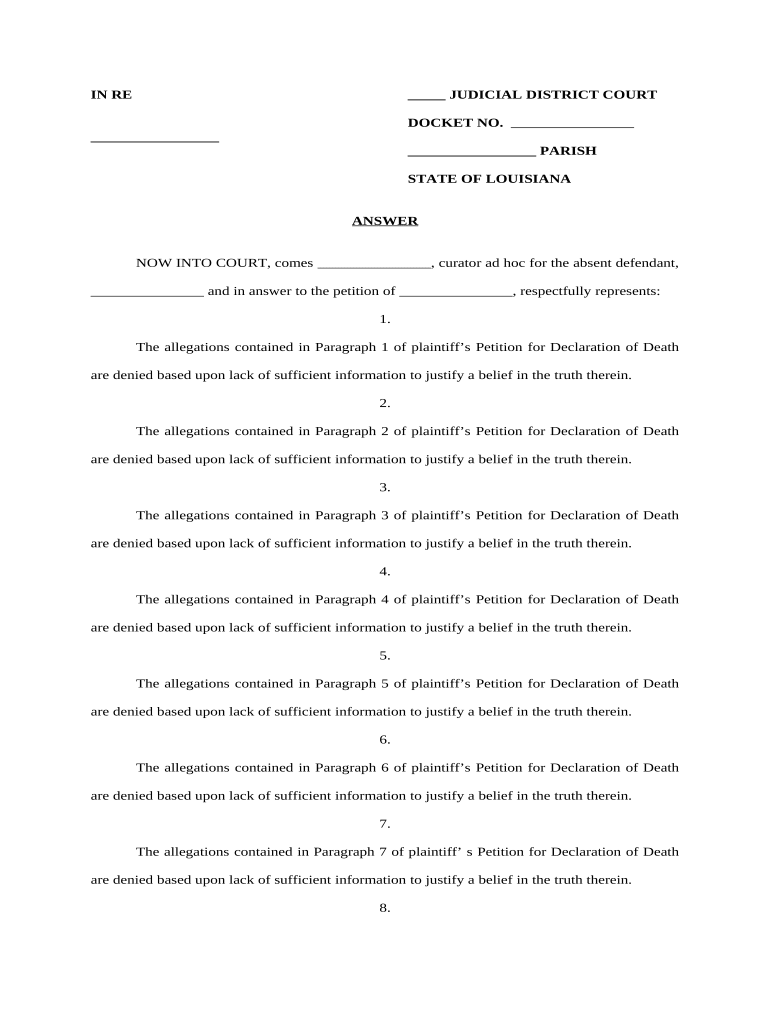
A proper Louisiana Answer follows court caption conventions and clearly structures admissions, denials, defenses, and the requested relief. Attach exhibits and include a certificate of service.

Caption

Court name, case number, and parties must match the petition exactly, including parish and docket number; mismatches cause rejection.
Parties

Identify petitioner(s) and respondent(s) clearly with full legal names, addresses, and counsel information including bar numbers when applicable.

Admissions/Denials

Respond to each numbered allegation in the petition by admitting, denying, or stating insufficient knowledge to admit or deny.

Affirmative Defenses

Include any affirmative defenses, jurisdictional objections, or motions the respondent intends to raise supporting factual or legal positions.

Signature Block

Respondent or counsel must sign, print name, provide contact information, and include date; follow notarization requirements where applicable.

Certificate of Service

State the method and date of service on all parties; accurate service prevents default and evidentiary disputes.

Required Identifying Data on the Answer

Case Number: Exact docket identifier
Parish Court: Court name and division
Petitioner Name: Full legal name(s)
Respondent Name: Full legal name(s)
Date of Disappearance: MM/DD/YYYY or date range
Relief Sought: Specific requested action

Step-by-Step: Completing the Answer

Follow a clear sequence to draft, sign, serve, and file the Answer to avoid procedural defaults and to preserve evidence.

  • 01
    Review Petition: Number each allegation to prepare matching responses.
  • 02
    Draft Responses: Admit, deny, or state lack of knowledge per paragraph.
  • 03
    Sign / Notarize: Sign personally or counsel signs; notarize if required.
  • 04
    File & Serve: File with parish clerk and serve all parties properly.

How to Configure an Online Filing Workflow

Configure your document and signing workflow to match court e-filing requirements and evidence preservation practices.

Document Format PDF/A is preferred for long-term archival and court acceptance.
Field Placement Place signature, date, and certificate of service fields clearly.
Signer Authentication Use email plus SMS or ID verification where court rules require stronger assurance.
Exhibit Attachments Append exhibits as separate, clearly labeled PDF attachments.
Filing Method Select e-file portal or clerk's accepted delivery method.

Where and How to File or Serve an Answer

Filing and service steps vary by parish. Confirm local rules with the clerk before submitting to ensure acceptability and proper notice.

  • Parish Clerk: File the original Answer with the parish clerk's office.
  • Service Method: Serve other parties via sheriff or authorized process server.
  • Proof of Service: Attach a signed certificate of service to the filed Answer.
  • Hearings: Monitor clerk notices for hearing dates and orders.

Digital Signing and eSubmission Considerations

Courts and clerks accept electronic filings differently across parishes; align your e-sign and e-file setup with local rules.

  • File Formats: PDF and DOCX accepted by many systems
  • Authenticator Options: Email, SMS code, or ID verification
  • Key Integrations: Salesforce, Microsoft 365, Google Workspace

Confirm the parish e-filing portal or clerk's office will accept electronically signed and digitally timestamped documents before relying on e-signature workflows.

eSignature Vendor Pricing Comparison for Court Filing Workflows

Compare signNow and common alternatives for per-user pricing, trial availability, bulk features, audit trails, and HIPAA support to decide which vendor aligns with filing and evidence needs.

signNow DocuSign Adobe Sign PandaDoc HelloSign
Starting Price $8/user/mo $15/user/mo $14/user/mo $19/user/mo $15/user/mo
Free Trial 7-day free trial Verify with vendor Verify with vendor Verify with vendor Verify with vendor
Bulk Send Yes (premium) Yes Yes Yes Verify with vendor
Audit Trail Yes Yes Yes Yes Yes
HIPAA Compliant Yes (BAA available) Yes Yes Verify Verify
Envelope Cap No cap 100 envelopes/user/year Varies by plan Varies by plan Varies by plan

Practical Tips for an Accurate and Efficient Answer

Follow procedural checklists and preserve evidence to reduce delays and challenges during adjudication.

Verify Party Names
Confirm spelling and legal names against petition and government IDs; mismatches can cause service defects or identity challenges later in litigation.
Meet Filing Deadlines
Note parish-specific deadlines and allow time for in-person or e-filing processing to prevent defaults and adverse judgments.
Attach Supporting Exhibits
Include declarations, witness statements, or documentary proof as exhibits with clear labels to support denials or affirmative defenses.
Limit Overbroad Denials
Be specific when disputing facts. Vague blanket denials can harm credibility and complicate later factual development.

Typical Timing and Deadlines to Track

Timing for an Answer depends on service method and parish rules; confirm local code or the clerk for exact periods.

Service Date:

Clock starts on the date of proper service to the respondent.

Response Window:

Varies by parish; commonly 15–30 days after service — verify locally.

Filing Receipt:

Keep the clerk-stamped copy as the official filing record.

Hearing Notice:

The court will set hearings; watch clerk dockets for dates.

Appeal Timing:

If adverse, note short deadlines for post-judgment relief and appeals.

Common Preparation Errors to Avoid

  • Omitting a numbered response to each petition paragraph creates ambiguity and may be treated as admission of allegations.
  • Using inconsistent party names or incorrect case numbers can result in misfiling and procedural delay or dismissal.
  • Failing to attach the certificate of service or proof of service leads to contested notice and potential default claims.
  • Relying on an unsigned or improperly notarized signature when the clerk requires notarization can cause rejection of the filing.

Risks and Consequences of an Incorrect or Late Answer

Default Judgment: Risk of judgment for petitioner
Property Transfer: Unprotected assets may transfer improperly
Probate Delay: Unresolved disputes extend estate administration
Perjury Exposure: False statements can trigger criminal liability
Statute Limits: Failure to preserve claims can bar relief
Attorney Costs: Increased legal fees and possible sanctions

Frequently Asked Questions About the Answer and Electronic Procedures

Answers to frequent procedural and e-sign questions to help avoid common filing problems and to explain legal validity under U.S. law.


Need help? Contact support

be ready to get more
Join over 28 million airSlate SignNow users