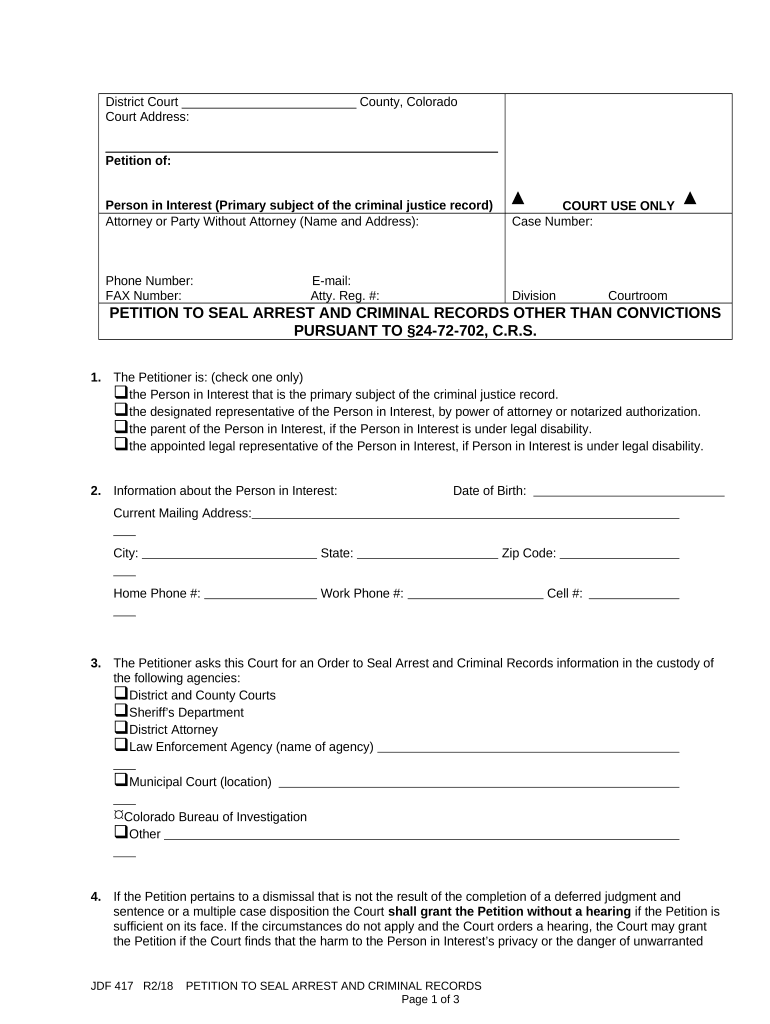
Colorado Petition to Seal Arrest and Criminal Records
What the Colorado Petition to Seal Arrest and Criminal Records Does
Why filing a Petition to Seal matters for Colorado residents
Sealing can reduce barriers to employment, housing, and education by restricting public access to past arrests and charges while preserving court interests and public safety oversight.
Who typically files or helps prepare a sealing petition
Support roles include paralegals and record specialists who gather certified dispositions, docket histories, and identity documents required by the court.
- Individuals seeking relief following dismissal or conviction who meet statutory eligibility criteria and want to reduce public disclosure risks.
- Criminal defense attorneys or private counsel who draft petitions, assemble proof of disposition, and represent petitioners at hearings.
- Court clerks, legal aid organizations, and background-check professionals who handle filing logistics or verify sealing outcomes.
Typical roles involved in a sealing petition
Petitioner
A person named in the arrest or case who seeks sealing. They must provide accurate identity information, certified court dispositions, and any statutory proof of eligibility to the court.
Attorney
A licensed attorney who prepares the petition, cites statutory grounds, and represents the petitioner at any hearing; attorneys verify eligibility and reduce procedural risk.
Risks and consequences of errors on the petition
Common mistakes that slow or block sealing petitions
- Submitting uncertified dispositions instead of certified court records, which frequently leads to immediate rejection or a request for corrected documents.
- Using inconsistent name formats or omitting aliases and birthdates, causing clerks to be unable to match the petition to the correct docket.
- Failing to check statutory eligibility windows or prior convictions that may disqualify the petition under Colorado law or court rules.
- Neglecting to serve required parties or to include required proposed order language, which can result in a continued hearing or denial.
Step-by-step: filling out the petition
-
01Identify case: Locate the exact court docket and case number.
-
02Gather records: Obtain certified disposition and arrest paperwork.
-
03Complete form: Enter names, dates, case details, and relief requested.
-
04File and serve: File with the clerk and serve required parties.
Configuring an electronic workflow for petition submission
| Field | Configuration |
|---|---|
| Signature Field | Signer name | Timestamp | Audit trail |
| Date Field | MM/DD/YYYY format enforcement |
| Attachments | Require certified PDF upload |
| Signer Order | Petitioner then attorney then clerk |
Where to file and how the petition moves through the court
-
File with Clerk: Submit petition to the appropriate county or district court clerk.
-
Serve Parties: Provide required notice to prosecuting authority and other statutorily required recipients.
-
Clerk Review: Clerk checks form completeness and docket matching.
-
Judicial Decision: Judge schedules hearing or issues order based on record and briefs.
Digital filing and eSubmission considerations
Preserve certified copies and an unbroken audit trail to support the petition if the court requests verification or in-person supplementation.
- File format: PDF/A preferred for court filings
- Authentication: Use required signer authentication method
- Audit Trail: Keep timestamped logs for record retention
Typical timelines and processing expectations
Preparation Time:
1–4 weeks to gather certified records
Clerk Processing:
Days to weeks depending on backlog
Service Period:
Follow local rules for service timing
Hearing Scheduling:
2–12 weeks if judge sets a hearing
Final Order Entry:
Once granted, sealing takes effect per court order
eSignature vendor comparison for preparing and submitting petitions
| signNow | DocuSign | Adobe Sign | PandaDoc | HelloSign | |
|---|---|---|---|---|---|
| Starting Price | $8/user/mo | $15/user/mo | $14/user/mo | $19/user/mo | $15/user/mo |
| Free Trial | 7-day free trial | No | No | Yes, limited | Yes, limited |
| Bulk Send | Yes | Yes | Yes | Yes | No |
| Audit Trail | Yes | Yes | Yes | Yes | Yes |
| HIPAA Compliant | Yes | Yes | Yes | No | No |
Practical tips to improve accuracy and reduce processing time
Representative scenarios where sealing petitions are used
Case Study 1
A petitioner with a dismissed misdemeanor sought sealing to clear online records
- Court required certified dismissal and service to the prosecutor
- After filing and a brief hearing, the court granted sealing for specified records, improving the petitioner’s public background profile and job prospects.
Case Study 2
An attorney filed a petition for a client with a deferred adjudication
- The petition cited statutory eligibility and attached certified court documents
- The judge entered an order sealing arrest records for routine public checks while preserving access by law enforcement and licensing boards.
Frequently asked questions about Colorado sealing petitions
-
Who is eligible to file?
Eligibility depends on the case disposition, time elapsed, and statutory bars. Cases dismissed or certain nonconvictions are commonly eligible; convictions may require additional criteria. Check local statutes or consult counsel.
-
How long does processing take?
Processing varies by county and caseload; clerical review may take days, while hearings and final orders commonly take weeks to months depending on scheduling and required service periods.
-
Can the petition be e-signed and filed electronically?
Electronic signatures are generally valid under the ESIGN Act (15 U.S.C. §7001) and UETA where adopted. Confirm the court’s eFiling requirements and whether a scanned notarization or RON is accepted.
-
Will sealing remove records from background checks?
Sealing limits routine public access and many background search results, but some government agencies, licensing bodies, and law enforcement may retain access as permitted by statute.
-
What supporting documents are required?
Typically include certified disposition, arrest report if available, identification, and proposed order. Missing certified documents are a frequent cause for clerk rejection.
-
What if the petition is denied?
If denied, the order should explain grounds for denial; you may be able to amend, provide additional evidence, or appeal consistent with local appellate procedures.