Identification
Specify property address, unit numbers, owner name, and responsible party so that the disclosure unambiguously applies to the exact real property and avoids later disputes about covered areas.
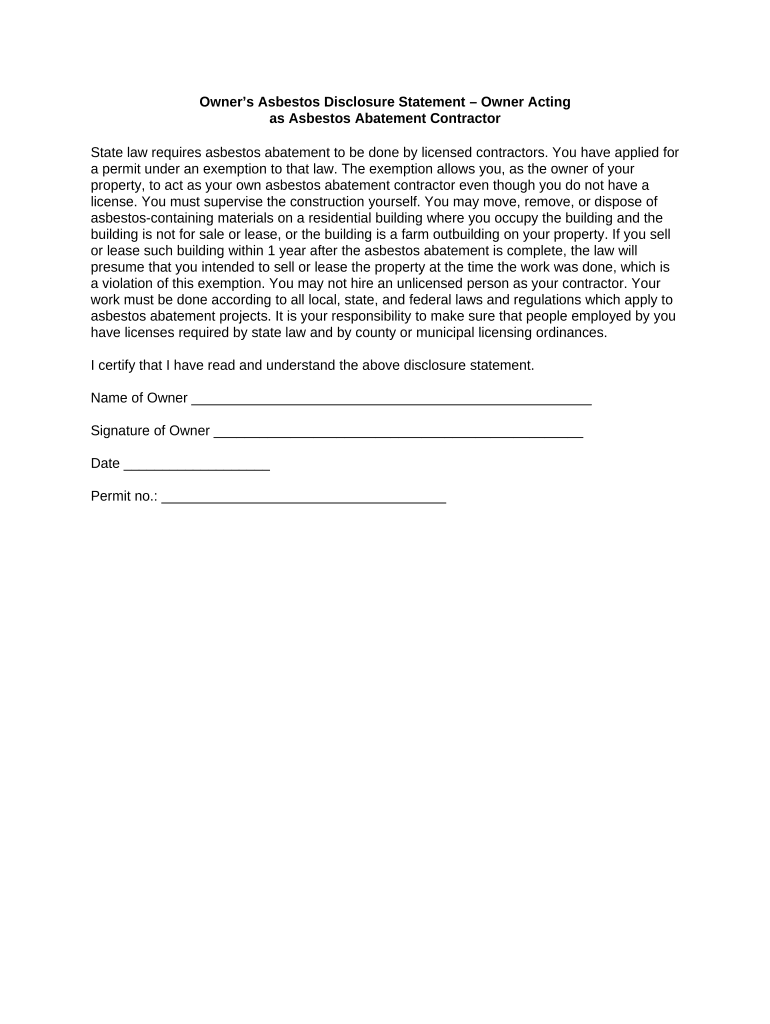
Providing an Asbestos Disclosure reduces legal uncertainty by documenting known asbestos conditions and remediation history, supports informed decision-making for buyers and tenants, and helps satisfy contractual or regulatory disclosure duties under state law and federal frameworks such as ESIGN and UETA when delivered electronically.

Typical users include sellers, buyers, property managers, real estate agents, and environmental consultants in a real estate transaction.
Specify property address, unit numbers, owner name, and responsible party so that the disclosure unambiguously applies to the exact real property and avoids later disputes about covered areas.
Summarize inspection dates, inspector or laboratory name, sample results, and whether a bulk sample or visual survey was performed, with clear indication of asbestos-containing materials identified.
Describe exact locations of suspect materials by room, system, or structure component and include drawings or photos when available to aid assessment and abatement planning.
Note any removal, encapsulation, containment, or repair actions taken, the dates, contractor credentials, permits, and clearance testing results if completed to document compliance steps and final reports.
Include a concise health advisory describing potential risks of asbestos exposure, recommended precautions during renovations, and references to EPA or state guidance where relevant.
Provide dated signature blocks for disclosing party and recipient acknowledgement; include printed names, titles, and contact information to verify who provided and received the disclosure.
Electronic delivery requires PDF support, secure attachments, and an audit trail compatible with ESIGN and UETA requirements.
| Field | Configuration |
|---|---|
| Document Upload | Attach PDF plus inspection reports |
| Signer Role | Seller, buyer, lender as needed |
| Required Fields | Signature, date, initials, acknowledgement |
| Retention Policy | Export to secure storage, 7+ years |
| signNow | DocuSign | Adobe Sign | PandaDoc | HelloSign | |
|---|---|---|---|---|---|
| Starting Price | $8/user/mo | $15/user/mo | $14/user/mo | $19/user/mo | $15/user/mo |
| Free Trial | 7-day free trial | Trial varies by plan | Trial varies by plan | Trial varies by plan | Trial varies by plan |
| Bulk Send | Yes | Yes | Yes | Yes | No |
| Audit Trail | Yes | Yes | Yes | Yes | Yes |
| HIPAA Compliant | Yes | Yes | Yes | No | No |
Tim Martin, founder of Martin Properties, adopted e-sign workflows to circulate condition reports and disclosures for residential closings across his portfolio.
Fertility Centers of Illinois integrated e-signing to manage consent and facility disclosures, consolidating signed forms for audits and patient records.
Provide prior to signing lease or purchase agreement when required.
Arrange sampling early in due diligence to allow lab turnaround.
Complete post-abatement clearance before re-occupancy or final closing.
Schedule notarization or RON sessions ahead of closing date.
Retention begins on signature and should capture version history.
Schedule accredited survey and collect samples.
Receive lab results and prepare disclosure form.
Contractor performs abatement and documents work.
Obtain clearance testing, sign disclosures, deliver records.