Bill number
Unique reference assigned by the carrier or shipper for tracking and reconciliation across invoices, manifests, and customs documents; use consistent numbering to avoid duplicate records.
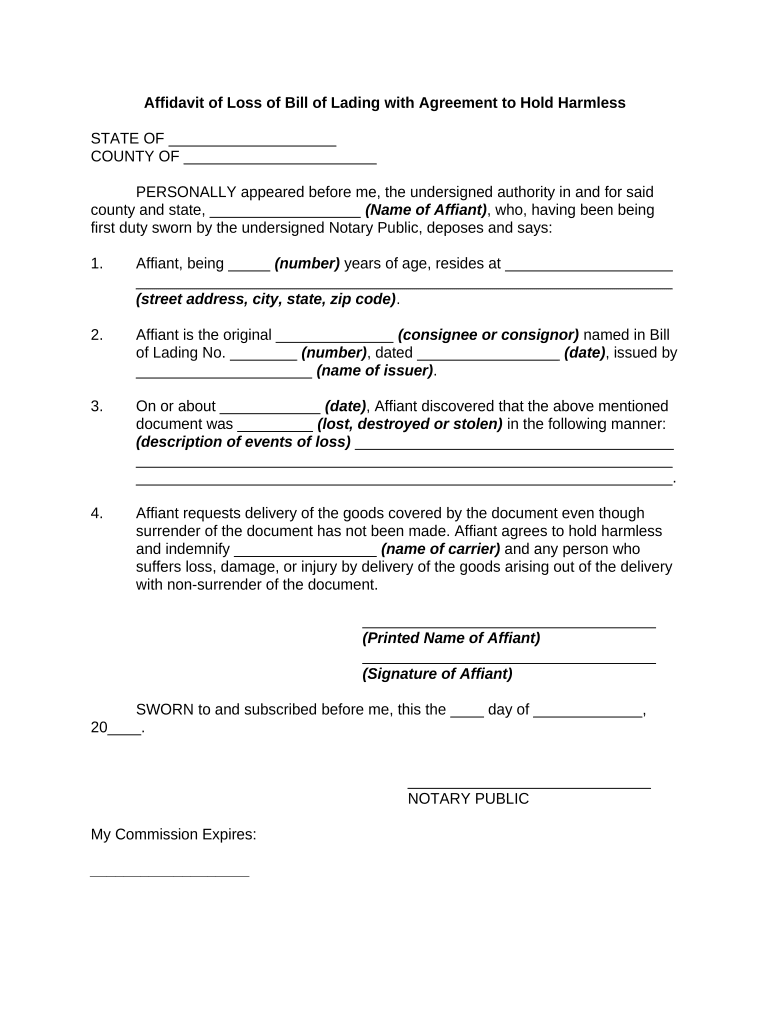
A complete Bill of Lading clarifies responsibilities for pickup, carriage, delivery, and payment while preserving rights to make or defend claims. Accurate details reduce delivery delays, lower dispute risk, and support customs and insurance processing. Using a standardized form that captures freight terms, parties, and itemized cargo description helps carriers, shippers, consignees, and brokers rely on a single authoritative record.

Multiple parties use and depend on Bills of Lading: carriers, shippers, consignees, freight forwarders, customs brokers, insurers, and lenders engaged in trade finance. Accurate execution affects movement, payment, and title transfer.
Ensure each named party understands their role on the form; conflicts or missing details commonly delay delivery or trigger claims.
The shipper (or consignor) is the party that arranges carriage and provides cargo details. Their representative signs to confirm quantity, description, and handling instructions; incorrect shipper information can expose them to claims and customs penalties.
The carrier (or its authorized agent) signs to acknowledge receipt of goods and to accept carriage obligations. Carrier signatures record the condition and count at receipt and form the basis for delivery obligations and liability assessment.
Unique reference assigned by the carrier or shipper for tracking and reconciliation across invoices, manifests, and customs documents; use consistent numbering to avoid duplicate records.
Name the place of receipt and the place of delivery clearly, including city, state, and country where applicable, to prevent routing errors and support correct customs classification.
Describe goods with sufficient specificity (HS code when used, packaging type, hazardous classification if applicable), so handlers and customs can identify and process the cargo correctly.
Record package marks, serials, and identifying labels so individual cartons are traceable and to support count verification on arrival and during claims investigations.
Specify who pays freight, accessorials, duties, and other fees; indicate prepaid, collect, third-party billing, or payment terms to avoid invoicing disputes.
Provide signer name, title, date, and carrier receipt acknowledgment; signatures establish the receipt condition and trigger delivery or title transfer rights.
| Field | Configuration |
|---|---|
| Required fields | Set shipper, consignee, description as mandatory |
| Conditional fields | Show hazardous fields when HS or UN codes entered |
| Signer order | Carrier signs after shipper data entry |
| Audit trail | Enable timestamps, IP, and action logs |
When you execute Bills of Lading electronically, choose a platform that supports secure signing, export formats, and integration with freight systems.
Confirm the platform preserves an immutable audit trail, supports commonly used formats, and integrates with your transportation management and customs systems for seamless processing.
Notify consignee as specified by contract
Report damage or shortage per carrier terms
Provide BOL for import documentation timely
Pay per invoice due dates to avoid holds
Retain signed BOL until retention period ends
Carrier or agent issues BOL when goods are received by carrier
BOL supports routing decisions and transfer between carriers
Consignee receives goods upon presentation or verification of BOL
Use BOL to file or defend claims and to reconcile invoices
| signNow | DocuSign | Adobe Sign | PandaDoc | HelloSign | |
|---|---|---|---|---|---|
| Starting Price | $8/user/mo | $15/user/mo | $14/user/mo | $19/user/mo | $15/user/mo |
| Free Trial | 7-day free trial | Varies | Varies | Varies | Varies |
| Bulk Send | Yes | Yes | Yes | Yes | No |
| Audit Trail | Yes | Yes | Yes | Yes | Yes |
| HIPAA Compliant | Yes | Yes | Yes | No | No |
A U.S. freight forwarder standardized BOL fields to match customs filings and reduced clearance errors.
A retailer required SKU-level details on incoming BOLs to streamline receiving.