Establishing secure connection…Loading editor…Preparing document…

California Petition for Withdrawal of Funds from Blocked Account

This template is fully customizable. Edit the text, fill out the fields, and send it for signature. Give it a try!
California Petition for Withdrawal of Funds from Blocked Account

What the California Petition for Withdrawal of Funds from Blocked Account Is

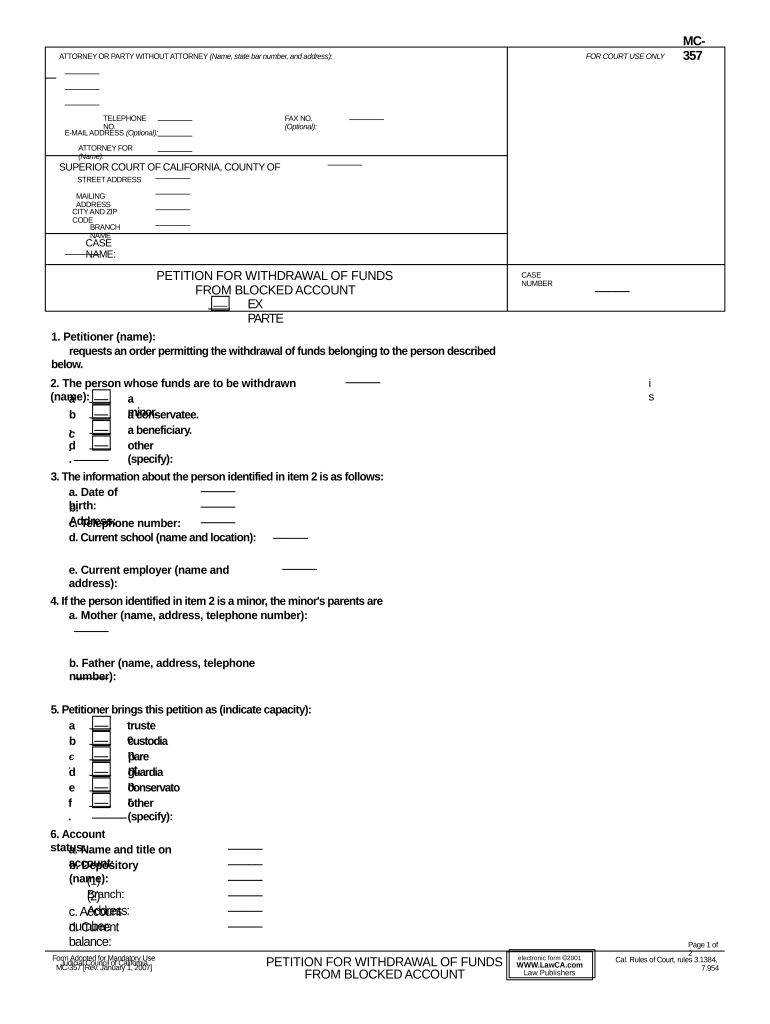
The California Petition for Withdrawal of Funds from Blocked Account is a formal written request submitted to the court or to a financial institution to release money that has been placed on hold or blocked pending litigation, lien resolution, or administrative review. The petition explains the legal basis for release, identifies the account and parties, and attaches supporting evidence such as a court order, settlement agreement, or proof of lien satisfaction. Proper completion ensures banks and courts have the information needed to evaluate release without unnecessary delay.

Why Filing This Petition Matters

A correctly completed petition expedites access to funds, clarifies legal entitlement, and documents compliance with court and banking procedures, reducing hold times and administrative disputes.

Why Filing This Petition Matters

Who Typically Prepares or Submits This Petition

The petition is used by individuals and organizations seeking to release money that a bank or clerk has blocked due to dispute, lien, or court proceedings.

  • Individual account holders seeking release after a dispute with a creditor or administrative hold.
  • Attorneys or trustees who represent clients and submit court-authorized petitions for fund release.
  • Financial institutions or escrow agents preparing administrative releases after verifying court orders.

Typical Signers and Filers

Claimant

An individual or entity named on the blocked account who files the petition to claim funds; usually provides identity documents, account details, and evidence of entitlement for bank and court review.

Attorney / Trustee

A licensed attorney or appointed trustee who prepares the petition, attaches legal support (orders, settlement documents), and represents the claimant in communications with the bank or court.

Essential Compliance and Security Elements

Encryption: AES-256 at rest
Transport Security: TLS 1.2/1.3
Authentication: Multi-factor options
Audit Trail: IP, timestamp, activity log
Regulatory Fit: ESIGN and UETA compliant
HIPAA Support: BAA available if required

Risks and Consequences of Errors

Delayed Release: Processing delays or additional review
Account Freeze: Extended hold pending clarification
Financial Loss: Missed payments or penalties
Court Sanctions: Possible fines for inaccurate filings
Bank Refusal: Incomplete petitions may be rejected
Wrong Recipient: Funds released to incorrect party

Common Preparation Pitfalls to Avoid

  • Submitting the form without a clear court order or settlement attachment leads to bank requests for supplemental documents and processing delays.
  • Using mismatched names, incorrect account numbers, or out-of-date identification causes verification failures and possible rejection.
  • Failing to include proof of lien satisfaction, release letters, or payment receipts forces additional correspondence and slows release.
  • Omitting a certified signature, notarization (when required), or proper attorney representation can result in refusal to process.

Step-by-Step: Completing the Petition

Follow these steps to prepare a complete petition before filing with the court or submitting to the bank.

  • 01
    Gather Documents: Collect ID, bank statements, court orders, and lien releases.
  • 02
    Fill Petition: Complete all fields accurately; include account and case numbers.
  • 03
    Attach Evidence: Attach certified court orders, releases, and supporting statements.
  • 04
    Submit: File with the court or deliver to bank per local procedures.

How the Review and Release Process Typically Flows

The petition triggers identity and entitlement checks by the bank and may require court authorization before funds are released.

  • Submission: Petition filed with court or submitted to the bank.
  • Verification: Bank verifies account details and attached documents.
  • Court Authorization: Where required, court issues order to release funds.
  • Release: Bank processes release and records transaction.

Key Components to Include in a Professional Petition

A complete petition organizes identity, account specifics, legal basis, and supporting documentation so banks and courts can evaluate release without further questions.

Case Identification

Include the court name, case number, and presiding judge where applicable. Accurate case identification ties the petition to the judicial record and prevents misrouting or confusion during review.
Account Details

State the bank name, account number, account holder names, and type of account. Clear account identification helps the financial institution locate the correct funds and avoid releasing unrelated balances.

Claimant Information

Provide full legal names, contact information, and authorized representatives or counsel details. This enables the bank to validate authority and communicate efficiently about next steps.

Legal Basis

Describe the legal reason for release, citing orders, settlement terms, or statutory provisions where relevant. A concise legal statement aids reviewers in understanding entitlement.

Supporting Evidence

Attach court orders, lien release documentation, settlement agreements, and proof of identity. Well-organized exhibits significantly reduce follow-up requests from banks or clerks.

Requested Relief

Specify the exact amount to be released, account disposition instructions, and whether funds should be paid to a third party. Precise instructions prevent ambiguity and erroneous disbursement.

Typical Digital Workflow Settings for Online Completion

Configure your electronic workflow to capture identity, evidence, and acknowledgment before submission.

Field Recommended Setting
Signer Authentication Email + SMS code or stronger
Document Attachments PDFs with notarized pages preferred
Audit Capture Enable IP, timestamp, and history
Storage Encrypted cloud archive

Technical Considerations for eSubmission

Choose a platform that supports secure uploads, identity verification, and an auditable signing trail for legal submissions.

  • File types: PDF and DOCX accepted
  • Authentication: Email, SMS, or MFA
  • Integrations: CRM and cloud storage

Typical Timelines and Processing Expectations

Processing times depend on bank, court schedules, and the completeness of submitted materials.

Initial Submission:

File as soon as supporting documents are assembled

Bank Review:

Often takes 7–30 business days depending on institution

Court Consideration:

Scheduling varies by court docket and may take weeks

Release Execution:

Once authorized, banks typically process disbursement within business days

Appeal / Objection Period:

Deadlines vary; check local rules for response windows

Real-World Examples of Similar Petition Use

These examples show how organizations streamline release workflows and document handoffs when funds are blocked.

Optica Ventures LLC

A small investments firm used an organized petition to coordinate bank review and legal clearance.

  • The interface simplified collection of signatures and exhibits.
  • The team reported that a straightforward, well-documented submission reduced follow-up requests and improved turnaround for client disbursements.

Martin Properties

A real estate operator prepared a petition with escrow and title attachments to release earnest money held pending lien clearance.

  • The process required clear escrow instructions.
  • Providing complete exhibits and a proposed court order helped close the transaction without additional court appearances.

Practical Tips for Accurate and Efficient Completion

Adopt consistent practices to minimize rework and speed bank or court approvals.

Verify Names and Numbers
Use the account holder’s exact legal name and full account number; mismatches are the leading cause of verification delays and rejections.
Organize Attachments
Label exhibits, include authenticated copies where required, and provide a concise index to help reviewers locate critical evidence quickly.
Use Strong Authentication
Choose platforms that support multi-factor authentication and produce an auditable signing trail to meet court or bank evidentiary needs.
Confirm Bank Requirements
Contact the bank early to confirm any institution-specific forms, fee schedules, or authorization formats before submission.

eSignature Vendor Pricing and Feature Snapshot for Petition Workflows

Comparing vendor costs and compliance features helps select a platform that supports secure petition preparation and auditable submission.

signNow DocuSign Adobe Sign PandaDoc HelloSign
Starting Price $8/user/mo $15/user/mo $14/user/mo $19/user/mo $15/user/mo
Free Trial Yes, 7-day free trial Varies by vendor Varies by vendor Varies by vendor Varies by vendor
Bulk Send Yes Yes Yes Yes No
Audit Trail Yes Yes Yes Yes Yes
HIPAA Compliant Yes Yes Yes No No
Envelope Cap No cap 100 envelopes/user/year Varies Varies Varies

Frequently Asked Questions About the Petition and Submission Process

Answers to common questions regarding evidence, notarization, timelines, and digital submission for petitions to withdraw funds.


Need help? Contact support

be ready to get more
Join over 28 million airSlate SignNow users