Establishing secure connection…Loading editor…Preparing document…

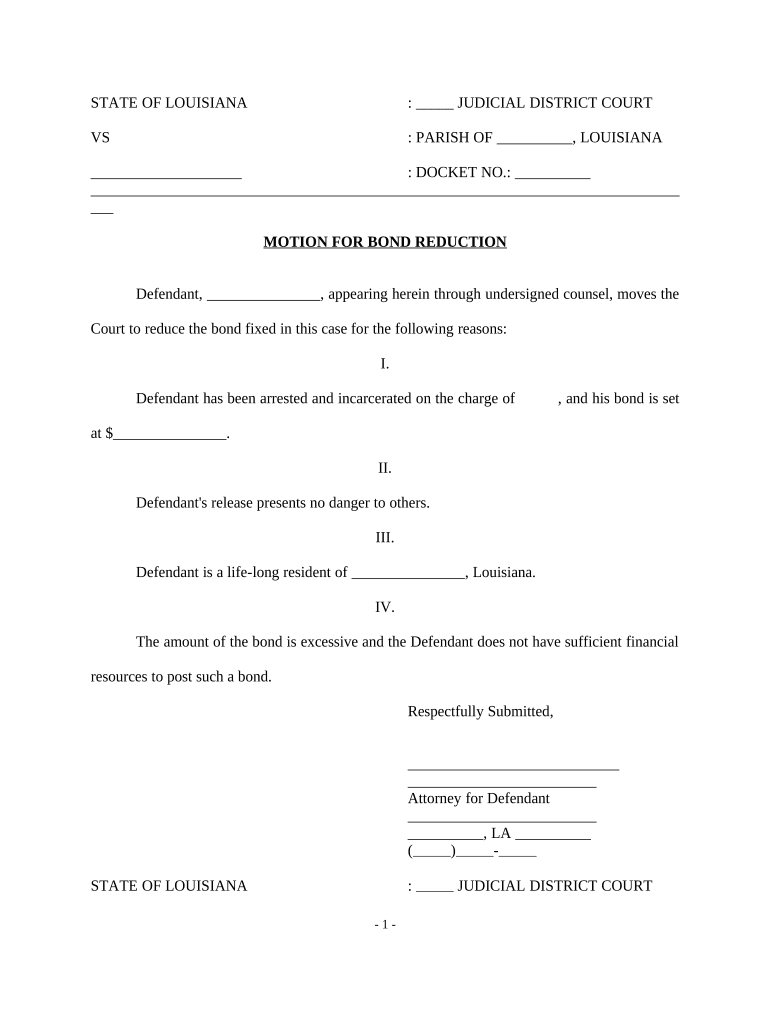
Bond Reduction

This template is fully customizable. Edit the text, fill out the fields, and send it for signature. Give it a try!
Bond Reduction

What a Bond Reduction Is and why it matters

A Bond Reduction is a formal amendment or filing that lowers the cash, surety, or lien bond amount securing a contractor, developer, or defendant. It documents a reduced financial obligation while preserving the underlying bond’s legal effect, often used after completion of work, partial release of claims, or when collateral is substituted. The process typically requires the obligee’s consent, surety concurrence, and, when applicable, court or clerk approval before the reduced bond amount becomes enforceable.

Why you might request a Bond Reduction

A Bond Reduction limits ongoing financial exposure, frees capital or collateral, and clarifies the remaining secured obligation. It also updates public records and reduces administrative costs while preserving claim procedures. Electronic execution and retention are generally recognized under the ESIGN Act (15 U.S.C. ch. 96) and UETA where adopted.

Why you might request a Bond Reduction

Common parties who prepare or approve a Bond Reduction

Each party has distinct responsibilities: the obligee records consent, the surety issues the amendment, and the principal ensures accuracy and timely execution.

  • Project owners and obligees who accept reduced security and update public records accordingly.
  • General contractors and subcontractors seeking release of collateral after milestone completion.
  • Surety companies and underwriting teams that must consent and document the amended obligations.

Essential parts of a professional Bond Reduction document

A complete Bond Reduction combines identification, justification, authority, and execution details so all parties and recorders can verify the change.

Bond reference

Original bond name and number plus date of issuance to link the reduction to the exact instrument and avoid ambiguity in enforcement.
Parties identified

Full legal names and addresses for principal, obligee, and surety so records and service addresses remain accurate for future notices or claims.

Reduced amount

Explicit new bond amount stated in currency, with prior amount referenced and the residual exposure calculated for clarity.

Reason and basis

Concise justification for reduction such as completed work, partial claim resolution, or substitute collateral, with supporting reference documents cited.

Consent and authority

Signatures or written approvals from the obligee and surety, and any required corporate authority notation or power-of-attorney reference.

Execution details

Execution date, notarization or witness block if required, and instruction on where the amended bond will be recorded or filed.

Required identification fields at a glance

Bond Number: Unique bond identifier
Principal Name: Legal entity name
Obligee: Party protected by bond
Surety: Issuing surety company
Reduction Amount: New bond dollar amount
Effective Date: MM/DD/YYYY effective date

How to complete a Bond Reduction step by step

Follow these four core steps to prepare, sign, and file a bond reduction correctly and with clear documentation.

  • 01
    Review original bond: Confirm bond number, obligations, and any endorsement language first.
  • 02
    Gather evidence: Collect lien waivers, completion certificates, substitute collateral, or court orders supporting the reduction.
  • 03
    Prepare the amendment: Complete the reduction form, state the new amount, and include required party details.
  • 04
    Obtain approvals: Get written consent from the obligee and surety, then notarize or witness as required.

Setting up a digital workflow for Bond Reduction processing

Configure routing, authentication, and attachments so the reduction moves through review, approval, and recording reliably.

Field Configuration
Notification recipients List obligee, surety, principal, and clerk emails for automated alerts.
Authentication level Use email link or SMS code; choose KBA for higher assurance.
Attachments required Mandate completion certificates and lien waivers before approval.
Certificate generation Auto-create completion certificate and audit trail on finalization.

Where to send and how the Bond Reduction moves through parties

A typical route includes submission to the obligee and surety, optional court or clerk filing, and final recording where required.

  • To the Obligee: Deliver signed reduction and supporting documents for consent and acknowledgement.
  • To the Surety: Send reduction for underwriting review and formal surety concurrence.
  • To the Court or Clerk: File if the original bond is court-ordered or state statute requires filing.
  • To Public Records: Record with county or agency when statutory recording is required for third-party notice.

Digital delivery, signing, and file-format needs

Ensure the chosen platform supports PDF/A export, an audit trail, and the required notarization or witness workflow before eSubmission.

  • File formats: PDF or DOCX recommended
  • Integrations: CRM/ERP and cloud storage supported
  • Authentication: Email, SMS, or advanced options

Typical timelines and processing expectations

Processing times depend on surety review, obligee approval, and any court or clerk calendar; plan for review windows before the effective date.

Internal review period:

Immediate to 5 business days depending on document completeness

Surety review window:

Often 7 to 21 business days for underwriting and approvals

Court filing timeframe:

30 to 90 days if judicial approval is required

Recording or indexing:

5 to 15 business days after submission to clerk or county

Effective date note:

Effective when signed by required parties or on specified effective date

Consequences and common risks of improper Bond Reduction

Invalid reduction: May be void for lack of surety or obligee consent
Increased liability: Principal or surety can face uncovered claims
Bond cancellation: Surety may rescind coverage for noncompliance
Legal fees: Court disputes and defense costs increase
Claim disputes: Third parties may challenge reduced security
Recording errors: Clerical mistakes can misstate public notice

Representative scenarios where a Bond Reduction is used

These examples show typical contexts and outcomes to help you match process steps to your situation.

Project Contractor

A contractor completed the final punch list and provided lien releases

  • Surety reviewed completion documents and agreed to a reduced bond
  • The obligee signed the amendment and the reduced bond was recorded to free retained funds and close project accounts.

County Clerk Filing

A municipality required a reduced performance bond after partial completion

  • The obligee and surety executed a bond reduction form
  • The county clerk indexed the amendment, updating public notice and reducing the principal’s collateral obligations for future draws.

Key milestones from request to recorded reduction

These numbered stages describe the sequential milestones typically seen from request through final recording or approval.

01

Initiation and documentation

Principal requests reduction and gathers supporting documents and lien releases.

02

Surety underwriting review

Surety evaluates risk, collateral, and issues conditional or unconditional consent.

03

Filing or court submission

If required, parties file the amendment with clerk or court for approval and docketing.

04

Recording and finalization

Clerk or county records the reduced bond and parties retain certified copies.

Overview: eSignature vendor pricing and capabilities relevant to Bond Reduction workflows

Comparing base pricing and key capabilities for eSignature platforms used to execute and deliver Bond Reductions; signNow is listed first per vendor alignment.

signNow DocuSign Adobe Sign PandaDoc HelloSign
Starting Price $8/user/mo $15/user/mo $14/user/mo $19/user/mo $15/user/mo
Free Trial 7-day trial Varies by plan Varies by plan Varies by plan Varies by plan
Bulk Send Yes Yes Yes Yes No
Audit Trail Yes Yes Yes Yes Yes
HIPAA Compliant Yes Yes Yes No No

Common questions and answers about Bond Reductions

Answers to frequent questions on authority, signatures, notarization, eSigning, timelines, and remedies when a reduction is contested.


Need help? Contact support

be ready to get more
Join over 28 million airSlate SignNow users