Establishing secure connection…Loading editor…Preparing document…

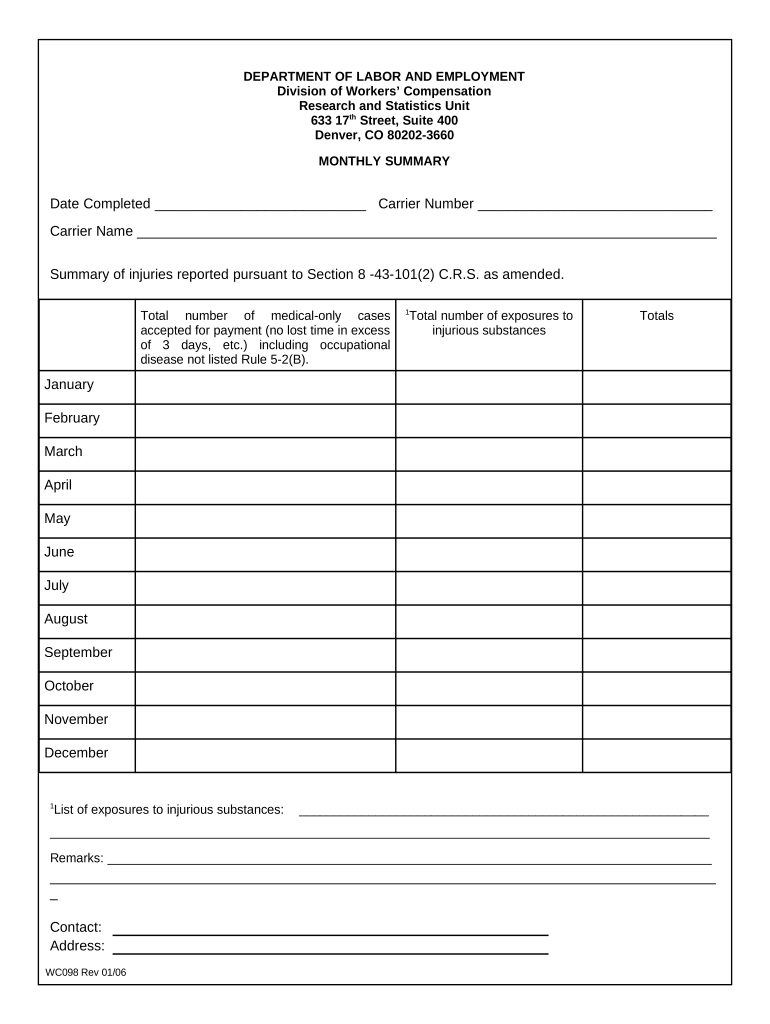
Colorado Monthly Summary of Workers' Compensation Injuries

This template is fully customizable. Edit the text, fill out the fields, and send it for signature. Give it a try!
Colorado Monthly Summary of Workers' Compensation Injuries

What the Colorado Monthly Summary of Workers' Compensation Injuries Is

The Colorado Monthly Summary of Workers' Compensation Injuries is a standardized employer report that aggregates work-related incidents for a given calendar month. It lists incident counts, injured worker identifiers, injury dates, injury type, treatment provided, lost-time status, and claim initiation details. Employers use the summary to support insurer claim intake, establish an audit trail for compliance, monitor trends in workplace injuries, and coordinate return-to-work planning and loss-control activities across departments.

Why a Monthly Summary Matters for Compliance and Claims

Monthly summaries centralize incident records, speed claim intake, and create a documented audit trail for Colorado workers' compensation administration. They support faster adjudication, clearer medical and return-to-work planning, and proactive safety interventions based on trend data.

Why a Monthly Summary Matters for Compliance and Claims

Who Prepares and Reviews This Monthly Summary

Employers, insurers, HR teams, and third-party administrators use the Colorado Monthly Summary to centralize incident reporting and support claims processing.

  • Private employers with Colorado-based employees who report workplace injuries monthly to insurers or internal safety teams.
  • Workers' compensation insurance carriers and third-party administrators processing claims and tracking claim status across policyholders.
  • Occupational health providers and safety managers using aggregated data to plan interventions and monitor trends.

Core Sections to Include in a Professional Monthly Summary

A complete summary groups employer details, reporting period, incident counts, injured worker information, injury specifics, and claim status to support both claims handling and workplace safety review.

Employer Details

Enter employer legal name, Colorado employer account number, mailing address, NAICS code, contact person, phone and email. Accurate employer identifiers ensure correct claim routing and insurer matching.
Reporting Period

Specify the month and year covered, using MM/YYYY. This anchors incident dates and determines monthly totals for loss trend analysis and statutory filing cycles.

Incident Summary

Provide a brief count of incidents, classifications (medical-only, lost-time), locations, and brief narrative to contextualize clusters or repeated hazards for safety review.

Worker Information

Include employee name, job title, hire date, department, and last four of SSN or employee ID as required. Protect PII in transit and storage.

Injury Details

Record injury date, body part, nature of injury, cause, treatment provided, and whether hospitalization occurred; these details drive claim triage and medical cost estimation.

Claim Status

List claim number, insurer adjudication status, indemnity payments, return-to-work date if available, and any open case notes for ongoing monitoring.

Required Data Elements at a Glance

Employer Name: Legal business name on file
Employer Account: Colorado employer account number
Claim Number: Insurer claim or reference number
Injury Date: Enter date as MM/DD/YYYY
Employee Identifier: Last four SSN or employee ID
Treatment Summary: Brief medical care and provider name

Step-by-Step: Prepare and Submit the Monthly Summary

Follow these steps to prepare and submit the Colorado Monthly Summary accurately and on time with consistent data.

  • 01
    Gather Records: Collect incident reports, medical notes, and supervisor statements.
  • 02
    Complete Fields: Enter required employer, employee, and injury details exactly.
  • 03
    Review for Accuracy: Verify dates, identifiers, and claim numbers before sending.
  • 04
    Submit & Archive: Send to insurer and retain a secure copy with audit trail.

How to Configure an Electronic Workflow for This Summary

Set up an online workflow that collects required fields, enforces validation, and routes the completed summary to insurers securely.

Field Configuration
Authentication Method Email link or SMS code verification
Conditional Questions Show lost-time fields only if injury caused time away
Attachment Requirements Attach medical reports as PDF, restrict size to 10MB
Submission Copy Auto-email claimant and employer a signed PDF copy

Typical Routing: From Employer to Adjuster

Typical routing shows how the summary moves from employer through HR to insurer and claims adjuster for adjudication.

  • Prepare Report: Populate monthly fields and attach supporting documents.
  • Internal Review: HR or safety reviews for completeness and PII redaction.
  • Send to Insurer: Submit via secure portal, email, or eSubmission per insurer rules.
  • Monitor Status: Track receipt, claim assignment, and any follow-up requests.

Technical Requirements for eSubmission and Distribution

Digital submission requires compatible file formats, secure transport, and signer authentication appropriate to the sensitivity of the data.

  • File Formats: PDF/A or searchable PDF preferred
  • Authentication: Email link, SMS code, or two-factor
  • Integrations: Works with EHR, HRIS, and claims systems

Timelines and Time-Critical Actions to Track

Monthly entries should reflect the calendar month and be submitted according to insurer or carrier deadlines; align internal review and insurer transmission to avoid late penalties.

Monthly Report Due Date:

Prepare and submit within 30 days after month-end or per insurer agreement

Immediate Reporting for Severe Injuries:

Report fatalities or hospitalizations to insurer and Colorado authorities within 24–72 hours as required

Insurer Acknowledgment Time:

Expect insurer confirmation within 7–14 business days after submission

Record Retention Period:

Keep copies for at least five years for OSHA-related records

Adjustments and Amendments:

Submit corrected summaries promptly when new information affects totals or claim status

Common Preparation Mistakes to Avoid

  • Incomplete or inconsistent employee identifiers lead to duplicate claims and delayed adjudication; ensure SSN last four or employee ID are recorded consistently each month.
  • Missing injury dates or approximate dates hinder medical reviews and can trigger insurer information requests, prolonging claim processing.
  • Attaching non-searchable scans prevents data extraction and slows integration with claims systems; use searchable PDFs for better processing.
  • Failing to redact unnecessary PII before broader distribution risks privacy breaches and noncompliance with HIPAA where applicable.

Consequences of Incorrect or Late Summaries

Late Filing: Fines or insurer penalties possible
Incorrect Data: Claim delays and audit requests
PII Exposure: HIPAA breaches, regulatory fines
Underreporting: Potential legal liability
Premium Impact: Higher experience modification rates
Recordkeeping Failures: Civil penalties or litigation

eSignature Pricing and Feature Snapshot for Summary Workflows

A concise vendor comparison focusing on starting price, basic feature availability, and HIPAA support for organizations handling injury summaries.

signNow DocuSign Adobe Sign PandaDoc HelloSign
Starting Price $8/user/mo $15/user/mo $14/user/mo $19/user/mo $15/user/mo
Free Trial 7-day free trial Varies by vendor Varies by vendor Varies by vendor Varies by vendor
Bulk Send Yes Yes Yes Yes No
Audit Trail Yes Yes Yes Yes Yes
HIPAA Compliant Yes Yes Yes No No

FAQs: Common Questions About the Colorado Monthly Summary

Answers to frequent questions about timing, electronic signatures, PII handling, corrections, and retention for the monthly workers' compensation summary.


Need help? Contact support

be ready to get more
Join over 28 million airSlate SignNow users