Establishing secure connection…Loading editor…Preparing document…

Consent for Expedited Relinquishment of Parental Rights

This template is fully customizable. Edit the text, fill out the fields, and send it for signature. Give it a try!
Consent for Expedited Relinquishment of Parental Rights

What this Consent document is and when it applies

The Consent for Expedited Relinquishment of Parental Rights is a legal form used when a parent voluntarily gives up parental rights ahead of a court-ordered adoption or guardianship process. It documents a parent's clear, informed consent to expedite termination of legal parentage and typically accompanies a petition filed with a family or juvenile court.

Why this consent matters in adoption and guardianship cases

A properly completed consent clarifies parental intent, shortens court review time, and reduces procedural ambiguity for agencies and courts while preserving legal safeguards required by state law and federal e-signature standards.

Why this consent matters in adoption and guardianship cases

Who prepares and who signs this consent

Typical users include birth parents, adoption attorneys, child welfare agencies, and court clerks who coordinate filings and confirmations.

  • Birth parents who intend to terminate legal parentage
  • Adoption agencies and social workers facilitating placements
  • Attorneys representing parents, agencies, or prospective adopters

Who typically completes or reviews this form

Birth Parent

A parent giving consent must understand rights being relinquished and sign knowingly. Counsel or social worker presence is commonly recommended to confirm voluntariness and comprehension before signing.

Adoption Attorney

Licensed counsel prepares filings, reviews the consent with the parent, and ensures state-specific statutory requirements and court forms are satisfied prior to submission.

Core parts of a professional consent form

A clear consent includes identification, statement of intent, statutory references, signatory declarations, authentication steps, and filing instructions so courts can accept expedited relinquishment without additional clarification.

Parties

Names and relationships for parent(s), child, and agency or prospective adoptive parent(s). Accurate legal names and birthdates reduce processing delays.
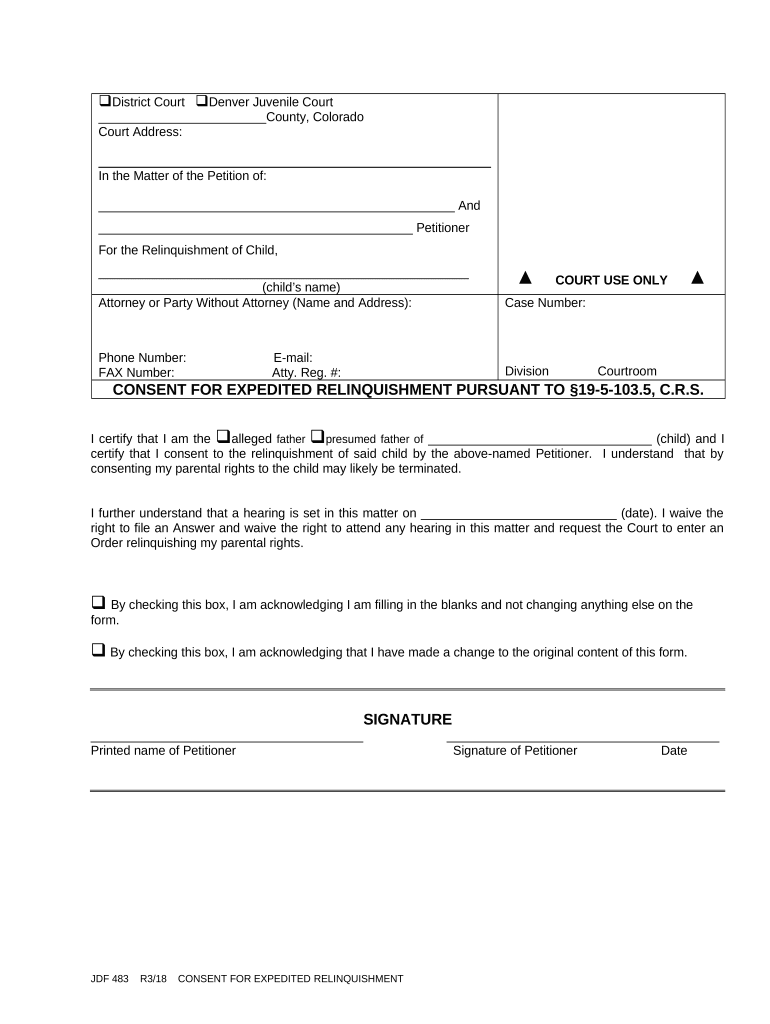
Statement of Consent

Explicit language indicating voluntary relinquishment of parental rights, including the specific rights being terminated and any limitations or conditions.

Effective Date

The date on which the consent takes effect and the date used by the court to calculate any waiting or review periods.

Authority and Notice

Reference to the state statute or court rule under which the consent is given, noting required disclosures and the parent’s right to legal counsel.

Authentication

Notary acknowledgment, witness signatures, or remote notarization details when allowed by state law; plus audit trail for e-signed records.

Filing Directions

Clear instructions on where to file, any supporting exhibits to attach, and whether the court requires original or certified copies.

Essential document and compliance data to capture

Signatory Name: Full legal name
Child Details: Full name and birthdate
Date Signed: MM/DD/YYYY format
Authentication: Notary or witness data
Retention: Retention instructions
Legal Basis: Applicable state statute

Step-by-step: completing and submitting the consent

Follow these sequential actions to complete the consent correctly and reduce the risk of court rejection or processing delays.

  • 01
    Collect IDs: Gather government-issued ID for the parent and any required documents.
  • 02
    Fill Fields: Enter names, dates, and statutory references in MM/DD/YYYY format.
  • 03
    Authenticate: Sign before a notary and required witnesses or complete RON where allowed.
  • 04
    File Court: Submit originals or certified copies to the appropriate family court clerk.

Practical tips for accurate and efficient completion

Adopt straightforward practices to minimize errors and speed court processing while documenting consent fully and transparently.

Confirm Identity
Verify signatory identity with government-issued photo ID and record the type of ID used to satisfy notarization or court verification.
Use Exact Wording
Preserve statutory or court-provided language. Avoid informal or ambiguous terms that may trigger judicial review or require amendment.
Record Witness Info
Collect full witness names, addresses, and phone numbers at signing to help the court confirm execution if required.
Keep Originals
Retain original executed and notarized documents; file copies only when the court permits or requests certified originals.

Configure an e-sign workflow for this consent

Set up the signing flow to match required order, authentication strength, and any notary or witness steps before sending to signers.

Field Configuration
Signing Order Sequential: parent → witness → notary
Authentication Email + SMS code or stronger KBA when required
Notary Integration Enable RON session or place hold for in-person notarization
Reminders Auto-reminders every 3 days until completion

Where to file and how the routing typically works

After execution, route the consent according to court or agency rules: deliver originals to the clerk, provide copies to the agency, and keep a retained original for records.

  • Court Clerk: File originals or certified copies per local rules.
  • Adoption Agency: Provide executed consent for the child’s adoption file.
  • Birth Parent Copy: Give the parent a dated, signed copy for their records.
  • Attorney File: Attorney retains a case copy and files supporting motions if required.

Digital signing and technical requirements

Use a secure e-sign platform that supports audit trails, PDF output, and required authentication for legal transactions.

  • File Formats: PDF and DOCX supported
  • Integrations: Works with Google Workspace and Microsoft 365
  • Authentication: Email, SMS, or advanced methods

Consequences and legal risks of errors

Invalid Consent: May be set aside
Delayed Adoption: Requires court hearing
Criminal Liability: False statements risk prosecution
Loss of Rights: Irreversible without court action
Administrative Fines: Court or agency penalties possible
Record Rejection: Clerk may refuse filing

Common mistakes that cause rejection or delay

  • Signing without required notarization or using an uncertified remote notary when RON is required by the court.
  • Entering inconsistent names or dates between the consent and birth certificate or court case documents, creating identity conflicts.
  • Omitting required witness information or having witnesses sign after filing instead of at the time of execution.
  • Altering statutory consent language without counsel, generating judicial objections and requests for amended forms.

Timing considerations and typical deadlines

Certain courts impose waiting or review periods and may require in-person hearings; timelines vary by state and court docket.

Immediate Effect Date:

Enter MM/DD/YYYY to indicate when consent takes effect

Court Review Window:

Court may set a review or waiting period before final order

Filing After Execution:

File as soon as possible to minimize relationship uncertainty

Agency Deadlines:

Child welfare agencies often have expedited timelines

Record Retention Start:

Retention measured from date of execution or court order

Comparing e-sign platforms for handling this consent

Choose a provider that supports audit trails, notary workflows, HIPAA BAA if needed, and scalable plan options; pricing and caps vary across vendors.

signNow DocuSign Adobe Sign PandaDoc HelloSign
Starting Price $8/user/mo $15/user/mo $14/user/mo $19/user/mo $15/user/mo
Free Trial 7-day free trial Varies Varies Varies Varies
Bulk Send Yes Yes Yes Yes Yes
Audit Trail Yes Yes Yes Yes Yes
HIPAA Compliant Yes Yes Yes No No
Envelope Cap No cap 100 envelopes/user/year Varies by plan Varies by plan Varies by plan

Frequently asked questions and common troubleshooting topics

Answers below address common points of confusion about execution, notarization, revocation, electronic signing, and filing to reduce avoidable rejections.


Need help? Contact support

be ready to get more
Join over 28 million airSlate SignNow users