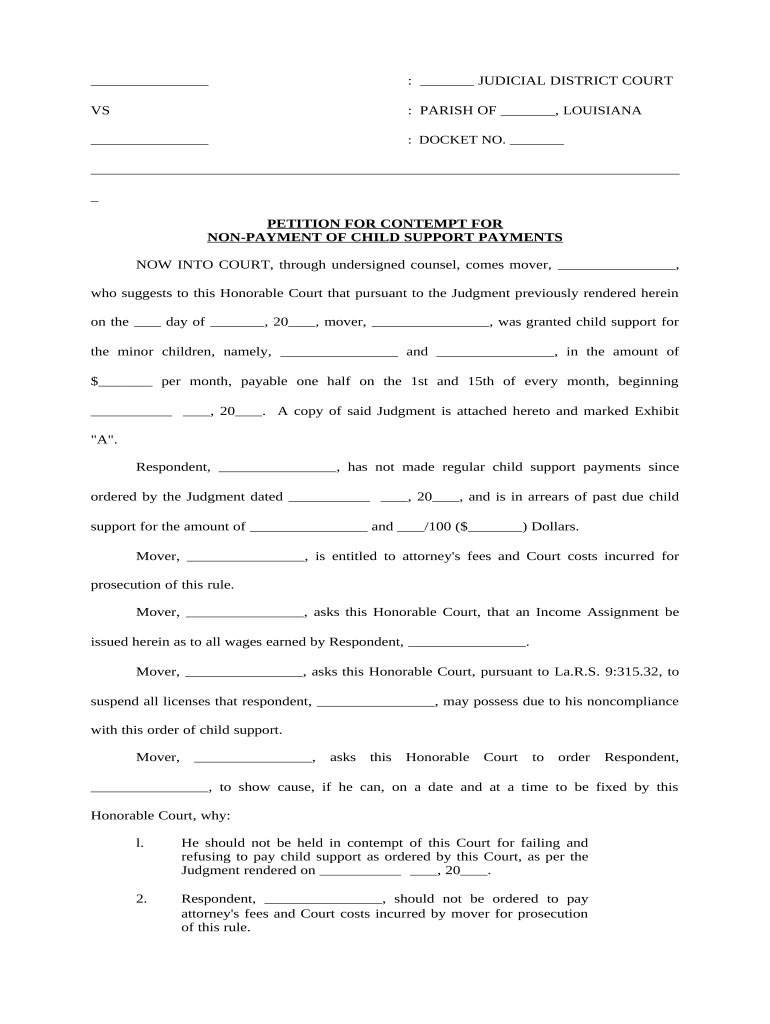
Louisiana Petition for Contempt for Non-Payment of Child Support
What the Louisiana Petition for Contempt for Non-Payment of Child Support Is
Why Filing a Contempt Petition Matters
A contempt petition enforces the court’s support order, preserves the child’s financial stability, and creates formal remedies to collect arrears; it documents refusal to pay and triggers legal tools such as wage garnishment or arrest for willful contempt.
Who Typically Files or Responds to This Petition
Parties and organizations involved commonly include parents, legal guardians, the state child support office, and family law attorneys.
- Custodial Parent or Guardian seeking enforcement and arrears collection.
- Noncustodial Parent (respondent) who must answer or contest the petition.
- State Child Support Enforcement Office filing on behalf of the child when appropriate.
Each user has different responsibilities—petitioners prepare evidence and service; respondents may submit defenses, and agencies handle administrative collection tools.
Step-by-step: Preparing and Filing the Petition
-
01Prepare Petition: Draft complaint, include order, arrears ledger, and relief requested.
-
02Serve Respondent: Complete service per parish rules; obtain proof of service.
-
03File with Court: File petition at family court clerk’s office or e-file if available.
-
04Attend Hearing: Present evidence; court decides remedies and possible sanctions.
How to Configure a Digital Workflow for This Petition
| Step | Responsible Party | Action owner | System requirement |
|---|---|
| Document Assembly | Petitioner | Merge order, ledger, affidavit into single PDF |
| Signer Authentication | Court/Clerk | Use email/SMS or stronger ID if required |
| Service Tracking | Petitioner | Attach proof of service PDF and certificate |
| Court Filing | Clerk | Accept e-file or paper entry per parish rules |
Digital Delivery and Platform Requirements
Choose a platform that secures personal data, preserves an audit trail, and supports the court’s accepted file formats before e-filing.
- Formats Supported: PDF, Word DOCX
- Integrations: Doc management, cloud storage, case management
- Security Features: Encryption, audit trail, signer authentication
Verify the court accepts electronically filed documents and that your provider can produce a tamper-evident signed PDF and full audit log for the record.
Typical Filing and Service Flow
-
File Petition: Clerk accepts paper or e-file.
-
Serve Respondent: Sheriff or private process server completes service.
-
Schedule Hearing: Court sets contempt hearing date.
-
Enforce Order: Court issues sanctions or collection remedies.
Common Preparation and Filing Pitfalls to Avoid
- Failing to attach the underlying child support order and recent payment ledger, which leads to dismissal or rescheduling.
- Using incorrect or incomplete service information, causing service to be invalid and the hearing delayed.
- Submitting unclear arrears calculations without receipts or bank records, prompting evidentiary disputes at hearing.
- Relying on informal electronic messages as proof of nonpayment instead of certified statements or official ledgers.
Consequences and Legal Risks to Consider
Typical Timing and Processing Expectations
Initial Filing to Hearing:
Often 30–90 days depending on calendar
Service Period:
Service usually required 7–30 days before hearing
Emergency Hearings:
May be available for immediate enforcement
Wage Withholding Setup:
Administrative orders take 1–2 pay cycles
Appeal Window:
Short timeframe — consult local rules
Key Milestones from Filing to Enforcement
Prepare and File
Assemble petition, ledger, exhibits, then file with the clerk.
Service Completed
Obtain proof of service per parish requirements.
Contempt Hearing
Court hears evidence and determines willfulness and sanctions.
Enforcement Actions
Court orders garnishment, arrest, license suspension, or other remedies.
eSignature Pricing and Feature Snapshot for Filing and Signing
| signNow | DocuSign | Adobe Sign | PandaDoc | HelloSign | |
|---|---|---|---|---|---|
| Starting Price | $8/user/mo | $15/user/mo | $14/user/mo | $19/user/mo | $15/user/mo |
| Free Trial | 7-day free trial | Varies | Varies | Varies | Varies |
| Bulk Send | Yes | Yes | Yes | Yes | No |
| Audit Trail | Yes | Yes | Yes | Yes | Yes |
| HIPAA Compliant | Yes | Yes | Yes | No | No |
Frequently Asked Questions About the Petition and eFiling
-
How do I prove arrears?
Provide the original support order, payment ledger, bank statements or employer payroll records showing missed payments, and any relevant correspondence; the court uses these to verify arrears and calculate interest or fees.
-
What happens after service?
The respondent may file an answer or request continuance; the court schedules a hearing where evidence is presented and the court decides on contempt findings and remedies.
-
Can I use electronic signatures?
Yes for many documents when permitted by court rules; ensure the e-signature method meets ESIGN/UETA standards and the court accepts electronically filed exhibits.
-
Is notarization required?
Notarization is sometimes required for affidavits or sworn statements attached to the petition; check parish rules or local court clerk guidance before filing.
-
Can the court jail someone for nonpayment?
A court may impose civil contempt sanctions, including incarceration for willful refusal to pay, but courts typically require a showing of ability to pay before jailing.
-
What if the respondent disputes the amount?
Disputes shift to evidentiary hearing where each side offers records; courts may order accounting, modify withholding, or set payment plans depending on findings.