Establishing secure connection…Loading editor…Preparing document…

Georgia Notice of Contest of Claim of Lien

This template is fully customizable. Edit the text, fill out the fields, and send it for signature. Give it a try!
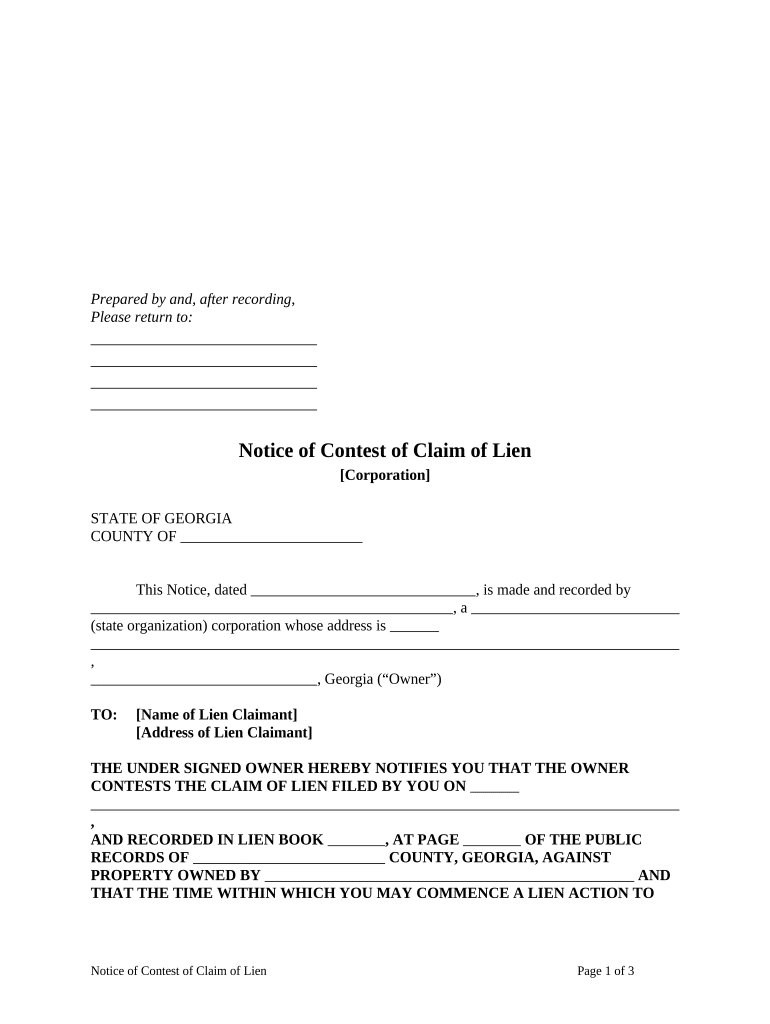
Georgia Notice of Contest of Claim of Lien

What the Georgia Notice of Contest of Claim of Lien Is

The Georgia Notice of Contest of Claim of Lien is a formal written filing used primarily by property owners or other interested parties to dispute an asserted lien on real property in Georgia. The document identifies the lien claim being contested, states the basis for contest, and creates a public record of the dispute. It is a procedural step intended to preserve rights, clarify ownership or payment obligations, and prompt resolution; specific legal effects and required wording depend on Georgia statutory and local recording rules.

Why a Notice of Contest Matters

Filing a Notice of Contest of Claim of Lien clarifies a property owner’s challenge to a lien, preserves defenses, creates record evidence of dispute, and can accelerate resolution or negotiation with claimants.

Why a Notice of Contest Matters

Who typically files or receives this notice

Parties often consult counsel or title professionals to confirm form language and delivery requirements before filing or serving the notice.

  • Property owners disputing an asserted lien against their title.
  • Prospective purchasers or title companies reviewing encumbrances before closing.
  • Lenders or investors protecting collateral and clarifying priority.

Primary signer roles

Property Owner

The owner who contests the lien signs to assert their position; they must provide identification, correct legal description, and authority to act if signing on behalf of an entity.

Title/Lender Representative

Title agents or lender counsel may prepare or submit the notice to protect closing interests; they must verify lien details and follow county recording procedures.

Core components of a professional contest notice

A concise, well-structured Notice of Contest includes identification, a clear statement of contest grounds, precise property description, claimant details, signature and authentication, and record/serving instructions to avoid return or rejection by the clerk.

Notice Heading

Clear title indicating it is a Notice of Contest of Claim of Lien and referencing the recorded claim instrument.
Parties Identified

Full legal names and addresses of the contesting party and the lien claimant to ensure correct service and indexing.

Property Description

Legal description or parcel identifier (lot, block, tax parcel) matching county records to avoid misfiling.

Basis of Contest

A brief factual statement of why the lien is disputed, e.g., payment in full, defective notice, or incorrect amount.

Signature and Date

Authorized signature block with date; notarization or acknowledgement if county practice requires it.

Filing and Service Instructions

Directions stating where the notice is recorded and how copies were delivered to interested parties.

Step-by-step: prepare and file a contest notice

Follow a clear sequence: verify lien details, prepare the notice, authenticate signatures, file with the county, and serve copies to interested parties.

  • 01
    Verify Lien: Confirm recorded document number, claimant name, and property description.
  • 02
    Draft Notice: Draft concise grounds, reference the lien, and include all identifying details.
  • 03
    Authenticate Signature: Sign and notarize if required by local practice or instruments.
  • 04
    File and Serve: Record with the county clerk and deliver copies to the claimant and other interested parties.

Where and how this notice is processed

Recording and service are two distinct actions: the county recorder indexes the notice, and the claimant or interested parties must receive the served copy according to local rules.

  • County Recording: Submit originals to the county clerk or recorder for official indexing.
  • Serve Claimant: Deliver a filed copy to the lien claimant by required method.
  • Notify Title/Lender: Provide copies to your title company or lender for closing or release actions.
  • Retain Proof: Keep filed copy, receipt, and service proof for your records.

Configuring an online workflow for completion and signature

Set up a digital workflow that supports the notice’s fields, signer authentication, optional notarization, and proof of service to create a complete record.

Field Configuration
Document Upload Use PDF or DOCX to preserve layout and legal text.
Signature Fields Place signature, printed name, and date fields for each signer.
Authentication Enable email, SMS, or stronger authentication per local practice.
Notary or RON Add notarization step if your county accepts remote or in-person acknowledgements.

Digital signing and technical considerations

Ensure the chosen platform provides admissible audit trails and exportable signed documents for county clerks and court use.

  • File Types: PDF and DOCX are broadly accepted for recording.
  • Authentication Options: Email, SMS, KBA, or stronger methods per county needs.
  • Integrations: Connect to title systems, storage, or closing platforms.

Common preparation pitfalls to avoid

  • Incorrect or truncated legal description that causes the clerk to misindex the notice and delay processing.
  • Using an abbreviated claimant or owner name that fails to match the recorded lien instrument precisely.
  • Failing to notarize or authenticate when local practice requires acknowledgement, leading to rejection.
  • Not serving the claimant or retaining proof of service, which can compromise enforcement or later disputes.

Consequences and risks of improper filing

Loss of Priority: May impair lien priority or legal defenses.
Rejection by Clerk: Clerk may refuse filing for insufficient information.
Sanctions: Court sanctions or costs for bad-faith filings.
Increased Costs: Added legal and administrative expenses.
Missed Deadlines: Failure to preserve rights under statute.
Title Clouding: Unresolved notices can delay closings or sales.

Practical tips for accurate, efficient completion

Adopt a checklist approach: verify identifiers, confirm claimant data, authenticate signatures, and document service to minimize rework and disputes.

Use Exact Recorded Text
Copy claimant name and legal description verbatim from the recorded lien instrument to ensure proper indexing and to prevent clerical rejection.
Document Service Carefully
Use certified mail or an acknowledged delivery method and keep receipts; proof of service is often required to defend against later claims.
Confirm County Procedures
County clerks may have specific filing coversheets, margins, or fee calculators; check the clerk’s office before submission to avoid delays.
Consider Counsel Review
When lien amounts are material or the dispute is complex, a brief attorney review can prevent costly mistakes and preserve remedies.

How this notice is used in real situations

Two practical scenarios illustrate common uses and outcomes when a contest notice is properly prepared and filed.

Owner Disputes Payment Claim

A homeowner discovers a contractor’s lien after final payment

  • The owner files a Notice of Contest referencing the recorded claim
  • Proper filing and service prompted a negotiated release and cleared title before closing.

Title Company Protects Closing

A title agent identifies an unexpected lien on opening title

  • The agent records a contest notice to document purchaser objection
  • The recorded notice forced expedited claimant action and limited closing exposure.

Essential factual data to include

Claimant: Full legal name
Contestant: Full legal name
Property: Legal description or tax parcel
Original Reference: Recording book/page or instrument number
Amount Claimed: Dollar amount listed
Filing Date: MM/DD/YYYY

eSignature vendor comparison for completing and filing the notice

Comparing common eSignature vendors for document preparation and signature workflows. signNow is listed first per comparative convention; pricing shown reflects common per-user annual rates where available.

signNow DocuSign Adobe Sign PandaDoc HelloSign
Starting Price $8/user/mo $15/user/mo $14/user/mo $19/user/mo $15/user/mo
Free Trial Yes, 7-day trial Varies by vendor Varies by vendor Varies by vendor Varies by vendor
Bulk Send Yes Yes Yes Yes Yes
Audit Trail Yes Yes Yes Yes Yes
HIPAA Compliant Yes Yes Yes No No

Frequently asked questions and quick answers

Common questions about validity, notarization, online signing, and next steps when a Georgia lien claim is contested.


Need help? Contact support

be ready to get more
Join over 28 million airSlate SignNow users