Establishing secure connection…Loading editor…Preparing document…

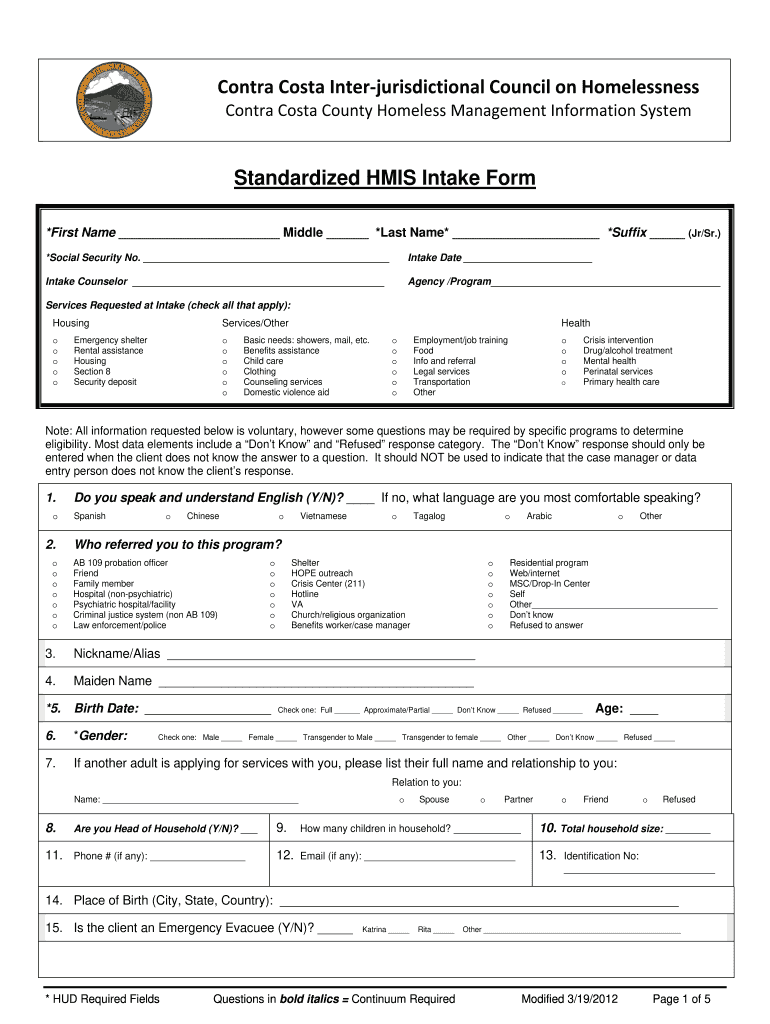
Contra Costa Standardized HMIS Intake Form

This template is fully customizable. Edit the text, fill out the fields, and send it for signature. Give it a try!
Contra Costa Standardized HMIS Intake Form

What the Contra Costa Standardized HMIS Intake Form Is

Contra Costa Standardized HMIS Intake Form is a county-level Homeless Management Information System intake template used to collect consistent client data for homeless services across Contra Costa County. The form captures demographic, housing, health, program eligibility, and case management details to support coordinated entry, reporting to HUD, and program evaluation. Agencies use the standardized intake to reduce duplication, improve data quality, and ensure compliance with federal and state privacy and recordkeeping requirements including HUD HMIS standards and HIPAA where applicable. The standardized structure also supports secure electronic submission and reporting.

Why standardizing intake matters in Contra Costa

Using the Contra Costa Standardized HMIS Intake Form promotes consistent client records, simplifies HUD reporting, and reduces intake errors. Standardization improves data sharing among providers while supporting compliance with federal privacy and e-signature laws such as ESIGN and applicable state UETA provisions.

Why standardizing intake matters in Contra Costa

Who completes the intake and how it flows across teams

Community providers, shelter intake staff, case managers, and coordinated entry teams in Contra Costa County commonly complete this standardized HMIS intake form.

  • Shelter and street outreach staff collecting intake and eligibility data during client encounters.
  • County HMIS administrators using the template for HUD reporting and program monitoring.
  • Behavioral health and supportive services teams coordinating care and referrals across providers.

Primary users and administrative roles

Case Manager

A Case Manager completes the intake during first client contact, records demographic and household data, documents housing history, and verifies eligibility. Accurate entries are critical for service coordination, and mismatches in name or SSN can trigger rework and delays.

HMIS Administrator

An HMIS Administrator configures system fields, maintains data quality rules, runs HUD and county reports, and manages user access. They ensure the intake template aligns with HUD Data Standards and local policies to support accurate program-level reporting and compliance.

Key data elements required on the intake

Full Legal Name: Exactly as on government ID
Date of Birth: Enter in MM/DD/YYYY format
Social Security Number: Provide SSN or TIN for verification
Current Address: Street, city, state, ZIP required
Contact Information: Phone and email for follow-up
Privacy Consent: Client signature for HIPAA/consent acknowledgements

Consequences of incorrect or incomplete intake data

Incorrect TIN: Triggers 24% backup withholding
Late Reporting: May affect HUD compliance status
Missing Consent: HIPAA violation risk and penalties
Data Errors: Program funding and audit exposure
Unsigned Form: Eligibility decisions may be invalidated
Privacy Breach: Possible state and federal fines

Common intake problems to avoid

  • Collecting incomplete contact details or P.O. boxes only, which prevents follow-up and verification, leads to higher case closure rates and wasted outreach.
  • Entering inconsistent names or misspelled identifiers across systems causes duplicate records and complicates HUD reporting and ART matching.
  • Skipping consent or insufficiently documenting authorization for information sharing undermines legal compliance and may block data access between partner agencies.
  • Using handwritten, illegible entries increases manual transcription time and creates higher error rates when migrating records into HMIS software.

Step-by-step: completing the intake accurately

Complete the Contra Costa Standardized HMIS Intake Form step by step to ensure accurate client records and compliant reporting.

  • 01
    Verify Identity: Confirm ID and record full legal name.
  • 02
    Collect Details: Capture demographics, housing history, and income.
  • 03
    Obtain Consent: Record HIPAA and information-sharing consents with dates.
  • 04
    Sign & Store: Get signatures, date, and file securely.

How intake data moves into HMIS and reporting

The intake collects client data, routes records to HMIS, and produces HUD-compliant reports for funders and program staff.

  • Upload: Scan or attach completed intake into HMIS.
  • Validate: Run data quality checks and deduplicate records.
  • Report: Generate HUD and county performance metrics.
  • Share: Provide case notes and referrals to partners.

Configuring a digital intake workflow

Configure your intake workflow to automate notifications, validations, and reporting to HMIS and HUD systems.

Field Configuration
Client Name Required; auto-fill from verified ID field.
Date of Intake Use MM/DD/YYYY; auto-timestamp entry on save
Consent Checkbox Record consent type, signer, and date
Program Code Select applicable program for reporting

Platform prerequisites for eSubmission and storage

signNow and similar platforms support secure electronic collection, basic authentication, and audit trails for HMIS intake forms.

  • Formats: PDF, DOCX, fillable forms
  • Integrations: Google Workspace and Microsoft 365
  • Authentication: Email, SMS code, and SSO

Key dates and time-sensitive items

Key dates and timelines affect reporting, eligibility, and retention for the intake form and related records.

Intake Effective Date and Service Period:

Enter MM/DD/YYYY; marks when services begin.

HUD Reporting Deadlines and Submissions:

Follow county schedule for HUD quarterly and annual reports.

Retention for Intake and Case Records:

Retain active records per program rules and federal standards.

Consumer Consent Renewal and Updates:

Update consent when program terms change or annually.

Data Correction and Amendment Deadlines:

Correct errors promptly to avoid reporting inaccuracies.

Milestones from intake through archival

Milestones show the intake lifecycle from initial contact to archival for compliance and reporting purposes.

01

Initial Contact and Screening

Client intake, ID verification, and eligibility screening completed.

02

Program Enrollment and Services

Enroll eligible clients, create case plan, and start services.

03

Ongoing Case Management

Document updates, service deliveries, and outcomes regularly.

04

Closure and Record Archival

Close records when services end, then archive per retention policy.

Essential sections included in the standardized intake

Core components of the Contra Costa Standardized HMIS Intake Form ensure consistent data capture and regulatory readiness for all participating agencies.

Demographics

Collects full legal name, aliases, date of birth, Social Security number or TIN when available, race, ethnicity, and contact details to support client identification, deduplication, and accurate reporting to HUD and county systems.
Housing History

Documents current living situation, prior addresses, duration of homelessness, barriers to housing, and exit destination fields so case managers can assess housing needs and report progress for program metrics.

Health & Vulnerability

Includes health conditions, behavioral health needs, disability status, and vulnerability assessments to prioritize service delivery, inform referrals, and meet HUD reporting requirements for vulnerable subpopulations.

Program Eligibility

Captures income, benefits, veteran status, and program-specific eligibility criteria so agencies can determine enrollment, apply targeting rules, and generate accurate outcome measures for funders and HUD.

Consent & Privacy

Provides explicit consent fields for data sharing, HIPAA authorizations where applicable, and notices about electronic records per ESIGN consumer disclosure requirements to document voluntary participation and informed consent.

Audit Trail

Includes signature blocks, timestamps, staff identifiers, and change logs to support data integrity, enable audits, and satisfy record retention policies required by HUD, HIPAA, and other applicable regulations.

Practical recommendations to reduce errors and speed processing

Practical tips reduce errors, improve completeness, and speed processing during intake completion and secure eSubmission across participating agencies.

Confirm Identification and Match Records Across Systems
Verify client identity using government ID where possible, check for duplicates in HMIS, and reconcile name/SSN variations before submission to minimize duplicate records and the need for corrective reporting and delays.
Use Standard Codes and Dropdowns
Choose program, funding, and outcome codes from validated lists. Using standardized picklists prevents misclassification, ensures consistent reporting across agencies, and reduces manual corrections during HUD and county reconciliations at closeout.
Document Consent and Sharing Permissions Clearly
Record explicit consent language, dates, and the scope of data sharing. For healthcare-related information include HIPAA authorizations and retain signed records to demonstrate informed consent during audits or when sharing across systems.
Leverage secure eSignature tools with audit trails
Use platforms that provide encryption in transit and at rest, audit logs, and signer authentication to meet ESIGN, UETA, and HIPAA recordkeeping standards; retain certificates of completion for audits and compliance reviews.

Real-world examples of the standardized intake in use

Examples show how agencies use the standardized intake to streamline services and reporting across Contra Costa.

Shelter Coordinated Entry

The county shelter network replaced multiple intake forms with the standardized HMIS intake to unify client records across providers.

  • Reduced duplicate entries and streamlined referrals.
  • Staff reported fewer data errors, faster eligibility determinations, and simplified HUD report preparation because consistent fields enabled automated exports and reduced manual reconciliation, saving administrators hours per reporting cycle and improving funder confidence.

Mobile Outreach

A mobile outreach team used the standardized intake on tablets to capture client information at encampment sites and immediately route records into HMIS.

  • Faster signups and real-time data.
  • Field teams completed intakes on-site, reduced transcription work, and enabled same-day referrals to shelters and services using secure electronic submission and timestamped audit logs, which improved follow-up and reduced case processing time.

How the standardized HMIS intake compares with agency-specific forms

Compare the standardized HMIS intake with agency-specific intake forms to choose the best workflow for reporting and services.

Criteria Standardized HMIS Intake Agency Intake Form
Purpose unified reporting local program needs
Field Consistency high variable
Reporting Ready often requires mapping
Customization limited high

Pricing and feature snapshot for common eSignature vendors

Compare common eSignature vendors for cost, bulk-send, HIPAA compliance, and envelope limits when selecting an eSubmission platform for HMIS intake.

signNow DocuSign Adobe Sign PandaDoc HelloSign
Starting Price $8/user/mo $15/user/mo $14/user/mo $19/user/mo $15/user/mo
Free Trial 7-day free trial Varies by plan Varies by plan Varies by plan Varies by plan
Bulk Send Yes Yes Yes Yes No
Audit Trail Yes Yes Yes Yes Yes
HIPAA Compliant Yes Yes Yes No No

Frequently asked questions about the intake, eSigning, and storage

Answers to frequent questions about using, eSigning, and storing the Contra Costa Standardized HMIS Intake Form.


Need help? Contact support

be ready to get more
Join over 28 million airSlate SignNow users