Establishing secure connection…Loading editor…Preparing document…

Notice of Plagiarism and Copyright Infringement

This template is fully customizable. Edit the text, fill out the fields, and send it for signature. Give it a try!
Notice of Plagiarism and Copyright Infringement

What this Notice Is and when to use it

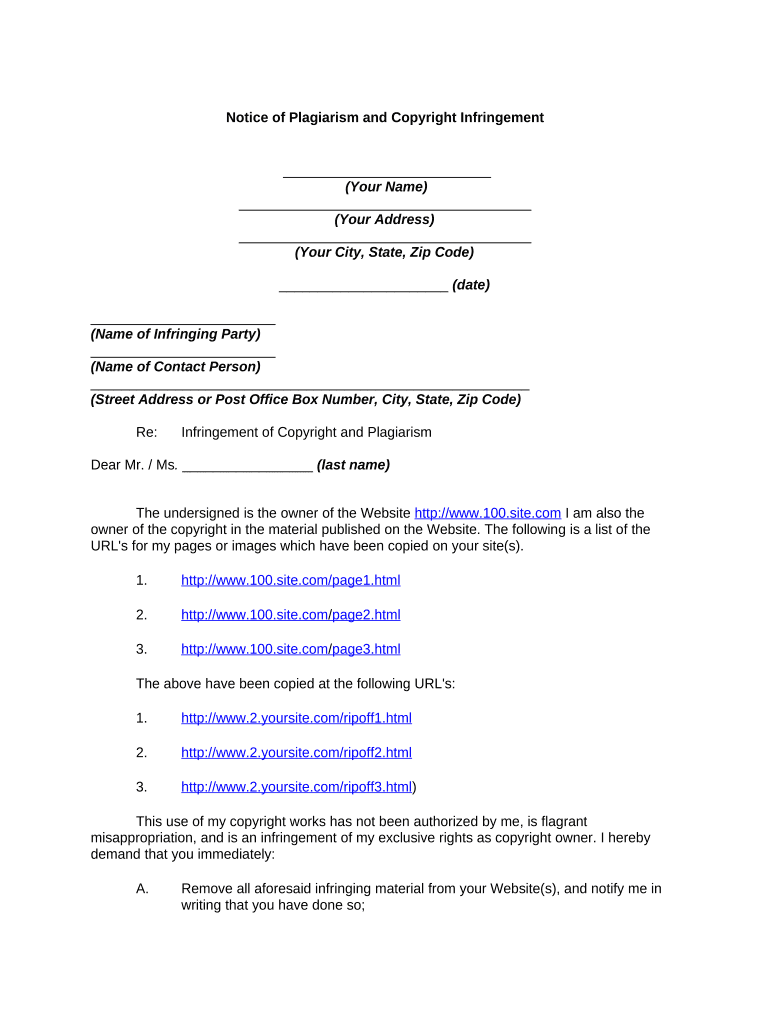
A Notice of Plagiarism and Copyright Infringement is a written communication that identifies alleged copying of original material and asserts the author's copyright interests. It documents the work claimed, explains how the allegedly infringing content duplicates or reproduces protected material, and requests a remedy such as removal, correction, attribution, or a cease-and-desist. The notice serves both as evidence of good-faith assertion and as the first formal step toward takedown, licensing negotiation, or litigation if the recipient does not cooperate.

Why sending a formal notice matters

A clear notice preserves evidence, creates a documented record of the claim, and gives recipients a practical opportunity to cure or respond before escalation. It improves chances of voluntary remediation and supports later enforcement steps while establishing intent and attribution for potential legal proceedings.

Why sending a formal notice matters

Who typically issues or receives these notices

Organizations and individuals use this notice to protect original works and to request corrective action from alleged infringers.

  • University integrity offices and faculty handling student work and academic publications, often coordinating with legal counsel and registrars.
  • Publishers, journals, and content platforms enforcing author rights and requesting takedowns or corrections for reposted material.
  • Independent authors, photographers, and creators asserting ownership and seeking attribution, removal, or licensing discussions.

Use the notice as an initial, documented step; retain copies and evidence to support any follow-up enforcement or legal action.

Core elements to include in a professional notice

A complete notice organizes identity, factual detail, evidence, claimed rights, and the relief sought. Present facts clearly, attach supporting files, and state the legal basis for the claim to reduce disputes and speed resolution.

Header

Sender identity and contact details along with date and a concise subject line stating 'Notice of Plagiarism and Copyright Infringement.'
Alleged Work

Full title, location, and a clear description of the original work claimed to be copied, including publication date and registration details if applicable.

Infringing Content

Exact URLs, file names, screenshots, or precise locations where the copied material appears, with timestamps when available.

Evidence Summary

Concise explanation of how the two works match (text excerpts, identical passages, structural similarity), plus attached exhibits showing side-by-side comparison.

Requested Remedy

State the specific relief sought—removal, correction, attribution, licensing terms, or cease-and-desist—and provide a reasonable response timeframe.

Signature Block

Printed name, title, organization, contact info, and a dated signature; indicate authority to act on behalf of the rights holder.

Step-by-step: preparing and sending the notice

Follow a short checklist to gather facts, document evidence, and deliver the notice in a verifiable way.

  • 01
    Identify the work: Confirm the original work and collect registration or publication details.
  • 02
    Collect evidence: Save screenshots, URLs, metadata, and side-by-side comparisons as PDFs.
  • 03
    Draft the notice: Complete required fields, state the legal basis, and specify the remedy requested.
  • 04
    Send and record: Deliver by email and a verifiable method; retain delivery and receipt records.

Typical digital workflow for issuance and tracking

Use a structured process that preserves metadata, records delivery, and enables easy retrieval if further action is needed.

  • Prepare document: Assemble notice, exhibits, and a cover page in a single PDF.
  • Apply fields: Add signature and date fields; include optional checkboxes and attachments.
  • Choose authentication: Select signer authentication (email, SMS code, ID verification) appropriate to the risk level.
  • Send and archive: Transmit via verifiable channel and store the signed record with an audit trail.

Recommended digital settings for reliable delivery

Configure authentication, attachments, and retention before sending to ensure the notice is valid and the record is preserved.

Field Configuration
Authentication Method Email link with optional SMS code for added verification
Signature Type Typed name plus date or drawn signature image as required
Evidence Attachments Require PDF exhibits and screenshots for submission
Retention Setting Auto-archive signed records for minimum seven years

Sending electronically: platform and format considerations

Choose a platform that captures timestamps, IP addresses, and an auditable signing trail to support later validation.

  • File formats: PDF and DOCX accepted
  • Integrations: Salesforce, Microsoft 365, Google Workspace
  • Accessibility: WCAG 2.0 Level AA

Ensure exported signed copies include the certificate of completion and embedded evidence to maintain a complete, defensible record.

Security and compliance elements to include

Encryption: TLS 1.2/1.3; AES-256 at rest
Certifications: SOC 2 Type II; ISO 27001
HIPAA Support: BAA available; HIPAA compliant
Audit Trail: Tamper-evident audit trail
Legal Compliance: ESIGN and UETA compliant
Accessibility: WCAG 2.0 Level AA

Typical timelines and response expectations

Establish and state realistic deadlines for recipient response and for your internal escalation steps to keep matters timely and procedurally sound.

Immediate issuance:

Send the notice promptly after a verified discovery of copying.

Response window:

Allow a reasonable response period, commonly 14–30 days for remediation.

Preservation period:

Preserve originals and evidence until resolution or legal closure.

Escalation timing:

If no cure, proceed to takedown request or counsel in the stated deadline.

Recordkeeping:

Retain delivery receipts and signed notices for later proof.

Common mistakes to avoid when preparing a notice

  • Failing to attach clear evidence or URLs makes the claim harder to verify and may delay recipient action or invite disputes.
  • Using vague or non-specific descriptions of copied content leads to ambiguity about what exactly is alleged to be infringing.
  • Sending from an unauthorized representative without proof of authorization can undermine the sender's standing and delay resolution.
  • Neglecting to preserve original files, metadata, and delivery receipts reduces the strength of any later enforcement or litigation.

Risks if the notice is incorrect or mishandled

Counterclaims: Risk of defamation or wrongful takedown allegations
Loss of standing: Incorrect ownership claims weaken enforcement
Evidence gaps: Missing metadata can limit legal remedies
Escalation cost: Legal proceedings increase time and expense
Reputational harm: Public disputes may affect credibility
Incorrect recipient: Sending to platform instead of actual infringer delays outcome

eSignature vendor comparison for sending and tracking notices

Compare baseline pricing and capabilities relevant to notices: starting price, trial availability, bulk send, audit trails, HIPAA support, and envelope limits.

signNow DocuSign Adobe Sign PandaDoc HelloSign
Starting Price $8/user/mo $15/user/mo $14/user/mo $19/user/mo $15/user/mo
Free Trial 7-day free trial Varies by plan Varies by plan Varies by plan Varies by plan
Bulk Send Yes Yes Yes Yes No
Audit Trail Yes Yes Yes Yes Yes
HIPAA Compliant Yes Yes Yes No No
Envelope Cap No cap 100 envelopes/user/year No cap No cap No cap

Frequently asked questions about notices and e-submission

Answers address common points about legal validity, authentication, platform selection, and record retention when issuing a Notice of Plagiarism and Copyright Infringement.


Need help? Contact support

be ready to get more
Join over 28 million airSlate SignNow users