Establishing secure connection…Loading editor…Preparing document…

Corporate Resolution

This template is fully customizable. Edit the text, fill out the fields, and send it for signature. Give it a try!
Corporate Resolution

What a Corporate Resolution Is and When It’s Used

A Corporate Resolution is a formal, written record of decisions approved by a corporation's board of directors or shareholders that authorizes specific corporate actions. Typical uses include opening or closing bank accounts, authorizing signatories, approving loans or real estate transactions, appointing officers, and delegating authority to execute contracts. The document identifies the corporation, summarizes the approved action, and names the authorized individuals with scope and limits. In the United States, corporate resolutions support internal governance, satisfy third-party requirements such as banks or title companies, and may be e-signed under ESIGN and UETA frameworks.

Why a Clear Corporate Resolution Matters

A Corporate Resolution provides clear, auditable evidence of corporate authority, reduces third-party friction, and establishes who may act on the corporation's behalf. It minimizes liability by documenting approvals, supports regulatory and banking requirements, and expedites transactions by clarifying delegated powers.

Why a Clear Corporate Resolution Matters

Who Prepares and Relies on Corporate Resolutions

Corporate officers, board members, corporate counsel, company secretaries, bankers, and title agents commonly prepare or request Corporate Resolutions for formal authorization.

  • Small and mid-size corporations needing bank account or loan authorizations.
  • Legal and compliance teams documenting board actions and meeting minutes.
  • External parties such as banks, title companies, and vendors verifying authority.

Typical Roles Involved

Company Secretary

The company secretary or corporate counsel typically drafts the resolution, confirms statutory authority under the corporation's articles and bylaws, prepares the board or shareholder meeting minutes, and ensures the adopted resolution is properly recorded and distributed to relevant internal and external parties.

Bank Relationship Manager

Bank officers or relationship managers request certified corporate resolutions to verify signatory authority for opening accounts, linking online banking, or executing loan documents; they rely on accurate corporate names, EINs, and explicit signatory limits to process transactions without delay.

Security and Compliance Considerations

Encryption In Transit: TLS 1.2 and TLS 1.3
Encryption At Rest: AES-256 full-disk and object encryption
Legal Frameworks: ESIGN and UETA recognized in U.S.
HIPAA Support: HIPAA compliance available with BAA
Audit Trail: Detailed timestamps, IP, and event logs
Certifications: SOC 2 Type II; ISO 27001

Core Elements to Include in a Corporate Resolution

A professional Corporate Resolution contains structured sections that identify the company, state the authorized action, specify signatories and limits, and include certification or attestations for third-party acceptance.

Company Details

Include the full legal name, state of incorporation, taxpayer identification number (EIN), principal office address, and the names and titles of corporate officers to precisely identify the entity taking action.
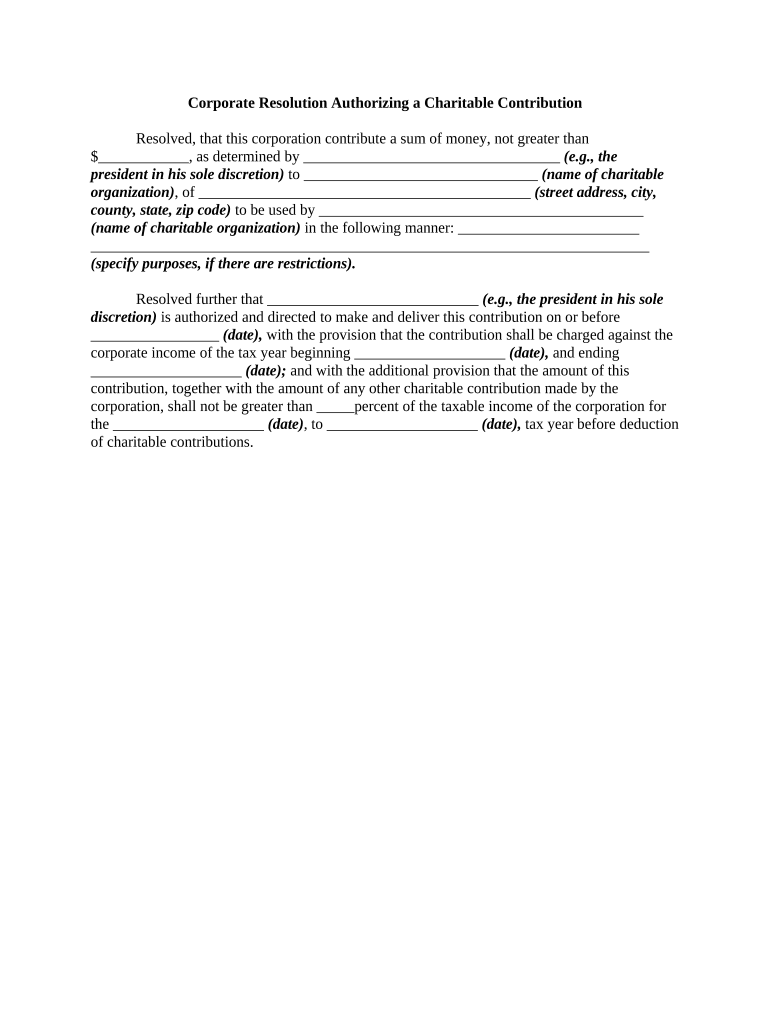
Resolution Statement

A concise recital describing the board action taken, the authority invoked, and the specific corporate power being granted or approved, written in clear, unambiguous language that third parties can rely upon.

Authorized Actions

Define the exact actions authorized — for example, opening bank accounts, executing contracts, borrowing funds, or transferring property — including any monetary or term limitations and procedural conditions.

Designated Signatories

Name the individuals or officer titles empowered to sign, include specimen titles and signature blocks, and specify whether authority is individual or joint and any authority limits.

Effective Date

State the effective date and duration of the authorization; specify whether the resolution is perpetual, time-limited, or conditional on external events or approvals.

Certification

Provide a certification block signed by the corporate secretary or authorized officer attesting to the board action, meeting quorum, and attaching minutes or certificates of incumbency if required.

Step-by-Step: Prepare, Approve, and Record a Resolution

Follow these steps to prepare, approve, and record a Corporate Resolution that meets corporate governance and third-party requirements.

  • 01
    Draft: Identify action and draft clear resolution language.
  • 02
    Review: Obtain legal and officer review for accuracy.
  • 03
    Authorize: Record approval at a board or shareholder meeting.
  • 04
    Record: File in minute book and distribute certified copies.

Configure an Online Resolution Workflow

Configure an online Corporate Resolution workflow to capture approvals, apply authentication, and automate recordkeeping across signing and distribution.

Field Configuration
Template Use a reusable template with fillable fields.
Authentication Select email, SMS code, or KBA per risk.
Notarization Enable RON or prepare for in-person notarization.
Distribution Send certified PDFs to stakeholders and banks.

Platform Capabilities to Support Corporate Resolutions

Choose a platform that supports secure eSignatures, audit trails, and integrations with your document management or ERP systems.

  • File Formats: PDF, DOCX, and fillable fields.
  • Integrations: Salesforce, NetSuite, Microsoft 365 supported.
  • Auth Options: Email, SMS, SSO, or KBA.

Typical Routing: From Draft to Delivery

Typical routing includes internal governance approval, legal review, electronic signature collection, and transmission to banks or registries as required.

  • Upload: Attach the final resolution to the template.
  • Approve: Capture board or shareholder approval electronically.
  • Sign: Authorized signatories add signatures and dates.
  • Deliver: Provide certified copies to banks and stakeholders.

Timing and Urgency: When to Act

Key timing considerations ensure the resolution is effective, accepted by third parties, and recorded with corporate records and external recipients.

Effective Date:

Specify MM/DD/YYYY; determines when authority begins.

Bank Acceptance:

Banks may require certified copies within days of request.

Notarization Window:

Obtain notarization or RON before submitting to banks.

Record Filing:

File in minute book immediately after adoption.

Duration:

Unless limited, authorization may remain until revoked.

Common Preparation Mistakes to Avoid

  • Using imprecise language that fails to clearly define authority or monetary limits, leading banks or counterparties to refuse acceptance or request additional documentation.
  • Not recording the resolution in the corporate minute book or failing to attach meeting minutes, which undermines the document's evidentiary value during audits.
  • Mismatched names, incorrect EINs, or inconsistent officer titles that cause third-party delays, rejected filings, or unintended backup withholding triggers.
  • Attempting to rely on unsigned or partially signed resolutions, or using initials where full signature blocks are required by third parties.

Risks and Consequences of an Incorrect Resolution

Rejection by Bank: Delays or denial of services.
Contractual Risk: Third-party refusal to transact.
Regulatory Scrutiny: Possible compliance violations.
Financial Exposure: Unauthorized obligations or liabilities.
Tax Consequences: Backup withholding or reporting errors.
Corporate Governance: Invalid corporate records or challenged minutes.

Supporting Documents and Export Options

Include supporting documents and choose export formats so third parties receive certified, machine-readable copies that meet evidentiary and recordkeeping needs.

Related Minutes

Attach the board or shareholder meeting minutes that record the vote, attendance, and motion language; minutes substantiate the resolution's authority for banks and auditors.

Certificate of Incumbency

A certificate of incumbency lists current officers and authorized signatories; banks often request this to verify authority and specimen signatures.

Notary / RON Proof

Supply notarized acknowledgements or RON session evidence when third parties require verified execution; preserve tamper-evident copies for audit trails.

Export Formats

Save final documents as signed PDF/A for archival, and maintain an audit log and a native editable copy for internal recordkeeping.

Practical Tips for Accurate and Efficient Resolutions

Adopt consistent templates, clear language, and strong authentication to reduce delays and ensure Corporate Resolutions are accepted by banks and counterparties.

Use a standard template and naming convention
Standardize the resolution format across the organization to include consistent headings, required fields, and a certification block; this lowers review time, prevents omissions, and simplifies producing certified copies or electronic exports for external parties.
Verify identity and authority before signing
Confirm signers' legal names, titles, and EIN cross-references against corporate records; require specimen signatures or a certificate of incumbency for unfamiliar banks or partners to prevent unauthorized commitments and downstream disputes.
Prefer explicit language for limits and duration
Spell out monetary limits, expiration dates, and conditional triggers; avoid vague terms like 'in general' or 'as necessary,' which increase third-party risk and frequently prompt requests for clarification or reapproval.
Maintain audit trails and certified copies
Keep signed originals or certified PDFs with full audit logs, and store them in a secure records system that supports retrieval, access controls, and the retention schedule required by tax, HIPAA, or securities regulations.

Real-World Examples of Electronic Resolutions

Real-world examples show how standardized Corporate Resolutions simplify banking and closing workflows for diverse organizations.

Martin Properties — Closing Efficiency

Martin Properties used electronic resolutions to speed property closings and provide certified authorization to title companies.

  • Reduced in-person signings and courier delays.
  • Tim Martin, Founder of Martin Properties, noted: 'I can process and execute all of these documents online with 100% compliance and built-in security. Whether on mobile or working offline, I can get forms back to their necessary parties efficiently.'

BIS — Corporate Compliance

BIS streamlined its authorization process for contracts and bank resolutions using electronic workflows.

  • Improved internal controls and auditability.
  • Dan Rotelli, CEO of BIS, said: 'We felt most comfortable with airSlate SignNow given their SOC 2 certification and strict focus on ESIGN and UETA act compliance.'

E-signature Pricing and Feature Comparison

Compare baseline pricing and core features across common e-signature providers to evaluate cost, compliance, and high-volume capabilities.

signNow DocuSign Adobe Sign PandaDoc HelloSign
Starting Price $8/user/mo $15/user/mo $14/user/mo $19/user/mo $15/user/mo
Free Trial Yes, 7-day trial Varies Varies Varies Varies
Bulk Send Yes Yes Yes Yes No
Audit Trail Yes Yes Yes Yes Yes
HIPAA Compliant Yes Yes Yes No No

FAQs: Common Questions About Corporate Resolutions

Answers to common questions about preparing, signing, and storing Corporate Resolutions, including electronic execution and third-party acceptance.


Need help? Contact support

be ready to get more
Join over 28 million airSlate SignNow users