Parties
Clearly identify every party using full legal names and, where relevant, roles (claimant, defendant, insurer), to avoid ambiguity about who is bound.
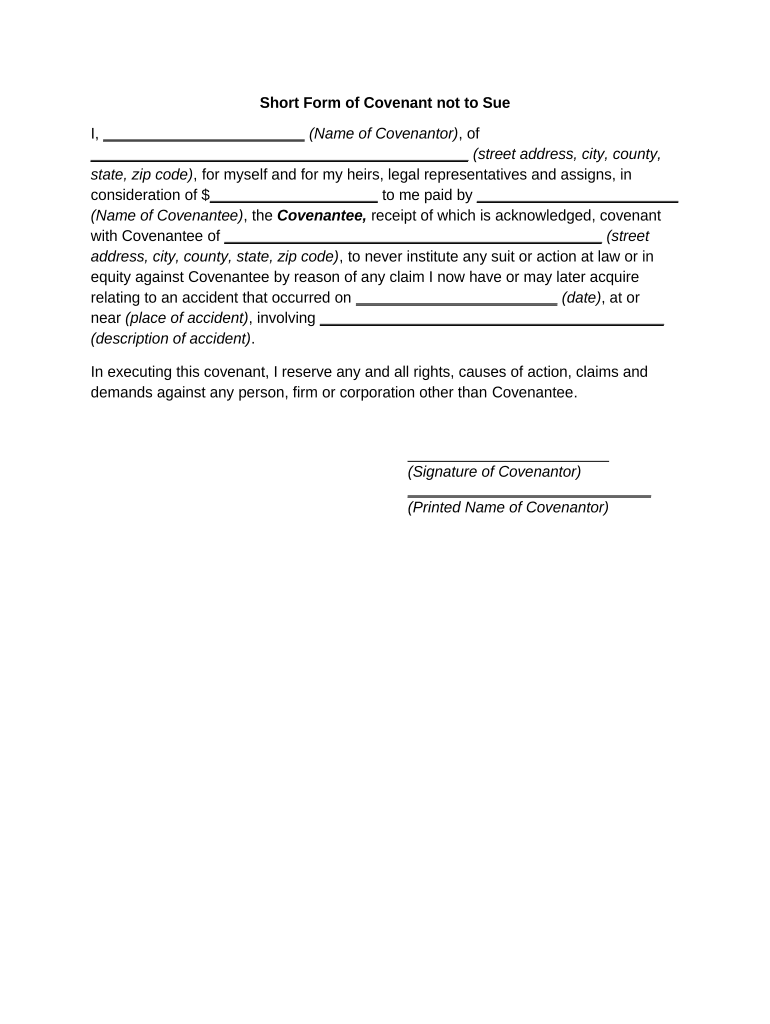
A Covenant Not to Sue provides a clear, enforceable mechanism to avoid litigation while documenting the settlement terms and obligations between parties. It can reduce dispute resolution costs, create predictable exposure limits, and serve as part of a broader risk-transfer or settlement strategy under governing state law.

Typical users include plaintiffs or claimants, defendants or releasees, insurers, and counsel advising settlement or release terms.
An individual or entity asserting a claim who agrees not to sue in exchange for consideration or other terms; usually signs as the releasing party and may attach related claim details or docket numbers.
The party receiving the covenant (often a defendant or insurer) who may provide payment, corrective action, or other consideration and will typically sign to acknowledge mutual terms and scope of covered claims.
Clearly identify every party using full legal names and, where relevant, roles (claimant, defendant, insurer), to avoid ambiguity about who is bound.
Describe claims with sufficient specificity—dates, contracts, or claim numbers—so enforceability and scope are clear without overbroad language.
State the payment amount or other consideration and the timing or conditions for performance to establish a bargained-for exchange.
Specify whether the covenant is perpetual, limited by statute of limitations, or subject to carve-outs such as fraud or future breaches.
Include signature blocks, dates, and any notary or witness lines required by state law to support evidentiary weight.
Address remedies for breach, choice of law, and whether the covenant bars all relief or only certain claims to reduce future disputes.
| Field | Configuration |
|---|---|
| Upload template | Use PDF or DOCX, set editable fields |
| Signer order | Specify sequential or parallel signing |
| Authentication | Choose email, SMS, or KBA |
| Retention | Enable audit trail and download copies |
Use a platform that preserves an audit trail, supports common formats, and meets necessary compliance (ESIGN/UETA and any sector-specific rules).
When obligations begin and payment triggers
Due dates or installment schedule
Varies by claim type, commonly 2–6 years
Any short window to rescind limited by contract
Report within carrier-specified period
| signNow | DocuSign | Adobe Sign | PandaDoc | HelloSign | |
|---|---|---|---|---|---|
| Starting Price | $8/user/mo | $15/user/mo | $14/user/mo | $19/user/mo | $15/user/mo |
| Free Trial | 7-day free trial | Varies | Varies | Varies | Varies |
| Bulk Send | Yes | Yes | Yes | Yes | No |
| Audit Trail | Yes | Yes | Yes | Yes | Yes |
| HIPAA Compliant | Yes | Yes | Yes | No | No |
An employee agrees not to sue for specific termination claims
Neighboring owners negotiate over boundary issues