Establishing secure connection…Loading editor…Preparing document…

Covenant Not to Sue Form

This template is fully customizable. Edit the text, fill out the fields, and send it for signature. Give it a try!
Covenant Not to Sue Form

What a Covenant Not to Sue Form Does and When it’s Used

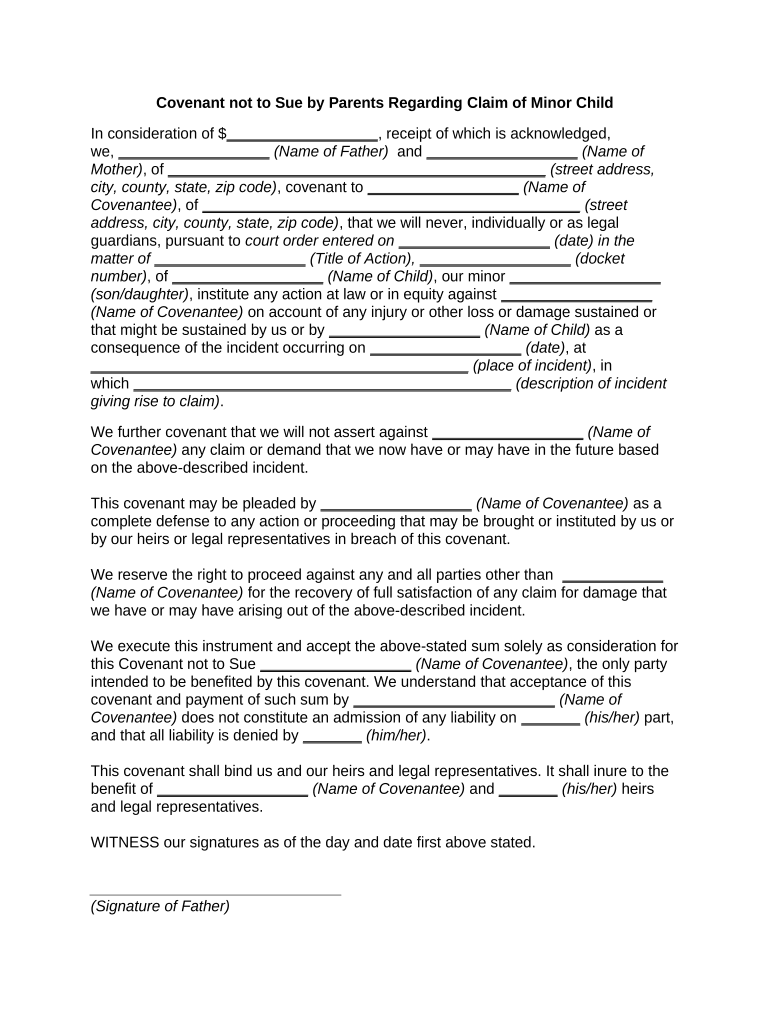
A Covenant Not to Sue Form is a written agreement in which one party promises not to initiate litigation against another for specified claims in exchange for consideration or other agreed terms. Common in settlements, releases, and dispute resolutions, the document narrows or extinguishes legal claims and clarifies the limits of future remedies. Properly drafted, it identifies the parties, describes the claims covered, states consideration, sets an effective date, and records signatures. Many jurisdictions permit electronic execution under the ESIGN Act (15 U.S.C. ch. 96) and UETA where adopted, but state-specific authentication or notarization rules may apply.

Why Parties Use a Covenant Not to Sue

A Covenant Not to Sue provides certainty and finality by documenting the scope of released claims, allocating risk, and avoiding further court costs. It supports enforceable settlements, helps close negotiations quickly, and creates a written record of the parties’ agreement while preserving specified rights where appropriate.

Why Parties Use a Covenant Not to Sue

Who Typically Prepares and Signs This Document

Several user profiles commonly prepare or sign covenants not to sue depending on the dispute and industry.

  • Real estate agents and closing attorneys handling property disputes and post-closing claims related to title or defects.
  • Healthcare providers and facilities resolving patient claims where liability is settled without full release of future treatment rights.
  • Legal counsel and insurers negotiating settlement terms to limit exposure and document waivers of specific claims.

Each role approaches drafting differently: attorneys focus on enforceability and language, insurers on subrogation and coverage, and operational staff on execution and recordkeeping.

Representative Signer Profiles

Claims Adjuster

Handles settlement approval and documentation for insured claims. The adjuster confirms consideration, verifies authority to settle, and ensures the covenant’s terms align with policy limits and subrogation interests before execution.

Litigation Counsel

Drafts and negotiates precise release language, ensures statute-of-limitations implications are addressed, and advises on notarization, witness requirements, and whether the covenant should coexist with a broader release or mutual release.

Key Security and Compliance Considerations

Encryption: TLS 1.2/1.3 in transit
Data at Rest: AES-256 encrypted storage
Regulatory Compliance: ESIGN and UETA compliance
Audit Trail: Detailed signer IP and timestamp
HIPAA Support: BAA available where required
Certifications: SOC 2 Type II; ISO 27001

Top Legal Risks If the Form Is Incorrect

Unenforceable Release: Ambiguous scope
Waived Rights: Overbroad language
Statute Issues: Missed limitations
Third-Party Claims: Unaddressed subrogation
Authentication Failure: Missing notarization
Identity Errors: Mismatched names

Common Preparation Mistakes to Avoid

  • Using vague terms like 'all claims' without defining the claim types and date ranges can create enforceability disputes and unintended waivers.
  • Failing to identify the correct legal parties and signatories may render the covenant unenforceable against intended beneficiaries or assignors.
  • Neglecting to state clear consideration or treating it as 'for good and valuable consideration' without specifics invites later challenge.
  • Overlooking state-specific notarization or witness rules can invalidate acknowledgements or complicate record acceptance in court.

Realistic Use Scenarios

Two practical examples illustrate how a Covenant Not to Sue resolves disputes while tailoring who retains which rights.

Automobile Accident Settlement

Driver and claimant agree to a payment and a covenant covering property and bodily injury claims arising before the effective date,

  • Payment and covenant are conditioned on timely execution and release delivery,
  • The covenant preserves unrelated future claims and documents that the claimant will not file suit on specified collision claims, reducing litigation risk and allowing immediate case closure.

Medical Billing Dispute

Patient and provider settle a disputed bill for a reduced amount in exchange for a covenant limited to prior billing errors,

  • Language excludes future treatment claims and malpractice allegations,
  • The provider obtains a limited waiver to collect reduced payment while the patient retains rights for unrelated care; the agreement clarifies billing adjustments and prevents future collection suits on the billed dates.

Step-by-Step: Completing a Covenant Not to Sue Form

Follow these steps to assemble the information and produce a clear, enforceable covenant.

  • 01
    Identify Parties: Enter legal names and roles for each party involved.
  • 02
    Describe Claims: Specify claim types, time periods, and factual scope covered.
  • 03
    State Consideration: Record exact payment or other value exchanged and payment terms.
  • 04
    Sign and Authenticate: All required signatures, dates, and notarization or witness steps.

Where to Send and How the Document Is Processed

Typical routing involves counsel, claims departments, possible court filing, and secure storage; choose destinations based on the agreement’s purpose.

  • To Opposing Counsel: Provide executed copies for client file and future reference.
  • Court Filing: File only if part of a court-ordered settlement or dismissal.
  • Claims Department: Send to insurer for payment processing and recordkeeping.
  • Secure Archive: Store originals and electronic copies in a controlled repository.

How to Configure an Online Signing Workflow

Configure fields, authentication, and routing to match legal and operational needs before sending for signature.

Field Configuration
Signature Type Electronic signature | Wet ink as required
Authentication Email link | SMS code | KBA optional
Notary Handling Remote Notarization | In-person notarization
Retention Policy Secure archive | Access controls and retention

How a Covenant Not to Sue Compares with a Mutual Release

Compare scope, parties, and common use cases to choose the right instrument for a settlement.

Criteria Mutual Release Covenant Not to Sue
Scope all claims specified claims
Consideration
Typical Parties both sides claimant only
Primary Use full settlement limited non-suit promise

Essential Elements Every Professional Covenant Should Include

A well-constructed covenant clearly defines parties, scope, and execution steps to reduce ambiguity and litigation risk.

Parties

Full legal names for each individual or entity, including capacity and authorized signatory details to ensure binding obligations.
Claim Description

Precise identification of claims, incidents, dates, and factual scope that are covered or intentionally excluded by the covenant.

Consideration

Exact payment amounts, credit allocations, or non-monetary compensation, plus timing and conditionality of the consideration exchange.

Release Language

Clear statement of the covenant’s limits—whether it bars suit entirely, is limited to certain claims, or coexists with other releases.

Signatures

Signature blocks with printed names, titles where relevant, and signature dates; indicate if electronic signatures are acceptable.

Notary / Witness

Notary acknowledgement or witness lines when required by state law to support enforceability and admissibility.

Key Dates and Deadlines to Watch

Set and communicate deadlines for payments, revocation windows, and any court-related filing obligations tied to the covenant.

Effective Date:

Date obligations begin and statute-of-limitations impact

Payment Deadline:

When consideration must be delivered to trigger the covenant

Revocation Window:

Any short cancellation period or condition precedent

Court Filing Deadline:

Required if covenant accompanies dismissal or judgment

Record Retention Start:

Date counting begins for retention obligations

Practical Tips for Accurate and Efficient Completion

Adopt consistent drafting, validation, and storage practices to reduce errors and speed execution.

Use Precise Language
Draft narrowly to define covered claims, dates, and exceptions to prevent unintended waivers or litigation.
Confirm Authority
Verify signers’ authority for corporate entities and include title lines for clarity and enforceability.
Document Consideration
Specify payment method and timing and include conditions that trigger the covenant.
Retain Originals
Keep executed originals and certified electronic copies in a secure, access-controlled archive.

Comparison: Common eSignature Providers for Executing Covenants

Choose an eSignature provider that meets legal, authentication, and retention needs; signNow appears first for direct comparison.

signNow DocuSign Adobe Sign PandaDoc HelloSign
Starting Price $8/user/mo $15/user/mo $14/user/mo $19/user/mo $15/user/mo
Free Trial Yes, 7-day free trial Yes (trial) Yes (trial) Yes (limited) Yes (limited)
Bulk Send Yes Yes Yes Yes No
Audit Trail Yes Yes Yes Yes Yes
HIPAA Compliant Yes Yes Yes No No

Frequently Asked Questions About Covenants Not to Sue

Answers to common legal and execution questions help avoid mistakes and clarify when additional review or notarization is required.


Need help? Contact support

be ready to get more
Join over 28 million airSlate SignNow users