Establishing secure connection…Loading editor…Preparing document…

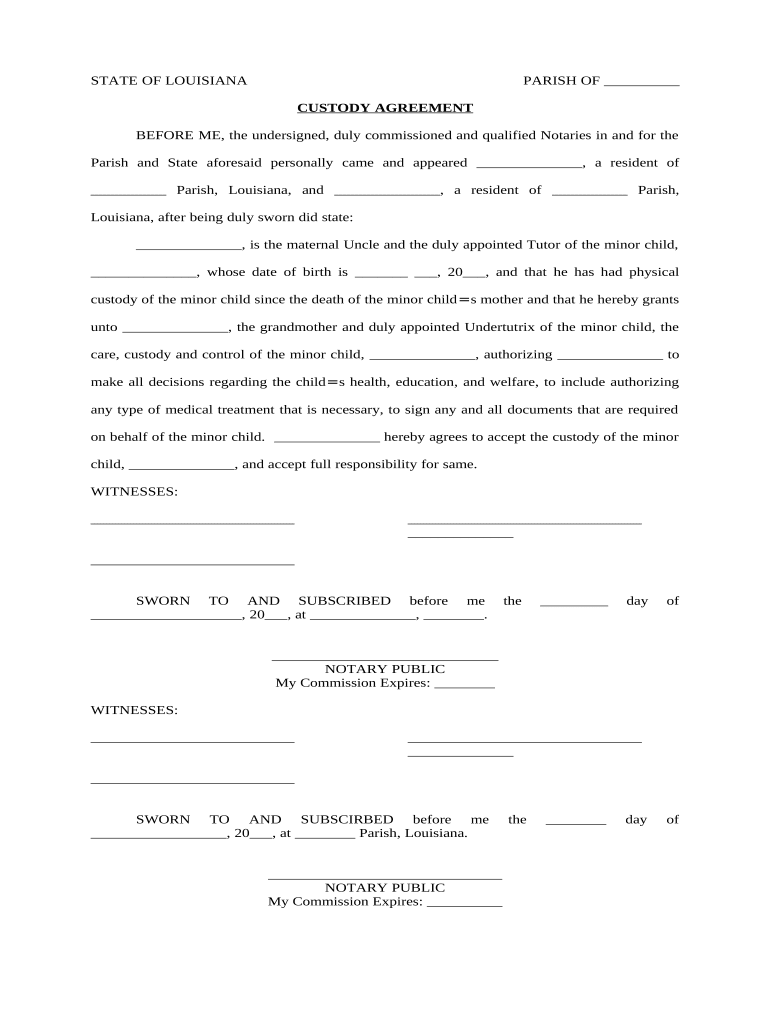
Custody Agreement

This template is fully customizable. Edit the text, fill out the fields, and send it for signature. Give it a try!
Custody Agreement

What a Custody Agreement Is and when it applies

A Custody Agreement is a legal document that records parental or guardian arrangements for the care, physical custody, and legal decision-making authority for a child or dependent. It can be executed between private parties or entered as part of a court order in family law proceedings. The agreement specifies parenting time, decision-making authority for education and healthcare, dispute resolution, and financial responsibilities tied to custody. Parties often use a written custody agreement to clarify expectations, reduce later disputes, and provide a record for courts when seeking formal approval or enforcement.

Why a formal Custody Agreement matters

A clear written custody agreement reduces ambiguity about parenting time, medical and school decisions, and relocation limits. It can streamline court review, provide enforceable terms, and help protect parental rights under applicable state family law. Electronic execution is widely accepted under federal ESIGN (15 U.S.C. ch. 96) and state UETA regimes where adopted, though some family-court filings may still require in-person procedures.

Why a formal Custody Agreement matters

Who typically prepares and signs a custody agreement

Typical participants include parents, guardians, attorneys, and occasionally mediators or court-appointed specialists.

  • Parents or guardians negotiating custody terms directly or through counsel.
  • Family law attorneys drafting or reviewing agreements for legal sufficiency.
  • Mediators or parenting coordinators facilitating mutually acceptable terms.

Each party should confirm signatory authority and consider attorney review before finalizing and filing the agreement.

Key signer roles and responsibilities

Parent – Petitioner

A parent initiating a custody agreement should provide accurate identity details, proposed parenting schedules, and supporting documentation such as school records or medical consent needs. They must be prepared to attest to facts under penalty of perjury if the document is filed with a court.

Family Law Attorney

An attorney reviews statutory requirements, suggests enforceable provisions, and ensures the agreement aligns with state custody standards. Counsel also advises on filing procedures, necessary court approvals, and whether notarization or witness signatures are required.

Essential data elements required in the Custody Agreement

Child Details: Full legal name and date of birth
Parent Names: Full legal names and contact info
Parenting Schedule: Physical custody and visitation terms
Decision Authority: Legal custody allocation
Healthcare Rights: Medical consent and emergency plan
Governing Law: State chosen to interpret agreement

Step-by-step: Completing a Custody Agreement

Follow this sequence to prepare a complete, court-ready custody agreement that can be signed electronically or on paper.

  • 01
    Gather documents: Collect IDs, birth certificates, and school records.
  • 02
    Draft terms: Describe custody, visitation, and decision-making specifics.
  • 03
    Review legal compliance: Ensure terms conform with state family law standards.
  • 04
    Sign and file: Execute signatures, notarize if required, and submit to court.

Configuring the online completion workflow

Set up fields and signer order so the agreement routes correctly, captures consent, and stores an audit trail.

Field Configuration
Signer Order Specify which parent signs first and any attorney sign-offs.
Authentication Use email verification or SMS code for signer identity.
Notary Step Add a notary field if the jurisdiction requires notarization.
Audit Options Enable timestamps, IP logging, and certificate of completion.

Where to send and how to submit the completed agreement

Decide whether the agreement will remain private between parties or be submitted to family court for approval.

  • Private Filing: Store signed copies with each party and counsel.
  • Court Submission: File with the family court that has jurisdiction over the child.
  • Clerk Requirements: Follow local clerk rules for format and required attachments.
  • Service of Process: Serve opposing party per state rules if filing initiated by one parent.

Digital signing and technical considerations

Use an eSignature provider that supports secure authentication, an audit trail, and retention for legal records.

  • File Formats: PDF or DOCX preferred
  • Authentication: Email, SMS, or stronger
  • Integration: Cloud storage and court filing systems

Ensure the chosen platform can produce a certificate of completion and meets any jurisdictional authentication or retention rules.

Typical timelines and court deadlines to keep in mind

Track timing for signing, filing, and any required court hearings to avoid procedural delays.

Effective Date:

Date parties sign; triggers obligations.

Court Filing Window:

Varies by jurisdiction; file promptly if court approval desired.

Hearing Scheduling:

Expect several weeks to months for the court calendar.

Modification Notice:

Provide required notice periods before petitioning for changes.

Record Retention:

Keep originals and certified copies per retention rules.

Common mistakes to avoid when preparing a custody agreement

  • Using vague language for parenting time or decision-making, which leads to differing interpretations and court disputes later.
  • Failing to confirm signatory authority or using inconsistent names between IDs and the agreement, creating enforceability problems.
  • Neglecting to check whether notarization, witness signatures, or in-court approval are required by your jurisdiction before filing.
  • Relying on informal email agreements or texts without explicit intent to sign and proper retention, increasing risk of non-enforceability.

Risks and legal consequences of errors or omissions

Nonenforceable Terms: May be void or modified by court
Perjury Risk: False statements expose parties to sanctions
Delayed Relief: Court may deny emergency relief
Loss of Rights: Improper signatures can forfeit parental claims
Sanctions: Court sanctions or fee shifts possible
Child Welfare Impact: Immediate safety concerns may prompt state intervention

eSignature vendor pricing and capability overview for custody agreements

Compare basic pricing and key features useful for custody agreement workflows; signNow appears first per the vendor data provided.

signNow DocuSign Adobe Sign PandaDoc HelloSign
Starting Price $8/user/mo $15/user/mo $14/user/mo $19/user/mo $15/user/mo
Free Trial 7-day free trial Varies Varies Varies Varies
Bulk Send Yes Yes Yes Yes No
Audit Trail Yes Yes Yes Yes Yes
HIPAA Compliant Yes Yes Yes No No

Real-world signNow customer experiences with legal and healthcare workflows

These short case notes illustrate how secure eSignature and compliance certifications support sensitive documents.

Dan Rotelli, CEO — BIS

We felt most comfortable with airSlate SignNow given their SOC 2 certification and strict focus on ESIGN and UETA act compliance.

  • Platform trust
  • That compliance record helped BIS adopt digital execution across legal workflows while satisfying internal audit and risk teams.

John Butler, Founder — Fertility Centers of Illinois

The airSlate SignNow team has been exceptional, responsive, the API has been great, and we're extremely happy that we chose airSlate SignNow as a company.

  • Integration benefit
  • The API and secure signing allowed us to exchange sensitive medical consent documents while retaining audit logs for compliance.

Practical tips for accurate, enforceable Custody Agreements

Follow these best practices to reduce risk and ensure the agreement is clear, executable, and acceptable to courts.

Use precise schedules
Draft parenting time and holiday schedules with exact days, times, and transportation responsibilities to prevent ambiguity and future disputes.
Confirm jurisdiction
Specify the governing state and venue for disputes; aligning the agreement to the correct family court reduces procedural challenges.
Document signatory intent
Capture explicit signer intent, consent to electronic records where used, and produce a certificate of completion for any eSignature transaction.
Preserve originals and certified copies
Keep signed originals or certified court copies and ensure secure, access-controlled storage for at least the recommended retention period.

Frequently asked questions about custody agreements and eSignatures

Answers to common questions about enforceability, filing, and using electronic signatures for custody agreements.


Need help? Contact support

be ready to get more
Join over 28 million airSlate SignNow users