Establishing secure connection…Loading editor…Preparing document…

Declaration of Gift Form

This template is fully customizable. Edit the text, fill out the fields, and send it for signature. Give it a try!
Declaration of Gift Form

What the Declaration of Gift Form Is and when it’s used

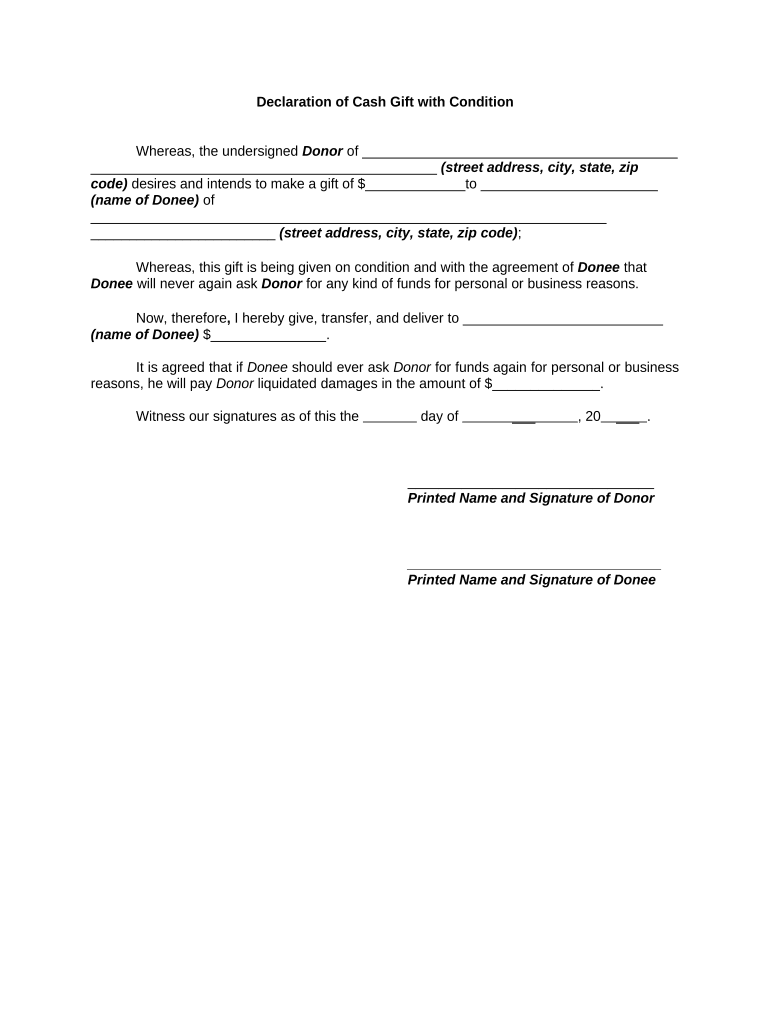
A Declaration of Gift Form is a written record that documents a donor’s voluntary transfer of money, personal property, or real property to a recipient without receiving payment or equivalent consideration. The form names the donor and recipient, describes the gifted item or amount, states the effective date, and records signatures and any notarization or witness acknowledgements. Organizations, families, and individuals use it to reduce disputes, support tax reporting, and create an evidentiary trail for legal or administrative review. Certain asset transfers (real estate, vehicles) may require additional recording steps or forms under state law.

Why a clear Declaration of Gift Form matters

A signed declaration documents donor intent, supports accurate tax reporting, and reduces later disputes about ownership. Clear language and proper execution protect both parties and create a record useful for estate, financial, and regulatory reviews.

Why a clear Declaration of Gift Form matters

Who commonly prepares and signs a Declaration of Gift Form

The signer set varies: simple personal gifts often use donor and recipient signatures, while institutional transfers may add witnesses, notaries, or professional reviewers.

  • Individual donors and family members who transfer money, personal property, or heirlooms.
  • Recipients and heirs documenting receipt for estate planning or personal records.
  • Attorneys, accountants, and financial institutions preparing formal records for tax or title purposes.

Essential components to include in a professional Declaration of Gift Form

A complete form reduces ambiguity and strengthens enforceability. Include clear identification, an accurate gift description, and execution details to reduce later disputes.

Donor identity

Full legal name and contact information for the person or entity making the gift, matching government IDs or organizational records to avoid name-mismatch issues.
Recipient identity

Full legal name and contact information for the recipient, plus relationship to donor if relevant for estate or tax context.

Gift description

Precise description of property, serial numbers, title information, or dollar amounts for cash gifts; avoid vague phrases like 'personal property' without detail.

Consideration statement

Explicit declaration that the transfer is a voluntary gift without exchange of consideration, and any nominal terms if applicable.

Execution details

Effective date, place of signing, signature block(s), and any required witness or notary acknowledgement appropriate to the asset and jurisdiction.

Tax and legal notes

A brief reminder about gift-tax reporting requirements and whether the parties consulted counsel or an accountant; avoids incorrect assumptions about tax consequences.

Step-by-step: complete and execute a Declaration of Gift Form

Follow these steps to create a clear and enforceable declaration.

  • 01
    Gather details: Collect IDs, title numbers, and valuation documents.
  • 02
    Complete form: Enter names, description, value, and effective date accurately.
  • 03
    Notarize or witness: Obtain required notary or witness signatures per jurisdiction and asset type.
  • 04
    Distribute and retain: Provide copies to parties and keep originals in secure records.

Typical workflow for preparing and delivering the form

This sequence represents a common end-to-end process for handling a Declaration of Gift.

  • Draft: Prepare the form with complete gift details and parties.
  • Review: Have legal or tax advisor review when values or titles are significant.
  • Execute: Sign, witness, and notarize as required by law.
  • Record: Record deed or title changes where statutorily required.

Configuring a digital workflow for online completion and signing

Set these fields when building an electronic workflow to collect signatures and evidence.

Field Configuration
Upload document PDF or DOCX input; preserve original formatting.
Signer roles Define donor, recipient, and any witness or notary roles.
Authentication Choose email, SMS code, or stronger KBA where required.
Retention policy Set secure storage timeframe and export options.

Technical considerations for e-signing and secure storage

Choose a platform that provides secure transit and storage, transparent audit logs, and integrations with your existing systems.

  • Authentication options: Support for email, SMS codes, KBA, and multi-factor authentication as needed.
  • Audit trail: Capture timestamps, IP addresses, and action history for each signer.
  • Integrations: Connectors for CRM, cloud storage, and document management simplify distribution and retention.

Time-sensitive filing and tax-related deadlines to watch

Some gift-related filings use general tax calendar dates; other recording deadlines depend on local recording offices.

Gift tax return (Form 709):

Due April 15 following the year of the gift; same extension rules as Form 1040.

Income tax filing:

Individual return due April 15; extensions available to Oct 15 with Form 4868.

Real property recording:

Record promptly with county recorder to protect title and public notice.

Notary/RON session:

Complete notary steps before transfer; RON session rules vary by state.

Retention start date:

Retention typically begins on effective date or date recorded, depending on document.

Common mistakes that weaken a Declaration of Gift Form

  • Vague descriptions of property that make it impossible to identify or transfer title later.
  • Failing to obtain required notarization or witness signatures for the asset and jurisdiction.
  • Incorrect dates or mismatched names that complicate record searches and legal recognition.
  • Neglecting tax reporting obligations (Form 709) when the gift exceeds the annual exclusion.

Short risks and potential legal consequences

Tax liability: Gift tax may apply; Form 709 may be required
Invalid transfer: Improper execution can invalidate the transfer
Probate challenge: Undocumented gifts risk courtroom disputes
Civil liability: False statements may raise legal exposure
Title defects: Unrecorded real property gifts can cloud title
Record retention: Failure to retain copies hinders audits or claims

Security and compliance essentials for electronic declarations

Encryption in transit: TLS 1.2/1.3
Encryption at rest: AES-256
Audit trails: Captures timestamps and IP addresses
Compliance frameworks: SOC 2 Type II and ISO 27001
Healthcare compliance: HIPAA BAA available where required
Regulatory support: 21 CFR Part 11 capability available

eSignature vendor comparison for executing and storing Declarations of Gift

This table compares core pricing and feature availability across common eSignature providers; signNow is listed first per comparison conventions.

signNow DocuSign Adobe Sign PandaDoc HelloSign
Starting Price $8/user/mo $15/user/mo $14/user/mo $19/user/mo $15/user/mo
Free Trial 7-day free trial Trial available Trial available Trial available Trial available
Bulk Send Yes (Business Premium/Site License) Yes Yes Yes No
Audit Trail Yes Yes Yes Yes Yes
HIPAA Compliant Yes Yes Yes No No

Frequently asked questions about the Declaration of Gift Form

Answers to common execution, tax, and validity questions when preparing or accepting a Declaration of Gift.


Need help? Contact support

be ready to get more
Join over 28 million airSlate SignNow users