Establishing secure connection…Loading editor…Preparing document…

Louisiana Final Decree of Adoption

This template is fully customizable. Edit the text, fill out the fields, and send it for signature. Give it a try!
Louisiana Final Decree of Adoption

What the Louisiana Final Decree of Adoption Is and what it does

The Louisiana Final Decree of Adoption is the court-issued judgment that legally creates or transfers parental rights for a child in Louisiana. It establishes the adoptive parent(s) as the child's legal parent(s), may authorize a legal name change for the child, and directs the clerk of court or state vital records office to amend the child's birth certificate. Because it is a judicial decree, the document is entered by a judge and becomes part of the court record, and it carries effects on inheritance, parental responsibilities, and official identity documents.

Why the Final Decree matters for families and records

A final decree ends the legal relationship between the child and any previous parent(s) where required and creates a permanent parent-child relationship with the adoptive parent(s). It is the controlling legal instrument for updating birth certificates, establishing custody and support obligations, and providing a stable legal identity for the child.

Why the Final Decree matters for families and records

Who typically needs or prepares this decree

Common professionals and parties involved in preparing or submitting the Louisiana Final Decree of Adoption.

  • Adoptive parents filing a petition or responding to court requirements for finalization
  • Family law attorneys preparing pleadings, proposed decrees, and birth certificate amendment requests
  • Court clerks and juvenile court personnel responsible for entering the decree and transmitting records

Each participant has distinct responsibilities: parents provide identifying data, attorneys ensure compliance with statutes and procedures, and the court issues the formal order that effects record changes.

Stepwise process to complete and file the decree

Follow these steps in sequence to finalize an adoption and ensure the decree is properly entered and recorded.

  • 01
    Prepare Petition: File adoption petition with supporting documents.
  • 02
    Court Hearing: Appear at scheduled hearing; judge reviews fitness and consent.
  • 03
    Entry of Decree: Judge signs the final decree and clerk enters it into the record.
  • 04
    Amend Vital Records: Submit certified decree to vital records to amend the birth certificate.

How to configure an online workflow for the decree

A clear digital workflow reduces administrative friction when routing proposed decrees for review and signature.

Field Configuration
Document Template Upload PDF of the proposed decree for reuse.
Reviewer Roles Assign attorney, petitioner, and clerk roles in order.
Authentication Use email plus SMS code or higher for identity verification.
Certified Copy Routing Auto-generate certified PDF for vital records and parties.

From petition to amended birth certificate — the core steps

This sequence shows the document flow after the decree is prepared and signed by the court.

  • File Proposed Decree: Submit proposed decree with petition and exhibits.
  • Judge Approves: Court enters the final, signed decree.
  • Clerk Prepares Certified Copy: Clerk provides certified copies for parties and agencies.
  • Vital Records Update: Submit certified decree to amend the birth record.

Key components found in a professional final decree

A well-drafted decree is clear about legal effects, parties, and administrative instructions for downstream record changes.

Caption

Court name, parish, case caption and docket number must match the petition and court filings precisely.
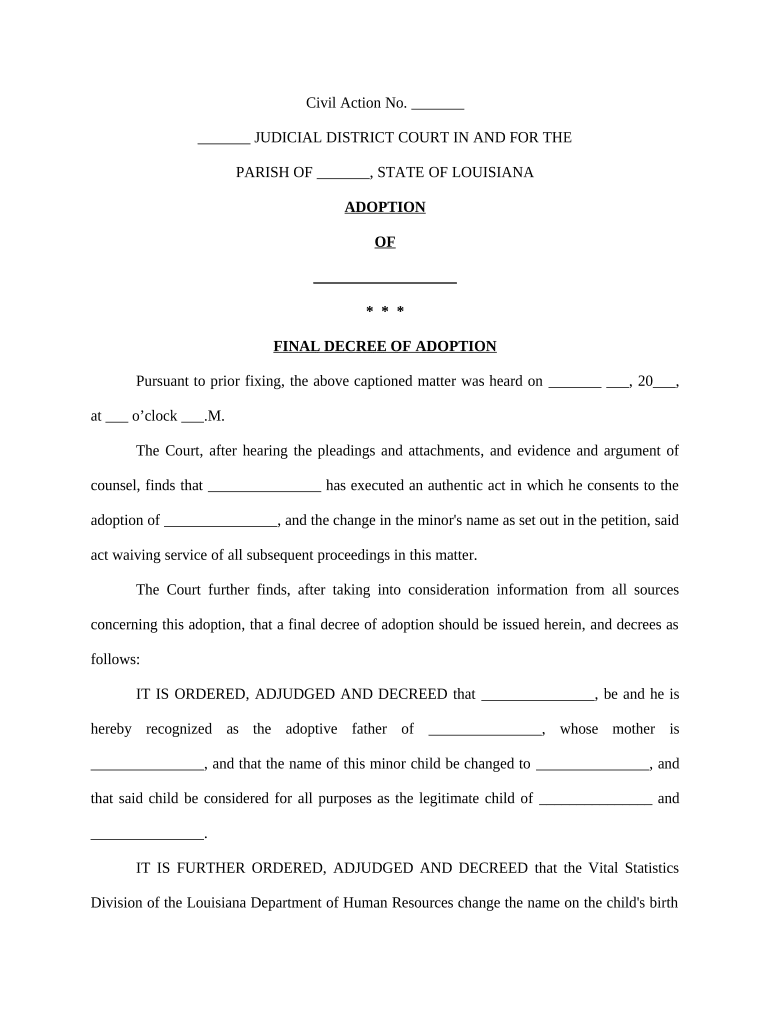
Findings of Fact

Concise court findings that statutory criteria were satisfied, such as consent, home study review, and best-interest determinations.

Judgment Language

Clear ordering clause that severs prior parental rights if required and vests custody and parental rights in adoptive parent(s).

Name Change Order

If applicable, the decree authorizes a legal name change and instructs the vital records office to update the birth certificate.

Entry Date and Signature

Judge signature block, date of signature, and clerk’s entry details that create the effective date of the decree.

Instructions to Agencies

Specific language directing clerk or state vital records to issue certified copies and amend registrations.

Essential identifiers and verification data to include

Docket Number: Exact case ID
Court Name: Full court title
Judge Name: Presiding judge
Child DOB: MM/DD/YYYY
Parent IDs: Government-issued IDs
Certified Signature: Court clerk seal

Common pitfalls when preparing the final decree

  • Inconsistent names between the decree and supporting IDs causing delays at the vital records office.
  • Omitting explicit instruction to amend the birth certificate, which can require additional filings and certified copies.
  • Using vague language about parental rights or custody that invites follow-up litigation or clarification orders.
  • Failing to secure the judge’s dated signature and clerk entry, leaving the decree without a clear effective date.

Consequences and risks of errors in the decree

Record Delays: Delayed birth certificate updates
Identity Mismatches: Future passport or SSN issues
Refiling: Additional court filings required
Appeals: Possible appellate challenges
Administrative Costs: Extra clerk and agency fees
Privacy Risk: Incorrect sealing or disclosure

Typical timing milestones to expect during finalization

Timelines vary by case complexity and court calendar; these items identify common time-sensitive steps after a proposed decree is submitted.

Scheduling Hearing:

Court sets a hearing date after review of the petition and reports.

Final Hearing:

Hearing occurs; judge evaluates statutory factors and issues a ruling.

Decree Entry:

Judge signs and clerk enters the final decree into the record.

Obtain Certified Copy:

Parties typically request certified copies from the clerk after entry.

Vital Records Update:

Submit certified decree to vital records to amend the birth certificate.

Key milestones from filing to record amendment

This sequential timeline highlights primary milestones and what to expect at each stage.

01

Petition Filed

Court receives and reviews initial adoption petition.

02

Pre-Hearing Steps

Home study, consents, and background checks completed.

03

Final Hearing

Judge issues findings and signs the final decree.

04

Record Update

Certified decree is submitted to vital records for amendment.

Digital requirements and integrations for e-document workflows

Use a platform that supports court-grade PDF output, certified copies, and secure transmission to agencies.

  • File Formats: PDF and Word DOCX supported for templates and exports.
  • Integrations: Connectors such as Salesforce, Microsoft 365, NetSuite, and Google Workspace simplify routing.
  • Authentication: Email plus SMS or stronger multi-factor signer authentication.

Choose software that preserves audit trails, issues certified PDFs for filing, and integrates with court or records management systems to reduce manual handling.

Comparing eSignature pricing and capabilities for adoption workflows

Platform costs and capabilities affect how you prepare, route, and deliver certified copies; signNow appears first for direct feature comparison.

signNow DocuSign Adobe Sign PandaDoc HelloSign
Starting Price $8/user/mo $15/user/mo $14/user/mo $19/user/mo $15/user/mo
Free Trial 7-day free trial Varies Varies Varies Varies
Bulk Send Yes Yes Yes Yes Varies
Audit Trail Yes Yes Yes Yes Yes
HIPAA Compliant Yes Yes Yes No No

Frequently asked questions about the Louisiana Final Decree of Adoption

Answers to common questions about execution, record changes, e-signature use, and certified copies for adoption final decrees.


Need help? Contact support

be ready to get more
Join over 28 million airSlate SignNow users