Establishing secure connection…Loading editor…Preparing document…

Deed in Lieu Form

This template is fully customizable. Edit the text, fill out the fields, and send it for signature. Give it a try!
Deed in Lieu Form

What a Deed in Lieu Form Is and when it’s used

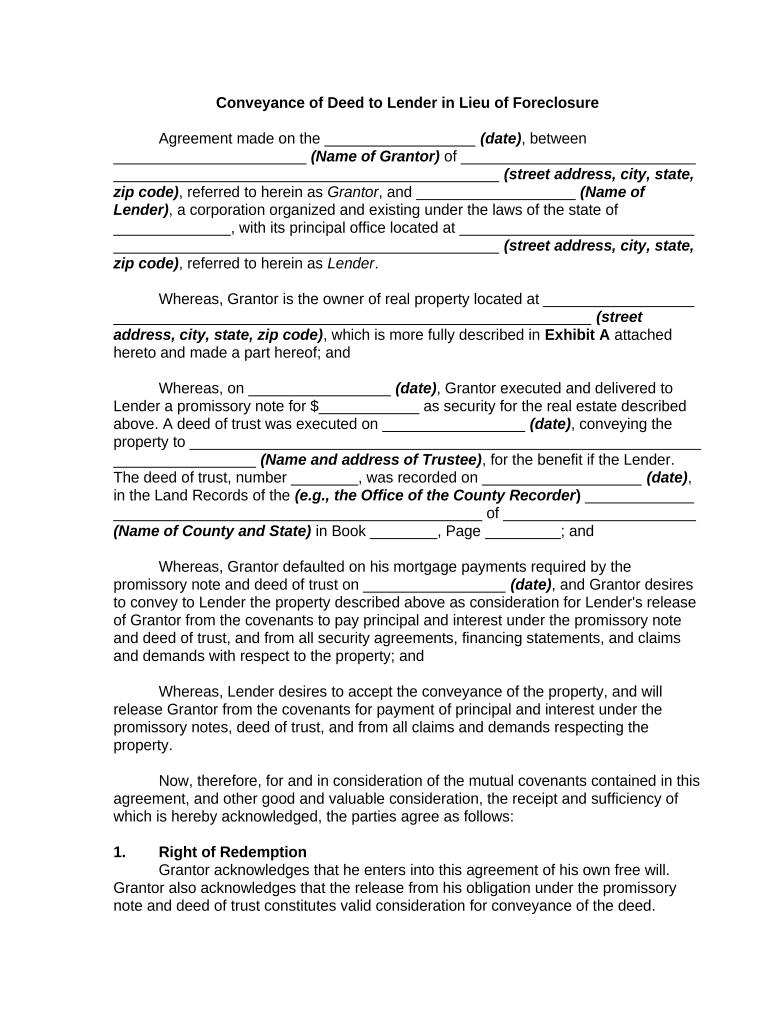
A Deed in Lieu Form is a legal instrument used when a borrower voluntarily transfers ownership of real property to a lender to satisfy a mortgage or debt and avoid foreclosure. The document records the transfer of title and typically includes representations about liens, encumbrances, and the condition of title. It may form part of a negotiated loss mitigation agreement and often requires review by title and legal counsel before acceptance. Execution, notarization, recording, and related releases are essential to complete the transaction and protect both parties.

Why a Deed in Lieu Form matters for borrowers and lenders

A Deed in Lieu can provide an out-of-court resolution that ends borrower liability in many cases, expedites transfer of title, and reduces the costs and delays of foreclosure for both parties. Properly drafted forms clarify obligations, protect against future claims, and support clean recording.

Why a Deed in Lieu Form matters for borrowers and lenders

Who commonly completes and signs a Deed in Lieu Form

Each participant has distinct responsibilities: lenders evaluate liens and approvals; borrowers must confirm their authority to convey title; attorneys and title agents ensure recording and release of encumbrances.

  • Lenders and servicers responsible for loss mitigation and title transfer decisions.
  • Borrowers conveying property to satisfy mortgage debt or avoid foreclosure consequences.
  • Real estate attorneys, title companies, and closing agents handling review and recording.

Core elements to include in a professional Deed in Lieu Form

A complete Deed in Lieu Form contains standard legal provisions plus transaction-specific items to ensure clear transfer, address liabilities, and support title recording.

Granting Clause

Clear language conveying title from grantor to grantee, identifying the property by legal description and ensuring the deed transfers all interest the grantor holds.
Consideration Statement

A concise statement of consideration (often nominal or release of debt) describing the exchange that supports the conveyance and explains why the transfer is effective.

Representations and Warranties

Grantor statements about ownership, absence of undisclosed encumbrances, authority to convey, and that no additional liens exist beyond those disclosed.

Release and Indemnity

Terms addressing whether the lender releases borrower from deficiency, any indemnities, and how subsequent claims will be handled between parties.

Title Matters

Requirements for title search, any cure obligations, handling of subordinate liens, and conditions precedent for lender acceptance of the deed.

Execution and Recording

Notary acknowledgment, witness requirements where applicable, signature blocks, and instructions for timely county recording to perfect transfer.

Essential information fields to collect

Grantor Name: Full legal name
Grantee Name: Lender or servicer legal name
Property Description: Lot and parcel ID
Mortgage Reference: Loan account number
Consideration: Value or debt release
Execution Date: MM/DD/YYYY

Step-by-step: completing the Deed in Lieu Form

Follow these steps in sequence to prepare, execute, and record a valid deed in lieu transaction.

  • 01
    Prepare draft: Insert full legal names and the property legal description.
  • 02
    Resolve liens: Obtain title report and address subordinate liens or conditions.
  • 03
    Obtain approvals: Lender loss-mitigation and counsel sign-off are required.
  • 04
    Execute and record: Sign before a notary, satisfy witness rules, and record in county.

How to configure an online Deed in Lieu workflow

Set up the document template so signatures, notarization, and title attachments proceed reliably in an electronic workflow.

Field Configuration
Legal Description Use locked multi-line text; require upload of legal description PDF if long
Signature Fields Place grantor and grantee signature and date fields; enable signer authentication
Notary Block Include acknowledgment block and conditional visibility for RON or in-person notary
Attachments Require title report and payoff statements as mandatory uploads

Where to send, record, and archive the completed deed

Understand the routing points after execution so the transfer is effective and public records are updated.

  • Title Company: Review and clear title issues prior to recording
  • County Recorder: Record the deed in the county where the property is located
  • Lender Records: Lender retains executed originals and loan file updates
  • Borrower Copy: Provide signed copy to borrower and counsel

Digital signing and submission considerations

Verify county recorder accepts electronic records and choose a platform that preserves tamper-evident audit trails and secure storage.

  • Authentication: Use email plus SMS or knowledge-based verification for higher assurance
  • Notarization Mode: Support RON where permitted; otherwise plan for in-person notarization
  • File Formats: PDF/A or signed PDF for recording and long-term storage

Typical timelines and processing expectations

Timing varies by lender, title clearance, and county recording schedules; plan milestones to avoid lapses and conflicting claims.

Lender review:

30–60 days for loss mitigation approval

Title clearance:

7–21 days to obtain and cure title exceptions

Execution window:

Sign and notarize within agreed acceptance period

Recording:

Recorded typically within 1–14 days after submission

Release issuance:

Reconveyance or lien release issued after recording and final processing

Common mistakes to avoid when preparing a Deed in Lieu

  • Using an incomplete legal description that prevents county recording and delays transfer.
  • Failing to clear junior liens, which can invalidate lender acceptance or create residual liability.
  • Mismatched grantor names between the deed and loan records leading to title defects.
  • Omitting an explicit deficiency release, leaving the borrower exposed to future claims.

Key risks and potential consequences of an incorrect Deed in Lieu

Tax Exposure: Possible taxable cancellation of debt
Deficiency Claims: Lender may pursue remaining debt
Title Defect: Recording rejection disrupts transfer
Fraud Allegations: Incorrect signatures raise fraud risk
Delayed Closing: Outstanding liens block sale or transfer
Credit Impact: Borrower credit and foreclosure history affected

Who is authorized to sign a Deed in Lieu

Individual Grantor

The borrower or property owner must sign if they hold title. If title is held jointly, all listed owners must sign or provide legally sufficient conveyance documentation; a mismatch can prevent recording and cloud title.

Lender Representative

An authorized officer, attorney-in-fact, or servicer representative with documented authority signs for the lender. Corporate signers should include corporate title and evidence of signing authority to ensure enforceability.

Key milestones from negotiation to recorded transfer

A standard milestone sequence clarifies responsibilities and helps track the transaction to completion.

01

Offer Presented

Borrower or counsel submits deed offer and supporting documents for lender review.

02

Lender Acceptance

Lender approves deed subject to title clearance and deficiency terms.

03

Execution & Notarization

Parties sign; notary acknowledgment recorded or RON session completed as allowed.

04

Recording Complete

County recorder files the deed and lender issues any reconveyance or release.

Comparison: eSignature platforms for executing and managing Deed in Lieu forms

Basic pricing and core capabilities vary across eSignature vendors; choose a provider that supports notarization, secure storage, and audit trails at the appropriate compliance level.

signNow DocuSign Adobe Sign PandaDoc HelloSign
Starting Price $8/user/mo $15/user/mo $14/user/mo $19/user/mo $15/user/mo
Free Trial 7-day free trial Trial available Trial available Trial available Trial available
Bulk Send Yes Yes Yes Yes Varies
Audit Trail Yes Yes Yes Yes Yes
HIPAA Compliant Yes Yes Yes Varies Varies

Real-world examples of electronic document workflows

These brief case summaries show how organizations use electronic signatures in real estate and related transactions.

Martin Properties

We processed remote closings online to maintain compliance on mobile devices.

  • Mobile signing reduced in-person requirements during closings.
  • The company completed deed-related transfers with secure audit trails and retained signed records for title and regulatory review following each transaction.

Optica Ventures LLC

The interface simplified document handling for investors and tenants.

  • Quick signer workflows cut turnaround time.
  • Their team relied on consistent templates and secure storage to ensure executed deeds and conveyance documents were accessible to counsel and title agents when needed.

Frequently asked questions about Deed in Lieu Form completion

Answers to common execution, recording, and legal questions to help reduce errors and delays.


Need help? Contact support

be ready to get more
Join over 28 million airSlate SignNow users