Parties
Full legal name and capacity of the person disclaiming (individual, guardian, attorney-in-fact). Include mailing address and contact information for record purposes.
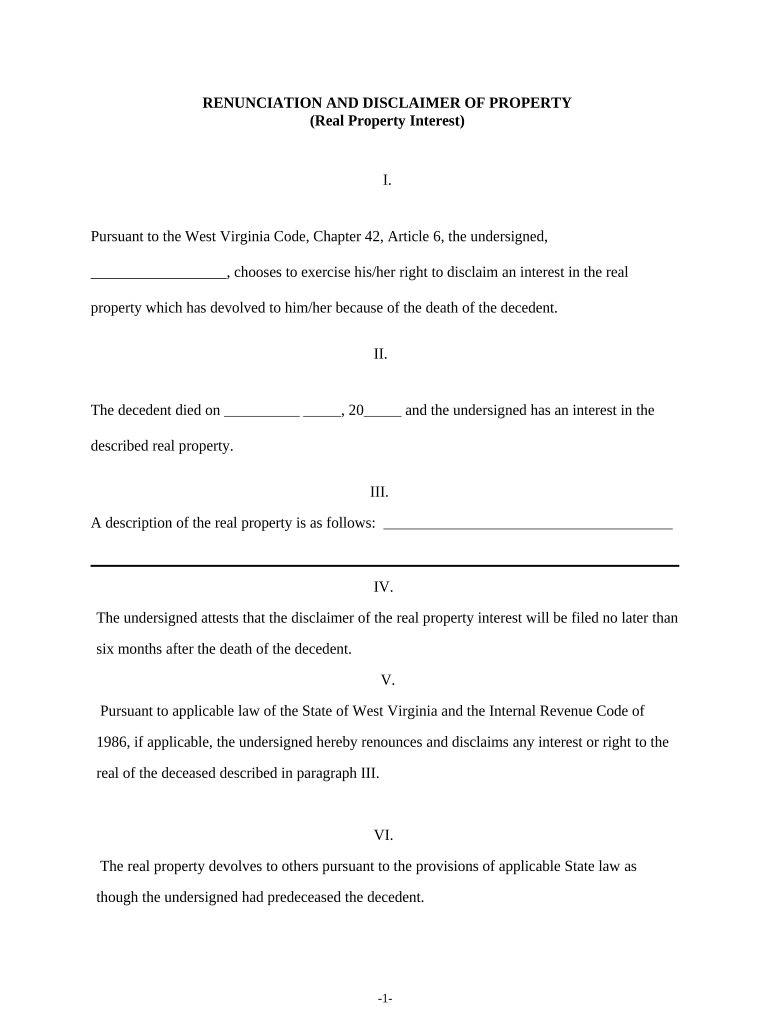
A properly executed disclaimer clarifies ownership, preserves intended distributions, and can preserve favorable federal tax treatment when done within statutory timeframes. It reduces probate disputes and simplifies title work when the disclaimant has no interest in the property.

Common users include estate representatives, heirs, title professionals, and attorneys who need to document an intentional refusal of property rights.
The form is also used by trust officers and legal counsel to align asset flow with decedent intent and with applicable tax or marital deduction planning.
An appointed executor or personal representative may sign a disclaimer on behalf of an estate only when the instrument and state law permit such action; executives often consult counsel to ensure the disclaimer does not conflict with fiduciary duties.
A beneficiary or heir with legal capacity typically must sign their own disclaimer. If a guardian or conservator is involved, state law may require court approval before disclaiming a minor's or incapacitated person's interest.
Full legal name and capacity of the person disclaiming (individual, guardian, attorney-in-fact). Include mailing address and contact information for record purposes.
Specific legal description or street address for real property, or detailed identification of personal property or intangible rights being disclaimed.
A concise clause stating the declarant irrevocably renounces and disclaims all right, title, and interest in the described property without accepting any benefit.
The date the disclaimer is signed or the date specified as effective; this controls timing for tax and title consequences.
Notary acknowledgement or witnesses where state law requires them; include space for notary jurat, seal, and required retention metadata.
Signature block for the disclaimant, printed name, and date. If applicable, space for conservator, guardian, or attorney-in-fact signatures and authority documentation.
| Authentication Method | Email link, SMS code, or stronger KBA for identity assurance |
|---|---|
| Conditional Fields | Show witness or notary fields only when state requires them |
| Template Saving | Save a template with required clauses for consistency |
| Automated Routing | Route copy to title company and counsel automatically |
| Audit Trail Retention | Capture timestamps, IP, and signing events for records |
Choose a platform that supports secure e‑signatures, required file formats, and any notarization or witness workflow your jurisdiction requires.
Ensure the platform provides an audit trail and retention options that comply with ESIGN and UETA requirements and with any sector-specific rules such as HIPAA when applicable.
Typically within 9 months after decedent's death (IRC §2518) to preserve federal tax treatment
Record disclaimers affecting real property quickly to protect priority
File with probate court when local rules require notice or docketing
Deliver disclaimers to trustee according to trust procedures
County recording times vary; plan for local delays
| signNow | DocuSign | Adobe Sign | PandaDoc | HelloSign | |
|---|---|---|---|---|---|
| Starting Price | $8/user/mo | $15/user/mo | $14/user/mo | $19/user/mo | $15/user/mo |
| Free Trial | 7-day free trial | Varies | Varies | Varies | Varies |
| Bulk Send | Yes | Yes | Yes | Yes | No |
| Audit Trail | Yes | Yes | Yes | Yes | Yes |
| HIPAA Compliant | Yes | Yes | Yes | No | No |
A beneficiary declines a life estate that would disqualify another tax election
A recorded cloud on title is traced to a potential successor who refuses interest