Establishing secure connection…Loading editor…Preparing document…

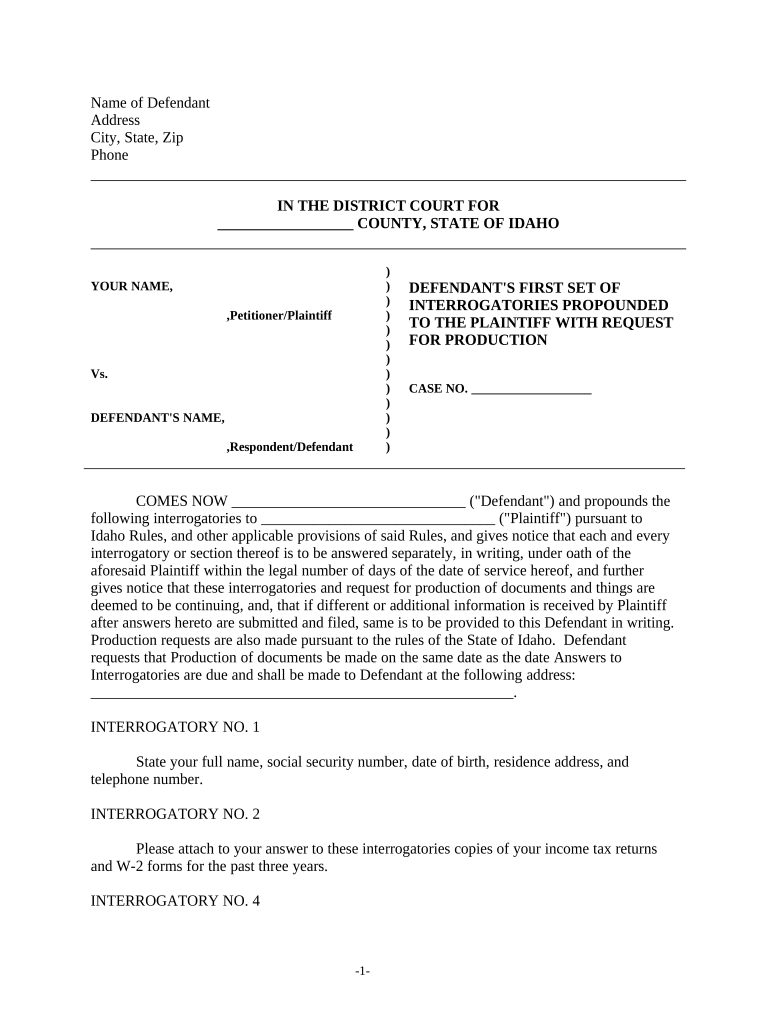
Discovery Interrogatories from Defendant to Plaintiff with Production Requests

This template is fully customizable. Edit the text, fill out the fields, and send it for signature. Give it a try!
Discovery Interrogatories from Defendant to Plaintiff with Production Requests

What this Discovery Interrogatories Package Is and When it Applies

Discovery Interrogatories from Defendant to Plaintiff with Production Requests is a combined set of written questions and document-production demands that a defendant serves on a plaintiff during civil litigation. It asks the plaintiff to answer specific fact-based questions under oath and to produce documents, electronically stored information, and tangible items relevant to claims or defenses. This package follows civil discovery procedures, integrates written interrogatories with Rule 34-style production requests, and is typically used before depositions or dispositive motions to narrow issues and preserve evidence.

Why serve interrogatories with production requests

Combining interrogatories with production requests clarifies factual disputes early, limits surprise at trial, and creates a contemporaneous record useful for motions and settlement negotiations.

Why serve interrogatories with production requests

Who prepares and responds to these discovery requests

Proper role assignment and collaboration reduce procedural errors and preserve objections and privileges.

  • Defense counsel and litigation teams preparing targeted fact questions and document lists to support affirmative defenses and deny claims.
  • Plaintiff's counsel coordinating document collection, privilege logging, and sworn interrogatory answers under client direction.
  • Paralegals and litigation support staff managing ESI collection, Bates-stamping, and meet-and-confer communications with opposing counsel.

Core elements included in a professional set of interrogatories and production requests

A well-constructed package organizes requests by topic, links questions to specific productions, and includes signature and verification language to comply with discovery rules.

Caption

Complete court caption and case number at the top to ensure proper service and filing alignment across discovery documents.
Definitions

Concise defined-terms section (e.g., 'Document', 'Plaintiff', date ranges) to avoid ambiguity in scope and to streamline responses.

Interrogatories

Numbered, discrete questions limited to permissible counts; each should request specific facts or identify particular transactions or witnesses.

Production Requests

A parallel list of document requests organized by topic with clear time ranges and format instructions for ESI production.

Verification

A sworn verification or signature block for the plaintiff to certify truthfulness under applicable rules and penalties for false statements.

Objection Protocol

Space for objections, privilege logs, and instructions for producing redacted or privileged materials with an accompanying privilege log.

Step-by-step: drafting and serving the combined requests

Follow a measured sequence to draft, review, serve, and track responses to ensure procedural compliance and defensibility.

  • 01
    Plan Topics: Identify key factual issues and relevant date ranges before drafting questions and requests.
  • 02
    Draft Questions: Write clear, narrowly tailored interrogatories that reference defined terms and avoid compound traps.
  • 03
    Format Production List: List document categories and specify ESI format, metadata fields, and privilege logging expectations.
  • 04
    Serve and Track: Serve per court/local rules, log service, and begin calendar for response deadlines and follow-up motions.

Typical discovery flow when combining interrogatories with production requests

A coordinated workflow minimizes redundancy and ensures requests are paired with document categories for coherent responses.

  • Issue Requests: Serve interrogatories and production requests together to align questions with document demands.
  • Plaintiff Response: Plaintiff answers under oath and produces documents or asserts objections and privilege claims.
  • Meet and Confer: Counsel negotiate scope, format, and privilege disputes before seeking court intervention.
  • Motion Practice: If disputes persist, file motions to compel or protective orders under local rules and Fed. R. Civ. P. 37.

Recommended digital workflow settings for preparing and delivering discovery

Configure your document management and e-delivery tools to capture service, timestamps, and version history automatically.

Field Configuration
Document Template Use a template with defined terms and placeholders to keep language consistent across discovery sets.
Version Control Enable automatic versioning to preserve prior drafts and show chain-of-custody for produced documents.
Audit Trail Record sending, delivery, and access events to support service and authentication disputes.
Secure Storage Keep originals in encrypted repositories with restricted access for privilege review.

Digital delivery and eSubmission considerations

Use systems that produce tamper-evident signed copies and exportable audit records to support admissibility and service proof.

  • File Formats: PDF, native ESI, or loadfiles preferred.
  • Authentication: Email delivery + audit trail or stronger MFA when required.
  • Integration: Connect to e-discovery and review tools for production.

Common deadlines and how they affect response timing

Observe federal and local deadlines; early calendar management reduces motion practice and waiver risk in discovery disputes.

Federal Response Time:

Fed. R. Civ. P. 33(b)(2) generally requires answers within 30 days after service.

Production Timing:

Fed. R. Civ. P. 34 allows 'reasonable time' for ESI production; specify format and timelines in requests.

Interrogatory Limits:

Fed. R. Civ. P. 33(a) limits parties to 25 interrogatories unless court orders otherwise.

Extensions:

Agreed stipulations or court orders can extend deadlines; document any agreements in writing.

Motion Practice:

Meet-and-confer requirements typically precede motions to compel under Fed. R. Civ. P. 37.

Key milestones in a discovery timeline

Track these milestones sequentially from service to final production to ensure compliance and timely remedies.

01

Service of Requests

Date defendant serves interrogatories and production requests on plaintiff.

02

Response Deadline

Plaintiff's answers and initial production due under applicable rules.

03

Supplemental Production

Ongoing duty to supplement responses as new information emerges.

04

Meet-and-Confer

Counsel negotiate scope and resolve disputes before filing motions.

Common drafting and service mistakes to avoid

  • Overbroad requests that lack date ranges or defined terms invite objections and will be narrowed by courts.
  • Vague interrogatories that ask for 'all facts' are often objected to; specify transactions, dates, or witnesses.
  • Failing to specify production format for ESI causes disputes and may force re-production in an agreed format.
  • Neglecting to include a verification or signature block can render interrogatory answers procedurally defective.

Consequences of improper drafting, service, or noncompliance

Sanctions: Court may impose monetary or evidentiary sanctions under Fed. R. Civ. P. 37.
Motion to Compel: Opposing party can seek an order compelling answers or production.
Adverse Inference: Judges may allow adverse inference or strike defenses for spoliation.
Waiver: Late or incomplete responses can result in waiver of arguments or evidence.
Privilege Loss: Failure to timely log privileges can be treated as waiver.
Increased Costs: Motion practice and re‑production increase attorney fees and court costs.

Security and compliance notes for handling produced materials

Encryption: TLS 1.2/1.3 transit; AES-256 at rest.
Audit Trail: Detailed logs of access and service events recommended.
HIPAA: Use BAA and redact PHI when producing healthcare records.
21 CFR Part 11: Consider electronic signature controls for FDA-regulated records.
SOC 2: SOC 2 Type II reports support vendor trust and security posture.
ESIGN/UETA: Electronic signatures are enforceable under ESIGN and UETA.

Real-world eSignature use examples for document-heavy workflows

These examples show how organizations use electronic tools to manage signed records and expedite document exchange.

Optica Ventures LLC — COO

Optica adopted digital signing for routine agreements to reduce turnaround time and administrative steps.

  • The interface is simple and easy-to-use for our team; more importantly, it is just as easy for our customers.
  • Their experience shows that reliable digital processes reduce manual handoffs, improving traceability and reducing time spent chasing signatures and copies.

Martin Properties — Founder

A real estate operator moved lease and consent forms online to close transactions without in-person meetings.

  • I can process and execute all of these documents online with 100% compliance and built-in security.
  • This shift decreased physical paperwork, sped up execution, and preserved audit evidence for later disputes or title reviews.

Practical tips to draft enforceable and efficient discovery requests

Adopt these best practices to reduce objections, streamline meet-and-confer negotiations, and limit motion practice.

Use Defined Terms
Define key terms and date ranges up front to prevent overbreadth objections and to make responses easier to search and produce.
Limit Scope
Target requests to specific transactions, documents, or custodians; overly broad requests are frequently narrowed or denied.
Specify ESI Format
State the native or image format, required metadata fields, and any preferred loadfile to avoid re-production disputes.
Preserve Evidence
Issue preservation notices and litigation holds concurrent with discovery to prevent spoliation and adverse rulings.

Comparison of common eSignature vendors relevant to discovery workflows

Vendor pricing and feature availability vary; the table summarizes starting price, trial terms, bulk-send capability, audit trail, HIPAA compliance, and envelope limits.

signNow DocuSign Adobe Sign PandaDoc HelloSign
Starting Price $8/user/mo $15/user/mo $14/user/mo $19/user/mo $15/user/mo
Free Trial 7-day free trial Varies Varies Varies Varies
Bulk Send Yes (Business Premium) Yes Yes Yes No
Audit Trail Yes Yes Yes Yes Yes
HIPAA Compliant Yes (BAA) Yes Yes No No
Envelope Cap No cap 100 envelopes/user/year limit Varies Varies Varies

Frequently asked questions about interrogatories and production requests

Answers to common procedural and practical questions about drafting, serving, and responding to combined interrogatories and production requests.


Need help? Contact support

be ready to get more
Join over 28 million airSlate SignNow users