Establishing secure connection…Loading editor…Preparing document…

Discovery Interrogatories from Plaintiff to Defendant with Production Requests

This template is fully customizable. Edit the text, fill out the fields, and send it for signature. Give it a try!
Discovery Interrogatories from Plaintiff to Defendant with Production Requests

What this set of discovery interrogatories and production requests is

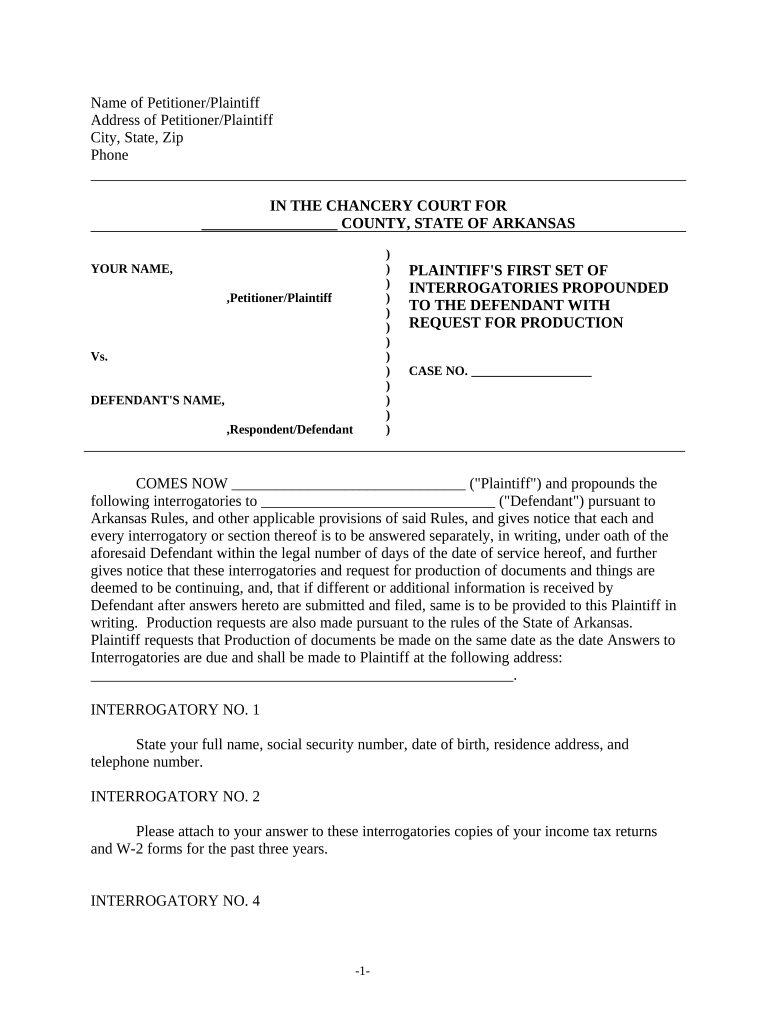
This document is a combined set of written interrogatories served by a plaintiff on a defendant that asks numbered factual questions and concurrently requests documents and other tangible things for inspection or copying. It follows the structure used in civil litigation to obtain information pretrial under Fed. R. Civ. P. 33 and Fed. R. Civ. P. 34. The form includes instructions, definitions, discrete interrogatory questions, requests for production, a verification clause, and a certificate of service. It is suitable for state and federal court practice with local-rule adjustments.

Why a well-prepared set of interrogatories and production requests matters

Clear interrogatories and production requests narrow issues, preserve evidence, reduce surprise at trial, and create a written record usable for motions, depositions, and trial preparation.

Why a well-prepared set of interrogatories and production requests matters

Who prepares and responds to these discovery documents

Accurate drafting and careful responses reduce dispute, minimize motion practice, and support efficient case management.

  • Plaintiff counsel: Drafts targeted questions to establish liability and damages.
  • Defense counsel: Coordinates fact collection, prepares objections, and signs verifications.
  • Corporate representatives: Provide documented answers after reasonable investigation and review.

Typical signers and document owners

Plaintiff Attorney

Responsible for drafting interrogatories and production requests tailored to claims alleged; ensures compliance with court rules and service requirements, and certifies good-faith content before service.

Defendant Representative

Answers under oath after reasonable inquiry, coordinates custodians for document production, and signs the verification attesting to the accuracy of the response.

Core components of a professional interrogatories-with-production package

A complete packet groups definitions and instructions, numbered interrogatories, document requests, verification, and a certificate of service to clarify scope, preserve objections, and show proof of delivery.

Caption & Docket

Court name, case caption, and docket number placed at the top so the document is properly routed and filed in the correct matter.
Definitions & Instructions

Defined terms and instructions narrow scope, set date ranges, identify custodians, and specify how to interpret means and includes in all requests.

Interrogatories

Numbered, discrete questions requesting factual answers and identification of witnesses, documents, and communications relevant to claims or defenses.

Requests for Production

Specific requests for documents, electronically stored information, and tangible items, with format and custodial specifications.

Verification

A signed declaration under penalty of perjury confirming that the responses are true and made after reasonable investigation.

Certificate of Service

Shows how and when the set was served on opposing counsel (mail, hand, email where permitted) and is required for proof of service.

Step-by-step: preparing and serving the interrogatories and production requests

Follow a methodical sequence to prepare, finalize, and serve discovery while preserving privileges and meeting court rules.

  • 01
    Draft: Compose definitions, instructions, interrogatories, and production requests.
  • 02
    Review: Confirm scope, privilege language, and client input; conduct privilege log plan.
  • 03
    Serve: Serve per applicable rules (mail, hand, or agreed electronic service).
  • 04
    Follow Up: Track response deadline and prepare meet-and-confer if responses are inadequate.

Where to send or file the interrogatories and requests

Interrogatories are served on opposing counsel or unrepresented parties; certain filings (motions) go to the court clerk. Method depends on local rules and service agreements.

  • Service on Counsel: Typically via agreed email, mail, or hand delivery to opposing counsel's address.
  • Service on Party: Serve the party directly if unrepresented, following state or federal service rules.
  • Filing with Court: Do not file routine discovery responses; file only motions or privileged logs when required by court rule.
  • Proof of Service: Complete and retain a certificate of service showing date, method, and recipient details.

Configuring an online workflow for drafting and sending discovery

Set up templates, signer roles, production formats, and reminders when using a digital platform to prepare and serve discovery.

Field Configuration
Template Name Create a reusable case-specific template
Signer Role Assign Plaintiff Counsel or Defendant Representative roles
Document Format Choose PDF/A or searchable PDF for ESI
Notifications Enable reminders for service and response deadlines

Digital delivery, signing, and format considerations

Ensure the platform captures robust audit trails and stores copies in a secure repository to support admissibility and chain-of-custody needs.

  • File Formats: PDF, searchable PDF, and DOCX supported for drafting and production
  • Authentication: Email/SMS codes, account logins, or stronger ID when court requires higher assurance
  • Integrations: Connectors for document management and case systems (CRM, NetSuite, Google Workspace)

Typical deadlines and timing expectations for responses

Standard federal and many state rules set a 30-day deadline to answer interrogatories and produce documents after service unless the parties or court order specify otherwise.

Response Window:

30 days after service is the common default deadline

Extended Time:

Agreed extensions or court order may alter the 30-day period

Requests for Production:

Usually 30 days; format of ESI should be specified

Meet-and-Confer:

Confer before motion practice to try to resolve disputes

Motions to Compel:

File after meet-and-confer and per local-rule timing requirements

Key milestones from drafting to motion practice

Track milestone dates to avoid waiver or default and to preserve rights to compel production if necessary.

01

Drafting Complete

Finalize questions, definitions, and production items before service

02

Service Date

Service date triggers the response deadline clock

03

Response Due

Responses due (commonly 30 days) unless extended

04

Motion to Compel

After meet-and-confer, seek court intervention if responses are deficient

Common drafting and response errors to avoid

  • Overbroad or vague requests that fail to describe documents by category, custodian, and date range
  • Failing to include a verification or signing block that results in unverified or noncompliant answers
  • Improperly withholding responsive documents without a privilege log or specific legal grounds for each item
  • Missing service or proof-of-service details that cause disputes over when deadlines began

Security and compliance elements to include or confirm

Encryption: TLS 1.2/1.3; AES-256 at rest
Audit Trail: Timestamps, IP, user actions recorded
Access Controls: Role-based permissions and logging
HIPAA BAA: Execute BAA when PHI is involved
Retention: Preserve originals and change logs
Authentication: Multi-factor options available

Potential consequences from incorrect or late responses

Sanctions: Court may impose monetary or evidentiary sanctions
Adverse Inference: Court can presume missing evidence harms the party
Waiver: Failing to timely object can waive certain defenses
Contempt: Refusal to comply may lead to contempt findings
Costs: Responding party may be ordered to pay fees
Delay: Late responses impair case strategy and trial preparation

How interrogatories compare with other common discovery requests

Interrogatories, requests for production, and requests for admission serve different functions; choose the tool that best elicits the needed facts or documents.

Criteria Interrogatories Requests for Production Requests for Admission
Purpose fact answers documents/esi admit or deny statements
Typical Deadline 30 days 30 days 30 days
Format written answers produce or inspect written admissions
Best Use identify facts and witnesses gather evidence narrow disputed facts

eSignature pricing and feature comparison for preparing and serving discovery documents

Compare common vendor starter pricing and core features relevant to legal discovery workflows; signNow is listed first per vendor ordering rules.

signNow DocuSign Adobe Sign PandaDoc HelloSign
Starting Price $8/user/mo $15/user/mo $14/user/mo $19/user/mo $15/user/mo
Free Trial 7-day free trial Varies by vendor Varies by vendor Varies by vendor Varies by vendor
Bulk Send Yes Yes Yes Yes No
Audit Trail Yes Yes Yes Yes Yes
HIPAA Compliant Yes Yes Yes No No

Examples of how teams use interrogatories with production requests

Two brief examples show common practical uses and outcomes from well-crafted discovery requests.

Case Study 1

A plaintiff used narrowly tailored interrogatories to identify key custodians and documents

  • The defendant produced emails tied to the claim
  • That targeted production enabled focused depositions and avoided broad motion practice, reducing time and expense.

Case Study 2

A defendant supplemented responses with a privilege log and clawback protocol

  • The plaintiff accepted limited production pending review
  • The parties avoided a costly motion to compel and the court approved the agreed protocol.

Frequently asked questions about using interrogatories and production requests

Answers to common procedural and practical questions about drafting, serving, objecting, and responding to interrogatories and production requests.


Need help? Contact support

be ready to get more
Join over 28 million airSlate SignNow users