Establishing secure connection…Loading editor…Preparing document…

Letter Regarding Distribution of Estate Assets

This template is fully customizable. Edit the text, fill out the fields, and send it for signature. Give it a try!
Letter Regarding Distribution of Estate Assets

What a Letter Regarding Distribution of Estate Assets Is

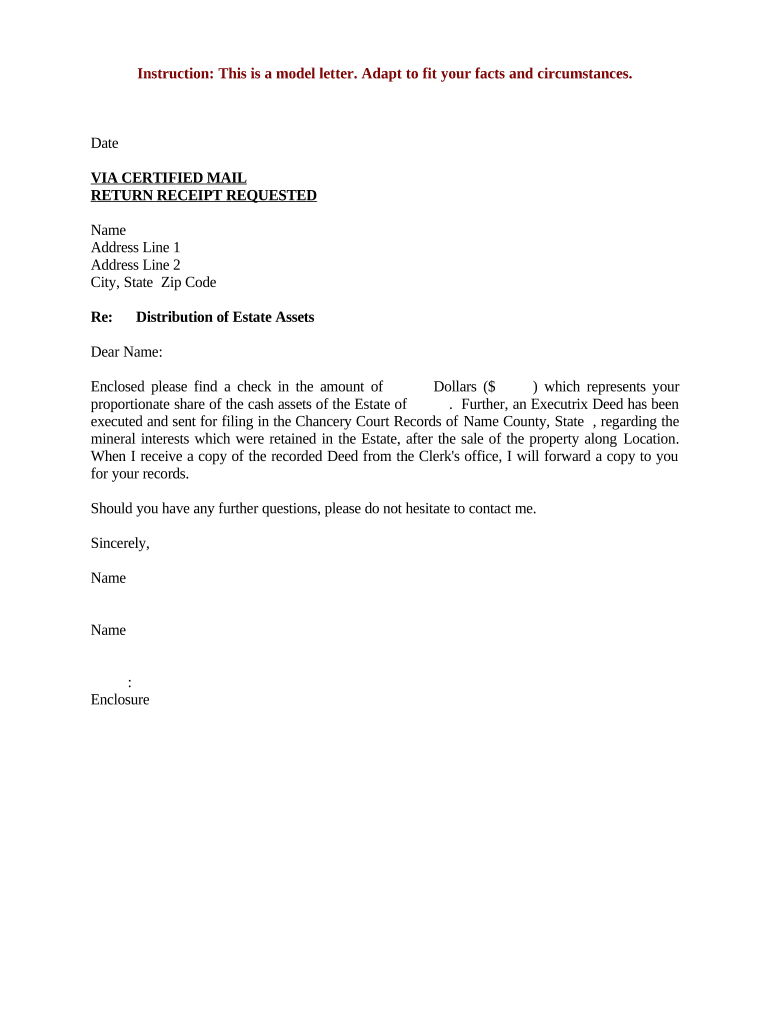
The Letter Regarding Distribution of Estate Assets is a formal written notice prepared by an executor, personal representative, or estate attorney that documents how a decedent’s property will be allocated to beneficiaries. It typically summarizes the estate inventory, identifies recipients and allocation amounts or percentages, and explains timing and any holdbacks for taxes or creditor claims. The letter often accompanies account statements, deeds, or a final accounting and helps institutions and beneficiaries understand the executor’s planned actions while creating a clear record for the estate file.

Why This Letter Matters for Estate Settlement

Use this letter to document the executor’s distribution decisions, reduce beneficiary disputes, provide a clear record for accounting and tax purposes, and create an auditable communication trail for institutions handling transfers.

Why This Letter Matters for Estate Settlement

Who Prepares and Receives This Letter

Executors, trustees, estate attorneys, and personal representatives commonly prepare and send this letter when closing an estate.

  • Individual beneficiaries entitled to cash, real property, or in-kind distributions under the will or intestacy.
  • Executors, personal representatives, and estate attorneys responsible for preparing final accounting and distributing assets.
  • Banks, brokerages, title companies, and custodians that require written instructions to process transfers or issue checks.

Core Sections to Include in the Letter

A well-structured Letter Regarding Distribution of Estate Assets organizes key details so institutions and beneficiaries can act without ambiguity during estate settlement.

Decedent

Full legal name, date of death, and probate case number if applicable, plus executor contact to link the letter to the estate file and court record.
Estate ID

Estate EIN (if issued), account identifiers, and probate docket number to facilitate transfers and avoid misrouting of funds or assets.

Asset Inventory

Concise list by category (cash, securities, real property, personal property) with values, locations, and any known liens or encumbrances noted.

Distribution Schedule

Clear mapping of each asset or cash amount to beneficiary names, relationship, and method of transfer (check, wire, deed), including percentages where applicable.

Conditions & Reserves

Detail contingencies, creditor holdbacks, tax reserves, and any timing conditions that must be satisfied before final distributions occur.

Signatures

Executor signature, printed name, and date; include attorney contact and add notary or witness blocks if state law or institutional policy requires authentication.

Required Information to Include

Executor: Name and contact details
Decedent Info: Full legal name and date of death
Beneficiaries: Names, addresses, and relationships
Asset List: Type, description, and location
Amounts: Monetary values or percentages to distribute
Supporting Docs: Account statements, deeds, tax forms

Step-by-Step: Preparing and Delivering the Letter

Follow these sequential steps to accurately prepare, review, and deliver a compliant Letter Regarding Distribution of Estate Assets to beneficiaries and institutions.

  • 01
    Gather Records: Collect wills, probate docket, account statements, and title documents.
  • 02
    Draft Letter: List assets, allocations, reserves, and any contingencies clearly.
  • 03
    Review with Counsel: Have the estate attorney verify legal and tax implications.
  • 04
    Send & Track: Deliver to beneficiaries and institutions; retain proof of delivery.

How to Configure an Online Distribution Letter Workflow

Configure an online template and routing workflow to automate repeated Letters Regarding Distribution of Estate Assets for timely, auditable distribution.

Field Configuration
Signer Order Executor first, then beneficiaries for acknowledgement
Notifications Email delivery with read and download receipts
Auth Email authentication with optional SMS code
Attachments Attach final accounting, statements, and deeds

Typical Routing from Draft to Transfer

Typical routing shows how the executor prepares the letter, secures approvals, and issues instructions to custodians for final asset transfers.

  • Prepare: Draft letter and attach supporting statements.
  • Approve: Attorney or court-approved accounting review.
  • Deliver: Send to beneficiaries and institutions with proof.
  • Execute Transfers: Banks and title companies process payments and deeds.

Technical Features to Look For

Choose a platform that supports secure PDFs, tamper-evident audit trails, conditional fields, and optional notarization for estate distribution letters.

  • File Formats: PDF and Word (DOCX) supported
  • Integrations: Bank portals, title services, and CRMs
  • Security: TLS 1.2/1.3 in transit; AES-256 at rest

Timing, Deadlines, and Processing Expectations

Key deadlines and timing expectations set beneficiary expectations and help meet tax, creditor, and probate requirements.

Issue After Inventory:

Send once inventory and appraisal are substantially complete.

Creditor Claim Period:

Wait the applicable state period before final distributions.

Tax Filings:

Coordinate with estate tax, income tax, and information return schedules.

Final Accounting:

Provide summary before court closing or final distribution.

Recordkeeping:

Retain signed letter and proofs for the required retention period.

Common Mistakes to Avoid

  • Omitting probate case references or incorrect estate identifiers leads to misdirected transfers, delays from institutions, and possible reissuance of checks or deeds.
  • Failing to list liens, mortgages, or creditor holds can result in institutions refusing transfers or requiring corrected accounting before honoring distribution instructions.
  • Using ambiguous transfer instructions or vague valuation descriptions creates disputes among beneficiaries and complicates tax reporting for the estate.
  • Delivering letters without retaining proof of delivery, signature, or authentication increases litigation risk and weakens the estate’s audit trail.

Penalties and Risks of Incorrect Distribution Instructions

Wrongful Distribution: Personal liability for executor
Tax Penalties: Late or incorrect filings may incur IRS fines
Breach Duty: Court removal or surcharge
Creditor Claims: Reversal and repayment obligations
Institution Rejection: Banks may freeze accounts
Litigation Costs: Attorney fees and court expenses

How the Letter Differs From Similar Post-Death Documents

Compare the Letter Regarding Distribution of Estate Assets with common alternatives to determine legal effect, filing needs, and when each instrument is appropriate.

Criteria Letter Small Estate Affidavit
Purpose inform & instruct substitute for probate in small estates
Legal Force non-binding instruction statutory affidavit
Notarization often required usually required
Court Filing not typically filed filed with court

Typical Roles Involved in Sending and Processing the Letter

Executor

The executor or personal representative is the fiduciary responsible for final accounting, creditor notifications, and authorizing distributions; they must retain copies of communications and obtain acknowledgements from beneficiaries when appropriate.

Institution Agent

Bank officers, title agents, or brokerage custodians receive the letter and require precise account details, legal documents, and authorized signatures; institutions may insist on notarization, corporate resolutions, or court letters before executing transfers.

Practical Examples of Use

Real-world examples show how secure, auditable letters reduce friction when coordinating asset transfers and title work.

Martin Properties

Martin Properties used electronic letters to manage property transfers after succession, reducing in-person signings and scheduling delays.

  • Faster closings and fewer delays.
  • By sending notarized distribution instructions and attached deeds through a secure e-sign workflow, the firm shortened transfer cycles, improved traceability, and provided beneficiaries a clear written record for accounting and title work.

Fertility Centers of Illinois

Fertility Centers of Illinois centralized administrative correspondence by sending compliant, auditable letters and consent transfers as needed.

  • Improved compliance and tracking.
  • Centralized signed copies and audit trails reduced follow-up requests and ensured institution acceptance when authorizing releases or transfers tied to estate matters.

Frequently Asked Questions and Troubleshooting

Answers to frequent questions about preparing, signing, and delivering a Letter Regarding Distribution of Estate Assets in the U.S.


Need help? Contact support

eSignature Pricing Comparison for Distribution Letters

Vendor pricing and capability comparison for eSignature options commonly used to deliver Letters Regarding Distribution of Estate Assets.

signNow DocuSign Adobe Sign PandaDoc HelloSign
Starting Price $8/user/mo $15/user/mo $14/user/mo $19/user/mo $15/user/mo
Free Trial 7-day trial No No Yes Yes
Bulk Send Yes Yes Yes Yes No
Audit Trail Yes Yes Yes Yes Yes
HIPAA Compliant Yes Yes Yes No No
be ready to get more
Join over 28 million airSlate SignNow users