Caption
Court name, case number, and party names must match the original filing to ensure clerks and enforcement authorities can locate the file.
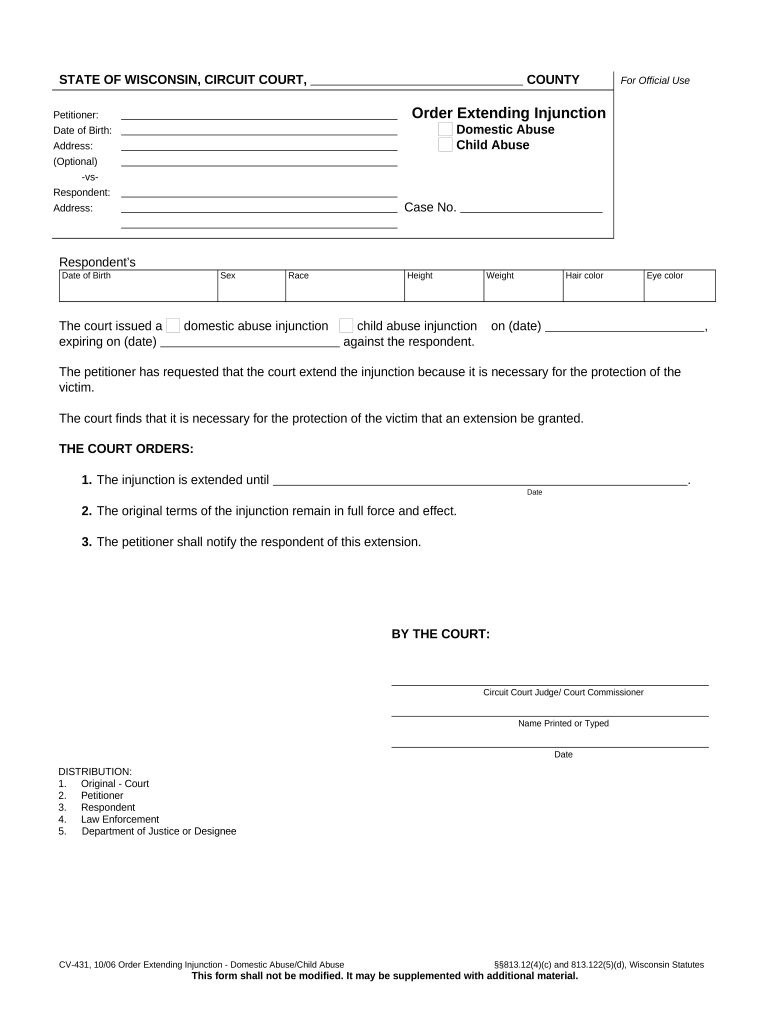
Extending an injunction preserves the status quo, prevents irreparable harm, and maintains judicially ordered protections while parties litigate. The extension enables additional fact-finding or briefing before a final adjudication and reduces the risk that a temporary measure will lapse prematurely, exposing the protected party to immediate harm or irreparable loss.

Common preparers include litigants’ counsel, court clerks, and self-represented parties preparing the extension motion and proposed order before a judge.
Courts may require additional compliance steps such as expedited hearing schedules, electronic proposed-order submission, or service on opposing parties per local rules.
Court name, case number, and party names must match the original filing to ensure clerks and enforcement authorities can locate the file.
Concise summary of prior order, relevant factual developments, and procedural posture to explain why extension is requested.
Cite governing rules and authority (for federal cases, see FRCP 65(b) and related precedent; state citations where applicable).
Clear start and end dates, geographic or conduct limitations, and any narrowed or broadened scope from the original order.
Instructions describing when the order is considered entered and how it must be served on opposing parties.
Language addressing contempt or other remedies for violations to support enforceability.
| Upload Format | Use PDF/A for stable rendering |
|---|---|
| Editable Fields | Add text/date fields for entry and clerk stamps |
| Signer Roles | Assign judge/clerk signature placeholders |
| Authentication | Enable multi-factor for judicial access |
| File Naming | Include case number and 'Proposed Order' |
Courts and clerks increasingly accept electronic proposed orders and e-filed motions but requirements vary by jurisdiction and court level.
Confirm local e-filing parameters and document naming rules before submission; retain a copy of the signed and entered order in the case file.
14 days (federal FRCP 65(b) limit without extension)
File extension motion before original order expires
Courts may set expedited hearings within days
Serve opposing parties promptly after entry
Monitor deadlines for interlocutory appeals
Submit motion and supporting exhibits to court
Provide required service and affidavit of service
Judge hears argument or acts on submitted papers
Clerk stamps the entered order and distribution occurs
| signNow | DocuSign | Adobe Sign | PandaDoc | HelloSign | |
|---|---|---|---|---|---|
| Starting Price | $8/user/mo | $15/user/mo | $14/user/mo | $19/user/mo | $15/user/mo |
| Free Trial | 7-day free trial | Varies | Varies | Varies | Varies |
| Bulk Send | Yes | Yes | Yes | Yes | No |
| Audit Trail | Yes | Yes | Yes | Yes | Yes |
| HIPAA Compliant | Yes | Yes | Yes | No | No |
| Envelope Cap | No envelope cap | 100 envelopes/user/year | Varies | Varies | Varies |
A company sought to extend a TRO after new evidence of misappropriation emerged
An employer requested extension while arbitration was scheduled