Establishing secure connection…Loading editor…Preparing document…

Easement

This template is fully customizable. Edit the text, fill out the fields, and send it for signature. Give it a try!
Easement

What an Easement Is and why it matters

An Easement is a legal right that allows one party to use or access another party's land for a specific purpose while the underlying ownership remains with the property owner. Easements can be affirmative or negative, express or implied, appurtenant (attaching to land) or in gross (personal). They commonly cover rights of way, utility lines, drainage, and access to landlocked parcels. Properly drafted easements define scope, duration, maintenance responsibilities, and recording instructions so that future buyers and title examiners can recognize and enforce the right.

Why a clear Easement protects property value and use

A well-drafted Easement reduces disputes, clarifies maintenance obligations, enables lawful access, and preserves title marketability. It creates predictable rights for current and future owners, lowers litigation risk, and supports financing and development planning when recorded in public land records.

Why a clear Easement protects property value and use

Who typically prepares or signs an Easement

The following parties commonly prepare, review, or sign Easements.

  • Property owners and developers who grant or need access rights over neighboring land for access, utilities, or drainage.
  • Utility companies, municipalities, and service providers that require permanent access or infrastructure placement across private property.
  • Title companies, real estate attorneys, and lenders that draft, review, or require recorded easements during transactions.

Roles overlap: attorneys draft legal language, title companies check recording, and property owners must approve scope and consider long‑term obligations.

Typical signatories and their roles

Grantor — Property Owner

A property owner who conveys the easement interest. The grantor must have authority to encumber title, provide an accurate legal description, and bind successors by recording the instrument.

Grantee — Rights Holder

An individual, utility, or municipality that receives the right to use land. The grantee’s obligations—maintenance, insurance, and scope of use—should be precisely stated to avoid future disputes.

Essential parts of a professional Easement

A robust Easement contains clear identity of parties, a precise legal description, a defined scope of permitted uses, duration or termination terms, consideration if any, and recording/notarization instructions to secure title notice.

Parties Identified

Full legal names of grantor and grantee, including entity type and signing authority to avoid ambiguity.
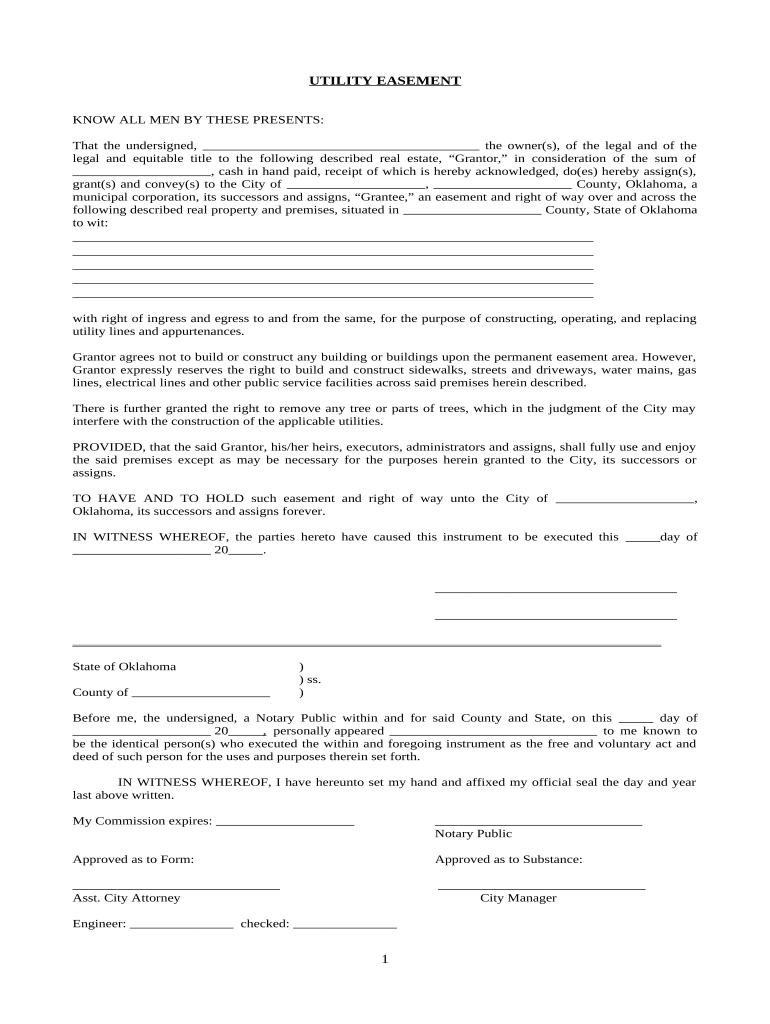
Legal Description

Metes-and-bounds or recorded parcel reference that precisely locates the servient and dominant estates for title clarity.

Scope of Use

Detailed permitted activities, dimensions, equipment limits, and any seasonal or time restrictions to limit disputes.

Duration Terms

Specify term (perpetual, fixed period) and conditions for termination or extinguishment, including abandonment criteria.

Consideration

Monetary amount or other exchange described plainly; note that nominal consideration may support enforceability.

Recording & Notary

Notary acknowledgment and county recording block with clerk instructions so the easement becomes public record.

Step-by-step: creating and executing an Easement

Follow these practical steps to prepare, execute, and record a legally effective Easement.

  • 01
    Gather Title Info: Obtain current deed and legal description.
  • 02
    Draft Terms: Define scope, duration, and maintenance.
  • 03
    Sign and Notarize: All parties sign before a notary.
  • 04
    Record Instrument: File with county recorder; obtain recording number.

Typical digital workflow for an Easement

A digital workflow streamlines drafting, signing, and recording while preserving an audit trail and the option for RON where allowed.

  • Upload Document: Import PDF or DOCX with standard form fields.
  • Place Fields: Add signature, date, and initial fields as needed.
  • Send to Parties: Route by email with signer order or link.
  • Notarize and Record: Apply RON or in-person notary then record.

Configuring an online Easement workflow

Configure authentication, signer order, notarization options, and recording steps to match legal and county requirements.

Field Configuration
Signer Order Set sequence: grantor then grantee then notary.
Authentication Email link plus optional SMS or KBA for verification.
Notarization Step Select RON or in-person notary and capture acknowledgement.
Recording Action Export to recorded PDF and send to county clerk.

Technical needs for eSigning and eRecording

Use a platform that supports PDF/DOCX, secure authentication, and produces a tamper-evident audit trail.

  • File Formats: PDF and DOCX support
  • Integrations: Cloud storage and title systems
  • Authentication: Email, SMS, or KBA options

Timing considerations and typical deadlines

Easement timing depends on transaction pace, lender requirements, and county recording schedules; plan for signing and recording before closing events.

Drafting Window:

Allow several business days for attorney review.

Signing Deadline:

Sign before closing or prior to planned use commencement.

Recording Delay:

County processing may take days to weeks.

Tax Reporting:

Record changes may affect property tax assessments.

Maintenance Notices:

Provide written notice timelines for repairs if required.

Key milestones from negotiation to recorded easement

Track these sequential milestones to ensure enforceability and clear title transfer.

01

Negotiation Complete

Agree on scope, location, and compensation.

02

Draft Execution

Prepare final instrument for signatures and acknowledgements.

03

Notarization

Obtain acknowledgment via in-person or RON depending on jurisdiction.

04

Recording Completed

File with county clerk and update title records.

Common preparation pitfalls to avoid

  • Unclear legal descriptions that reference informal addresses rather than recorded parcel identifiers, causing title exam exceptions and disputes.
  • Overbroad scope language that permits uses beyond intended access or utility placement and invites litigation over permissible activities.
  • Failing to include maintenance or repair responsibilities which leaves parties uncertain about cost allocation and long-term obligations.
  • Neglecting to record the instrument promptly, which leaves downstream purchasers unaware and increases the risk of adverse title claims.

Legal risks and potential consequences

Unrecorded Interest: May be subordinate to later bona fide purchasers
Ambiguous Scope: Triggers disputes and injunction risk
Incorrect Description: Title exceptions and recording rejections
Missing Signatures: Instrument may be void or unenforceable
Lack of Notarization: Recorder may refuse to accept document
Unauthorized Signatory: Enforceability challenged by successor owners

Security and compliance checkpoints for signed Easements

Encryption: TLS 1.2/1.3 in transit
Data-at-Rest: AES-256 encryption
Audit Trail: Timestamps, IP, and action log
HIPAA/BAA: BAA required for PHI contexts
21 CFR Part 11: Supported for regulated records
Access Controls: Role-based permissions and SSO

Comparing eSignature pricing and key features

Price and feature fit matter for high-volume transactions like recorded easements; the table compares starting price, trial availability, bulk send, audit trail, HIPAA support, and envelope caps.

signNow DocuSign Adobe Sign PandaDoc HelloSign
Starting Price $8/user/mo $15/user/mo $14/user/mo $19/user/mo $15/user/mo
Free Trial 7-day free trial, no credit card Varies by plan Varies by plan Varies by plan Varies by plan
Bulk Send Yes Yes Yes Yes No
Audit Trail Yes Yes Yes Yes Yes
HIPAA Compliant Yes Yes Yes No No
Envelope Cap No cap 100 envelopes/user/year Varies by plan Varies by plan Varies by plan

How an Easement differs from a License

Compare common criteria to understand permanence, transferability, and recording needs between an easement and a license.

Criteria Easement License
Transferable often yes generally no
Runs with Land
Requires Writing usually yes sometimes
Recording Typical

Real-world examples of using digital workflows for property documents

These short examples show how digital signing and recording streamline property transactions involving Easements.

Martin Properties — Onsite Closings

Tim Martin, Founder, Martin Properties used online execution to avoid in-person delays and keep closings on schedule.

  • He handled multiple access easements remotely.
  • By combining clear exhibit maps with secure eSign and notary workflows, the firm completed signings faster while maintaining recorded notice to title companies and lenders.

Optica Ventures — Title Coordination

Optica Ventures integrated signed easements into closing binders to reduce title exceptions and lender delays.

  • The team attached recorded instrument PDFs to closing packages.
  • Maintaining a consistent naming convention and audit trail reduced post-closing title queries and supported smooth resale and development permitting.

Practical tips for efficient, accurate Easement preparation

Adopt consistent drafting, review, and recording procedures to reduce rework and title issues during property transfers.

Use Recorded Descriptions
Always copy the legal description from the current deed or survey to avoid errors in parcel identification and recording rejections.
Attach Survey Exhibits
Include a stamped survey exhibit showing the easement location to remove ambiguity about boundaries and access routes.
Specify Maintenance
Allocate maintenance and repair responsibilities, frequency, and cost-sharing to prevent future disputes between parties.
Record Promptly
File the executed instrument with the county recorder immediately to protect against subsequent bona fide purchaser claims.

Frequently asked questions about Easements and common issues

Answers to practical questions about enforceability, revocation, recording, eSigning, and correcting errors when dealing with Easements.


Need help? Contact support

be ready to get more
Join over 28 million airSlate SignNow users