Establishing secure connection…Loading editor…Preparing document…

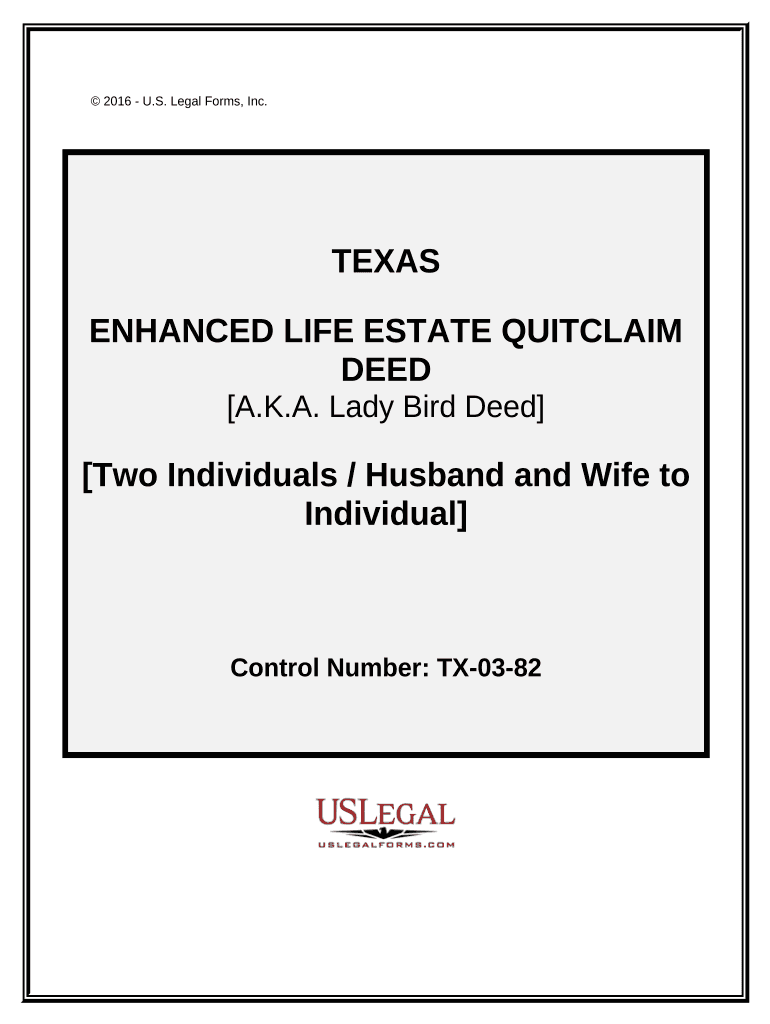
Texas Enhanced Life Estate Quitclaim Deed

This template is fully customizable. Edit the text, fill out the fields, and send it for signature. Give it a try!
Texas Enhanced Life Estate Quitclaim Deed

What the Texas Enhanced Life Estate Quitclaim Deed Is

A Texas Enhanced Life Estate Quitclaim Deed is a conveyance that transfers a property owner’s present interest to a grantee while retaining a life estate for the grantor, and often names one or more remainder beneficiaries who receive ownership automatically at the grantor’s death. It combines the simplicity of a quitclaim deed with enhanced survivorship features and optional retention of limited rights by the grantor. The deed is commonly used to avoid probate, allow limited use during the grantor’s life, and clarify succession without a will or trust probate proceeding.

Why People Choose an Enhanced Life Estate Quitclaim Deed in Texas

This deed helps preserve lifetime use for the grantor, establish successor ownership outside probate, and provide a straightforward transfer mechanism without mortgage lender involvement in many cases.

Why People Choose an Enhanced Life Estate Quitclaim Deed in Texas

Who Commonly Prepares or Signs This Deed

Typical users include property owners planning succession, family members accepting remainder interests, and attorneys preparing conveyances for estate planning.

  • Elder homeowners transferring later ownership while retaining occupancy and bills responsibility.
  • Adult children accepting remainder interest to avoid probate delays at the parent’s death.
  • Estate attorneys drafting clear succession language to complement or replace a basic will.

Step-by-Step: Filling Out a Texas Enhanced Life Estate Quitclaim Deed

Follow these sequential steps to prepare, execute, and record the deed in Texas counties.

  • 01
    Prepare draft: Gather current deed, legal description, and grantee details.
  • 02
    Describe life estate: Draft clear reservation language and remainder direction.
  • 03
    Sign before notary: Grantor signs in presence of an authorized notary public.
  • 04
    Record deed: File with the county clerk in the county where the property lies.

Where to Send and Record the Completed Deed

After execution and notarization, routing the deed properly ensures county indexing and effective transfer of the remainder interest.

  • County Clerk: Record original deed with the county clerk in the property’s county.
  • Title Company: Provide a copy to the title company if title insurance or reconveyance is needed.
  • Successor Owner: Share a recorded copy with the grantee to confirm rights.
  • Tax Authority: Notify the county appraisal district of ownership change if required.

How to Set Up an Online Signing Workflow

Configure a digital workflow to collect signatures, notarization, and a recorded PDF for easy distribution.

Field Configuration
Signature Order Grantor signs first, then witness or notary if required.
Notary Workflow Enable remote notary session or schedule in-person notarization.
Document Versioning Lock final recorded PDF as the authoritative copy.
Distribution Auto-send recorded copy to grantee and title company.

Digital Signing and File Format Requirements

Use a platform that supports notarized workflows, PDF exports, and an auditable signing trail.

  • File types: Support for PDF/A and DOCX for draft and final signatures.
  • Authentication: Email link, SMS code, or stronger multi-factor options.
  • Audit trail: Time-stamped IP and action history for evidentiary support.

Notarization and Witness Sequence for a Valid Deed

Execution must follow a clear signing sequence: grantor signature, witness swearing if required, notary acknowledgement, then recording to perfect the transfer.

01

Prepare Documents

Complete deed text and attach existing legal description before signing.

02

Signer ID

Grantor presents government ID for notary verification.

03

Witness Execution

If state requires witnesses, they sign in the grantor’s presence.

04

Notary Acknowledgement

Notary completes acknowledgement block and affixes seal.

05

Record Original

File the original signed, notarized deed with county clerk.

06

Obtain Recorded Copy

Request certified or stamped recorded copy for the grantee.

07

Update Tax Records

Notify appraisal district of ownership change where required.

08

Store Originals

Keep recorded original with estate records repository.

Consequences and Risks of an Incorrect or Incomplete Deed

Recording Rejection: County clerk may refuse to index an improperly notarized or incomplete deed.
Title Cloud: Errors in names or legal description can create title defects requiring cure.
Probate Exposure: Ambiguous survivorship language can lead to probate disputes.
Tax Impacts: Incorrect consideration or transfer reporting may trigger tax reporting obligations.
Loss of Homestead Protections: Improper transfers may compromise homestead exemptions or creditor protections.
Unintended Ownership: Failure to record timely can allow intervening claims or subsequent liens.

Common Preparation Mistakes to Avoid

  • Using a street address instead of the full recorded legal description causes clerks to delay or reject recording.
  • Failing to sign in the notary’s presence or omitting the notary seal invalidates the acknowledgement for indexing.
  • Mismatching grantor or grantee names with title records creates additional fees and corrective deed requirements.
  • Vague reservation language or failure to describe retained rights leads to disputes about occupation, maintenance, or income entitlements.

Essential Data Elements Required on the Deed

Grantor Name: Full legal name
Grantee Name: Full legal name or entity
Legal Description: Complete recorded description
Consideration: Stated amount or nominal value
Life Estate Terms: Clear reservation language
Notary Block: Acknowledgement plus seal

Core Sections to Include in a Professional Enhanced Life Estate Quitclaim Deed

A clear deed includes identifying information, a precise legal description, explicit life estate reservation language, successor designation, consideration, and a proper notary acknowledgement.

Granting Clause

Concise statement transferring the grantor’s interest via quitclaim, specifying the nature of the conveyance and any limitations on the grantor’s transfer.
Legal Description

Full recorded description of the land that exactly matches the current deed to ensure correct county indexing and avoid ambiguity.

Life Estate Reservation

Explicit language reserving the grantor’s right to occupy, use, or receive income for life; define any conditions or limitations.

Remainder Beneficiaries

Name the person(s) or entities who will automatically receive the property on the grantor’s death and describe distribution percentages if multiple.

Consideration Clause

State the amount or nominal consideration to satisfy recording requirements and support the validity of the transfer.

Acknowledgement

Notary block with signature, printed name, commission expiration, and official seal to comply with county recording rules.

Real-World Examples of How the Deed Is Used

These scenarios illustrate common practical uses of an enhanced life estate quitclaim deed in family and estate planning contexts.

Family Succession Example

A homeowner transfers title to adult children while reserving a life estate to remain in the home

  • Children accept remainder at grantor’s death to avoid probate
  • The recorded deed allowed the family to transfer ownership without a court probate proceeding and simplified tax reporting for the estate.

Asset Protection Example

An owner places property into an enhanced life estate to retain occupancy but name a trust as remainder

  • The trust receives title at death without executor intervention
  • This approach preserved the owner’s lifetime use while ensuring successor ownership processed through the title records rather than probate.

Practical Tips for Accurate and Efficient Completion

Follow these best practices to reduce rework, recording delays, and post-closing disputes.

Verify legal description
Copy the legal description verbatim from the last recorded deed or survey. Even small transcription differences can trigger rejections or require corrective deeds.
Coordinate with lender
Confirm whether mortgage lender approval or payoff is required before transferring title to avoid acceleration or lien issues.
Use precise survivorship language
State unambiguous remainder direction (e.g., 'on the grantor’s death, title shall vest in X, and not by survivorship to others').
Obtain recorded copies promptly
After recording, retrieve a certified copy and distribute to the grantee, title insurer, and tax authority to update records.

eSignature Provider Comparison for Deed Execution and Notarization

Key vendor differences for executing and storing deeds electronically. signNow is listed first per comparison conventions and supports notarized workflows on appropriate plans.

signNow DocuSign Adobe Sign PandaDoc HelloSign
Starting Price $8/user/mo $15/user/mo $14/user/mo $19/user/mo $15/user/mo
Free Trial Yes, 7-day free trial Varies by vendor Varies by vendor Varies by vendor Varies by vendor
Bulk Send Yes (Business Premium) Yes Yes Yes Yes
Audit Trail Yes Yes Yes Yes Yes
HIPAA Compliant Yes Yes Yes No No
Envelope Cap No cap 100 envelopes/user/year Varies by plan Varies by plan Varies by plan

Frequently Asked Questions About the Deed

Answers to common user questions about execution, recording, notarization, and post-recording steps for an enhanced life estate quitclaim deed.


Need help? Contact support

be ready to get more
Join over 28 million airSlate SignNow users