Establishing secure connection…Loading editor…Preparing document…

Ex Parte Motion for Funds for Expert Assistance

This template is fully customizable. Edit the text, fill out the fields, and send it for signature. Give it a try!
Ex Parte Motion for Funds for Expert Assistance

What the Ex Parte Motion for Funds for Expert Assistance Is

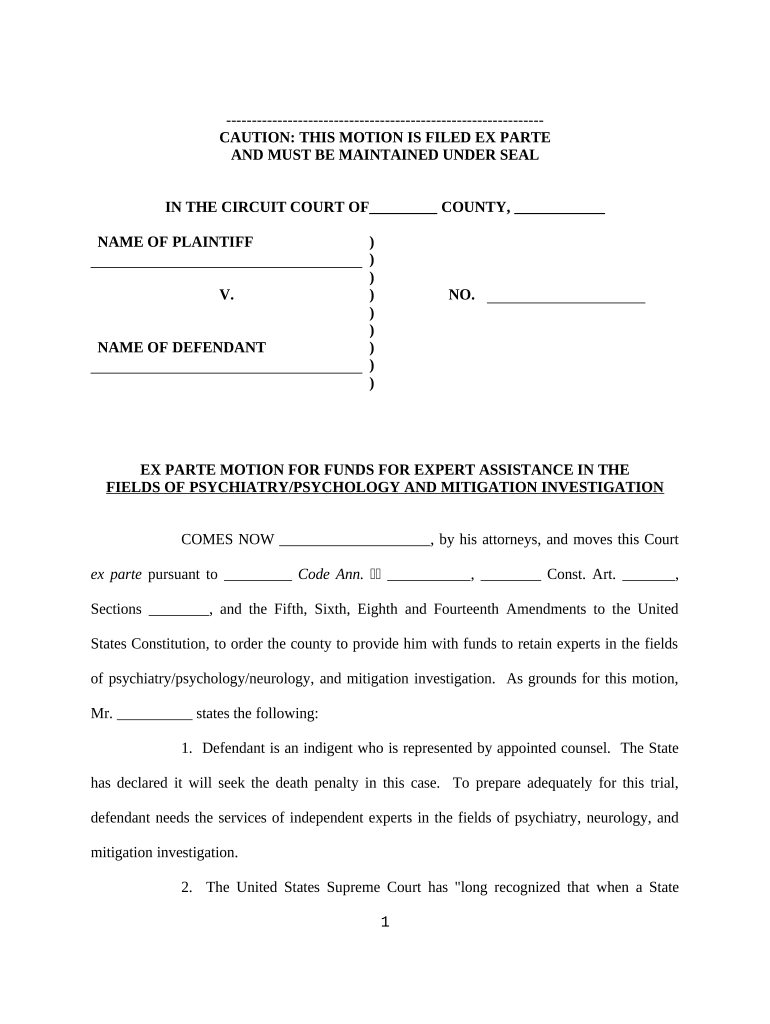
An Ex Parte Motion for Funds for Expert Assistance is a court filing used to request judicial authorization and payment for an expert's services without advance notice to the opposing party. It is most frequently used when disclosure would jeopardize an investigation, prejudice a party's position, or when timing requires expedited review. The motion explains the specific expertise needed, how the proposed expert's work will aid the court or the moving party, and an itemized estimate of fees and costs. Courts weigh necessity, specificity, and potential prejudice when deciding such requests.

Why This Motion Matters and Its Legal Basis

Courts grant funds for expert assistance to ensure a fair adjudicative process when a party cannot reasonably obtain necessary expertise on their own; ex parte filing may be permitted to protect confidentiality or preserve evidence. Electronic filings and preserved records are acceptable under federal e-signature law such as the ESIGN Act (15 U.S.C. ch. 96) and state UETA statutes where adopted, subject to local court rules.

Why This Motion Matters and Its Legal Basis

Who Typically Prepares and Files This Motion

Prosecutors or civil parties may occasionally file similar ex parte requests for narrow reasons, but courts scrutinize ex parte relief and often require narrowly tailored justification.

  • Public defenders and trial counsel who represent indigent clients and need court-funded experts.
  • Private criminal defense attorneys seeking forensic, psychiatric, or technical expert assistance.
  • Defense investigators or mitigation specialists working under court authorization for sensitive matters.

Core Elements to Include in a Professional Motion

A well-structured motion presents the case caption, a clear statement of need, expert qualifications, an itemized budget, and a proposed order, all organized to help the judge evaluate necessity, cost reasonableness, and confidentiality concerns.

Case Caption

Full court name, docket number, judge, and parties. This identifies the proceeding and ensures the motion routes correctly.
Procedural Posture

Briefly summarize the stage of the case and why immediate or confidential expert assistance is required at this point in proceedings.

Statement of Need

Explain the technical, scientific, or specialized issue and why counsel lacks the resources or expertise to proceed without court-funded help.

Expert Identification

Provide the proposed expert's name, professional credentials, CV highlights, and a short explanation of the expert's relevance to the case.

Itemized Budget

List anticipated fees, hours, travel, and expenses with reasonable estimates to allow the court to assess cost proportionality.

Proposed Order

Include a ready-to-sign order that limits scope, preserves confidentiality, and sets payment and reporting conditions for the expert.

Essential Information Required on the Motion

Court Identifier: Court name and docket number
Party Names: Full legal names of parties
Statement of Indigence: If applicable, counsel's financial showing
Expert CV: Expert résumé or qualifications
Budget Estimate: Itemized fees and expenses
Proposed Order: Draft order for judicial signature

Step-by-Step: Preparing and Filing the Motion

Follow a structured sequence to assemble factual support, proposed expert materials, and the narrowly tailored request the court needs to evaluate ex parte relief.

  • 01
    Draft Motion: Describe need, scope, and urgency in clear, concise terms.
  • 02
    Attach Exhibits: Include expert CV, itemized budget, and any supporting declarations.
  • 03
    File Ex Parte: Submit to the clerk or emergency calendar per local rules, often under seal.
  • 04
    Provide Order: Include a proposed order limiting scope and payment terms.

How to Customize and Submit the Motion Online

Set up a secure, auditable workflow for document assembly, review, and e-filing that preserves sealed attachments and retains an audit trail.

Template Name Motion for Expert Funds template
Auto-fill Fields Case caption, docket, counsel info
Authentication Email link or multi-factor signer verification
Attachments Add expert CV and itemized budget
Access Controls Restrict view for sealed filings

Where and How the Motion Is Filed or Submitted

Local court rules determine whether the motion is filed with the clerk, via a court's e-filing system, or presented to chambers under seal; confirm emergency or ex parte procedures in advance.

  • Clerk's Office: File via e-filing or in-person per local rules.
  • Emergency Calendar: Request expedited review if timing is critical.
  • Sealed Filing: File supporting exhibits under seal when confidentiality is required.
  • Judge's Chambers: In some courts, submit directly to chambers for ex parte consideration.

Digital Signing and eSubmission Considerations

Ensure the chosen workflow produces a court-ready PDF, preserves an audit trail, and meets any local e-filing or confidentiality requirements.

  • File Formats: PDF and DOCX accepted by most e-filing systems
  • Integrations: Connectors for Microsoft 365 and NetSuite available
  • Authentication: Supports email links, SMS codes, and SSO

Typical Timelines and Filing Expectations

Timing varies by jurisdiction; when an expert is urgently required, file as soon as practicable and request expedited or ex parte consideration per local rule.

File Promptly:

Submit the motion as soon as need is identified to avoid prejudice.

Request Hearing:

Ask for an expedited or emergency setting if timing is critical.

Service Deadline:

Follow local ex parte rules for service or sealing requirements.

Budget Revisions:

Update estimates if expert scope changes before approval.

Payment Timing:

Court order will specify when funds are to be released.

Common Mistakes to Avoid When Preparing the Motion

  • Submitting a vague or speculative budget instead of an itemized estimate undermines the court's ability to assess reasonableness and can result in denial.
  • Failing to attach the expert's qualifications or CV makes it difficult for the court to evaluate necessity and may prompt requests for supplemental materials.
  • Not following local ex parte or sealing procedures—such as improper service or missing sealing requests—can delay review or expose sensitive information.
  • Requesting overly broad authority (open-ended expert work) rather than narrowly defined tasks may lead the court to limit or deny funding.

Risks and Consequences of an Incorrect or Incomplete Motion

Denial of Request: No funds awarded
Court Sanctions: Possible monetary sanctions
Cost Liability: Moving party may bear expert costs
Trial Delay: Proceedings may be postponed
Evidence Exclusion: Expert work may be limited
Ethics Review: Potential professional misconduct inquiry

Practical Use Cases and Example Scenarios

The following illustrative examples show when and how courts commonly authorize expert assistance under ex parte procedures.

Forensic Analysis Example

A defense lawyer identifies potential digital evidence requiring immediate preservation and analysis to prevent loss.

  • The motion requests a forensic examiner and cost estimate.
  • The court orders a limited forensic image and payment from appointed funds, with the examiner to file a sealed report and billing statements.

Psychiatric Evaluation Example

Counsel suspects the client may lack competency and needs an urgent psychiatric evaluation for imminent hearings.

  • The motion seeks a court-appointed psychiatrist and estimated hours.
  • The judge authorizes a time-limited evaluation, orders confidentiality measures, and approves payment subject to detailed invoices.

eSignature Platform Pricing and Feature Comparison

Common eSignature providers offer differing price points, trial options, and compliance features; compare core criteria relevant to court filing and confidential document workflows.

signNow DocuSign Adobe Sign PandaDoc HelloSign
Starting Price $8/user/mo $15/user/mo $14/user/mo $19/user/mo $15/user/mo
Free Trial 7-day trial Varies Varies Varies Varies
Bulk Send Yes Yes Yes Yes No
Audit Trail Yes Yes Yes Yes Yes
HIPAA Compliant Yes Yes Yes No No

Frequently Asked Questions About the Motion

Answers to common questions about preparing, filing, and preserving ex parte motions for expert funds, including confidentiality and e-signature concerns.


Need help? Contact support

be ready to get more
Join over 28 million airSlate SignNow users