Establishing secure connection…Loading editor…Preparing document…

New York Executor's Deed

This template is fully customizable. Edit the text, fill out the fields, and send it for signature. Give it a try!
New York Executor's Deed

What the New York Executor's Deed Is

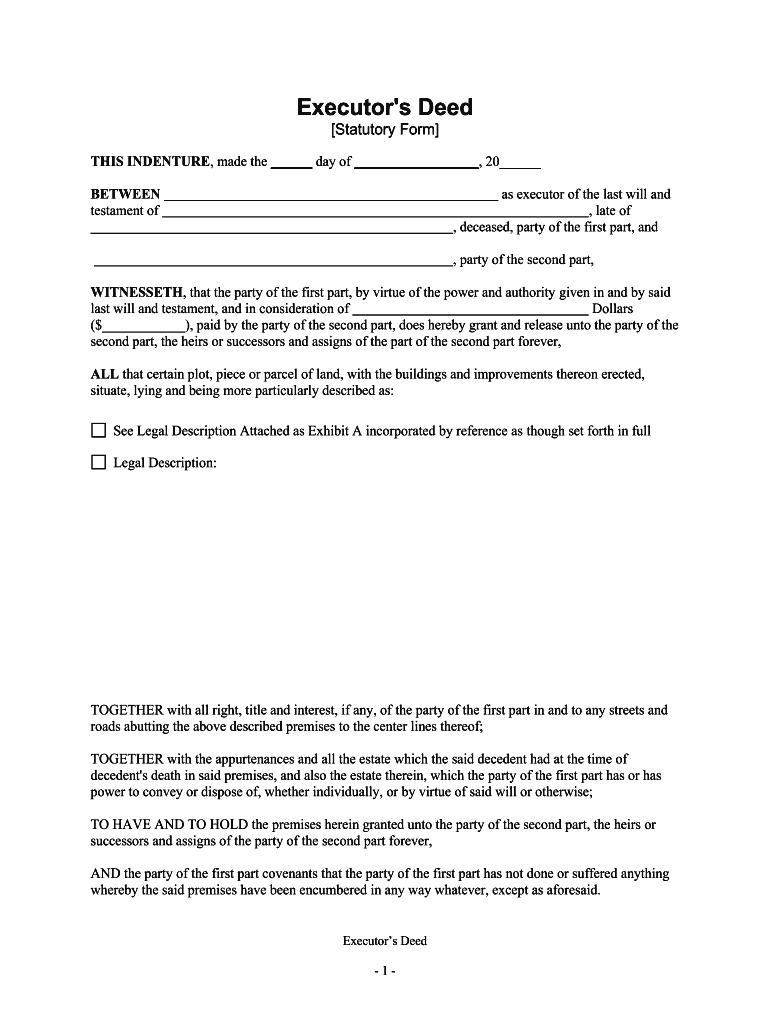
The New York Executor's Deed is a legal instrument used by an executor appointed by a probate court to transfer real property from a decedent's estate to a beneficiary or purchaser. It evidences the executor's authority, recites the probate court grant and decedent details, and conveys the estate's interest in specific real property by legal description. In New York, an executor's deed must be signed by the executor, include a notary acknowledgement, and be submitted for recording in the county where the property is located. Recording completes public transfer and provides constructive notice to third parties.

Why a Proper Executor's Deed Matters

An Executor's Deed clarifies title transfer after probate, protects beneficiaries and purchasers by documenting authority to convey, and allows prompt property recording. Clear execution and accurate legal description reduce risk of recording rejection, title defects, and post-closing disputes in New York estates.

Why a Proper Executor's Deed Matters

Who Prepares and Receives This Deed

Executors, probate attorneys, title companies, and beneficiaries commonly prepare or receive New York Executor's Deeds during estate administration and property transfers.

  • Probate courts and personal representatives who administer estates and need to transfer real property.
  • Title examiners and closing agents validating chain of title and preparing recording documents.
  • Buyers or devisees receiving property who require recorded deed for clear ownership evidence.

Essential Parts of an Executor's Deed

Core elements of a New York Executor's Deed define authority, property description, signatures, and recording details needed to effectuate a valid title transfer.

Executor Capacity

State the executor's full legal name and the probate court citation that grants authority. Include docket number and county to tie the deed to the court's letters testamentary or letters of administration.
Decedent Details

Provide the decedent's full legal name, date of death, and last known address. Accurate decedent identification prevents confusion with similarly named persons and supports clear title transfer.

Legal Description

Insert the property's complete legal description exactly as it appears on prior recorded instruments, including lot, block, subdivision, and metes and bounds where applicable; avoid street-address-only descriptions.

Consideration Clause

Specify the consideration exchanged, if any, or state conveyance is pursuant to estate distribution. Be explicit to satisfy recording office requirements and to clarify tax and transfer tax implications.

Signatures & Notary

Executor must sign in capacity indicated, date the signature, and present the deed to a notary for acknowledgement. Remote online notarization may be allowed where state rules permit.

Recording Information

Identify the county clerk or recorder, include instrument details for indexing, and attach appropriate transfer tax or recording cover sheets required by New York counties for acceptance and proper indexing.

Step-by-Step: Prepare and Record the Deed

Follow these steps to prepare, sign, and record an Executor's Deed for New York property transfers efficiently and accurately.

  • 01
    Prepare Draft: Draft deed with full legal description and executor information.
  • 02
    Obtain Probate: Confirm letters testamentary or administration are certified.
  • 03
    Sign & Notarize: Executor signs; obtain notary acknowledgement per state rules.
  • 04
    Record Deed: Submit to county clerk with transfer tax and fees.

Digital Workflow Configuration for an Executor's Deed

Configure a digital workflow for drafting, review, notarization, and recording to reduce manual steps and support audit trails for an Executor's Deed.

Field Configuration
Authentication Email link or SMS code verification
Notarization In-person or RON where permitted by law
Recording County clerk recording with applicable fees
Storage PDF/A archived with audit trail retention

How the Execution and Recording Flow Works

High-level flow for executing and delivering a New York Executor's Deed from drafting through recording and retention.

  • Draft: Prepare deed using verified legal description and court citation.
  • Sign: Executor signs in presence of notary or via RON if allowed.
  • Record: File with county clerk; pay transfer tax and recording fees.
  • Archive: Store recorded PDF and retain audit trail for compliance.

Technical and Integration Considerations for Deed Execution

Use a platform compatible with PDF, Word DOCX, and county clerk upload requirements and that supports audit trails and secure storage.

  • Integrations: Salesforce, NetSuite, Microsoft 365, Google Workspace integrations
  • File Formats: PDF, PDF/A, DOCX accepted
  • Security: TLS 1.2/1.3 and AES-256 encryption

eSignature Vendor Pricing and Compliance Snapshot

Compare common eSignature vendors for executing and delivering an Executor's Deed; pricing and compliance affect notarization, audit trail, and HIPAA needs.

signNow DocuSign Adobe Sign PandaDoc HelloSign
Starting Price $8/user/mo $15/user/mo $14/user/mo $19/user/mo $15/user/mo
Free Trial 7-day free trial Varies Varies Varies Varies
Bulk Send Yes Yes Yes Yes No
Audit Trail Yes Yes Yes Yes Yes
HIPAA Compliant Yes Yes Yes No No
Envelope Cap No cap 100 envelopes/user/year Varies Varies Varies

Critical Information to Verify

Executor Name: Full legal name as on ID
Decedent Name: Full legal name and date of death
Property Description: Complete legal description, not street address
Probate Citation: Court docket number and county
Consideration: Amount or statement of distribution
Notary Acknowledgement: Signature, notary seal, and date

Common Preparation Pitfalls

  • Using an incomplete legal description or relying on street addresses alone can result in recording rejection and require costly corrective deeds or affidavits.
  • Failing to identify the executor's authority with docket number leads title examiners to request certified copies of letters testamentary, delaying closings and recordings.
  • Omitting a proper notary acknowledgement or using an out-of-state notarization that does not meet New York standards risks refusal by the county clerk.
  • Not accounting for transfer tax forms or exemptions in New York (for example, estate transfers) can create unexpected tax liabilities or processing delays.

Consequences of an Incorrect Executor's Deed

Invalid Conveyance: Deed may be void
Recording Rejection: Missing notary or errors
Title Defect: Cloud on title
Tax Liability: Transfer tax assessed
Probate Delay: Executor authority challenged
Civil Litigation: Beneficiary disputes possible

Supporting Documents to Include

Supporting documents submitted with an Executor's Deed streamline recording and satisfy title company requirements; include certified court papers and tax forms as applicable.

Letters Testamentary

Attach a certified copy of letters testamentary or letters of administration showing executor authority; clerks and title examiners typically require this for indexing and proof.

Probate Court Order

Include any court orders authorizing sale or distribution, particularly where judicial approval of conveyance is required to validate the transfer terms.

Transfer Tax Return

In New York, attach the county transfer tax form and state TP-584 where required; accurate completion avoids recording holds and assessments.

Affidavits & Releases

Provide affidavits (e.g., no lien, surviving spouse) and lien releases to clear potential clouds and expedite title insurer underwriting.

Practical Examples of Executor's Deed Use

Examples illustrate common scenarios where a New York Executor's Deed completes estate transfers, resolves title issues, and supports closings.

Probate Distribution

A personal representative uses an Executor's Deed after probate to transfer a family home to a devisee with clear chain-of-title.

  • Recorded promptly after the probate grant.
  • Using certified letters testamentary, precise legal description, and proper notary acknowledgement minimized delays at the county clerk and ensured title insurance underwriter acceptance without further curative work.

Sale Closing

An executor sold estate property to a third-party buyer and conveyed title via an Executor's Deed prepared for closing documents.

  • Buyer required recorded deed for mortgage funding.
  • Coordinating the deed signing, transfer tax forms, and recording via the county clerk prevented funding delays and allowed lender to release proceeds per closing schedule.

Frequently Asked Questions and Solutions

Common questions about preparing, signing, notarizing, and recording a New York Executor's Deed, plus quick resolutions and references for follow-up actions.


Need help? Contact support

be ready to get more
Join over 28 million airSlate SignNow users