Establishing secure connection…Loading editor…Preparing document…

Florida Motion for Temporary Support and Other Relief

This template is fully customizable. Edit the text, fill out the fields, and send it for signature. Give it a try!
Florida Motion for Temporary Support and Other Relief

What the Florida Motion for Temporary Support and Other Relief Is

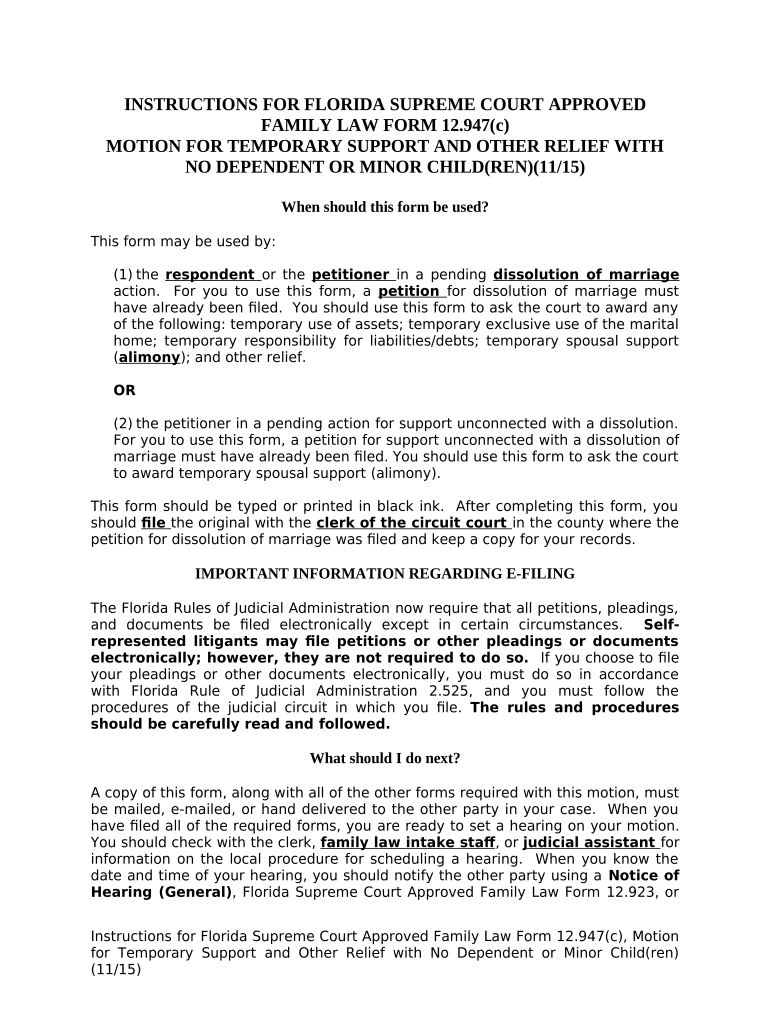
Florida Motion for Temporary Support and Other Relief is a family-court pleading filed to request interim financial orders and related urgencies during pending dissolution, paternity, or support proceedings. Typically submitted to the county circuit court, the motion asks the judge to set temporary child support, alimony, attorney fees, or injunctions while the case proceeds to hearings. Motions must state facts, cite legal grounds, and attach financial affidavits or sworn declarations. Courts may require e-filing through the state portal and compliance with local rules governing service, notice, and evidentiary exhibits.

Why This Motion Matters for Interim Financial and Protective Relief

Use this motion to secure temporary financial relief and preserve living arrangements while a family-law case is pending; it creates enforceable interim orders for support, attorney fees, or exclusive use of a residence, and frames evidentiary issues ahead of final disposition.

Why This Motion Matters for Interim Financial and Protective Relief

Who Typically Files and Responds

Typical filers are petitioners, respondents, or their counsel seeking interim child or spousal support, temporary custody, or emergency relief.

  • Pro se petitioners requesting immediate support and protection without counsel.
  • Family law attorneys filing verified motions, affidavits, and proposed temporary orders.
  • Guardian ad litem or third parties joining for child support or protective relief.

Who Signs and Submits the Motion

Petitioner Pro Se

A self-represented petitioner files the motion to request immediate support and protection; they must compile financial records, follow e-filing rules, and include a clear certificate of service to avoid dismissal or delays in temporary relief.

Family Law Attorney

An attorney prepares verified motions, crafted proposed orders, and a comprehensive exhibit index; the lawyer advises on ex parte thresholds, serves opposing counsel correctly, and uses court-compliant electronic workflows to expedite hearings and reduce procedural risk.

Core Elements to Include in an Effective Motion

Core elements make the motion effective: precise requests, supporting affidavits, statutory citations, notice proof, proposed orders, and clear scheduling language for temporary hearings.

Relief Sought

Clearly list each form of relief sought (child support, alimony, attorney's fees, exclusive use of residence, injunctions) with dollar amounts or specific actions and the legal basis for each request.
Factual Basis

Provide a concise factual narrative describing the parties' financial circumstances, recent income changes, hardship events, and dates for transactions that support urgent temporary relief requested.

Affidavits & Exhibits

Attach sworn financial affidavits, pay stubs, tax returns, bank statements, and declarations from witnesses; label exhibits and paginate attachments to aid the court's review efficiently.

Proposed Order

Include a proposed temporary order with precise findings, dates, payment instructions, custody terms, and implementation provisions the judge can sign to make the relief immediately enforceable pending final hearing.

Service & Notice

Demonstrate proper service on all parties per Florida Rules of Civil Procedure, include certificate of service, and propose expedited service methods when emergency relief or imminent harm is alleged.

Hearing Request

Specify whether an ex parte hearing is requested, provide availability windows, time estimates, and any witnesses who will testify, so the court can schedule a temporary hearing promptly.

Step-by-Step: Prepare, File, and Serve the Motion

Follow these steps to prepare and file a Florida Motion for Temporary Support and Other Relief accurately and efficiently.

  • 01
    Draft Motion: State facts, grounds, and exact relief requested.
  • 02
    Attach Exhibits: Include affidavits, financial documents, and exhibits.
  • 03
    Certificate of Service: Complete and attach proof of service.
  • 04
    File & Serve: E-file with clerk and serve opposing party.

Typical Filing Sequence and Court Interaction

This section outlines filing sequence, service, hearing scheduling, and temporary order entry in Florida courts.

  • Prepare Document: Complete motion and exhibits for filing.
  • E-File: Submit via county e-filing portal per local rules.
  • Serve Opposing Party: Use permitted methods: e-service, mail, or hand delivery.
  • Attend Hearing: Appear for temporary hearing or seek ex parte relief.

Configuring an Electronic Workflow for This Motion

Configure an electronic workflow for drafting, e-signing, notarization, and e-filing while maintaining compliance with court rules.

Workflow Configuration Field Name Example Set to require e-sign, attach exhibits, and route to counsel.
Signer Authentication Requirement (Email|SMS|KBA) Selection Choose email link or SMS code; KBA if required.
Document Visibility and Access Controls Limit downloads, set expiration, and restrict to named signers.
Notary and RON Configuration Options Enable remote notarization where permitted; attach recorded session.
E-Filing and Court Routing Settings Map document to court case type and include docket metadata.

Platform Requirements for Secure Preparation, Signing, and Submission

Ensure your e-signature platform meets courtroom admissibility and data security requirements used when preparing and submitting this motion.

  • File Formats: PDF/A preferred for court filings.
  • Integrations: Connect to e-filing portals and case management.
  • Security Standards: TLS 1.2/1.3 and AES-256 at rest

Required Information and Primary Form Fields

Petitioner Information: Full legal name, DOB, address.
Respondent Information: Full legal name, last known address.
Case Number: Existing docket number if available.
Relief Requested: Specific monetary amounts or actions.
Supporting Documents: Pay stubs, tax returns, bank statements.
Certificate of Service: Who was served, how, and when.

eSignature Pricing and Feature Comparison (signNow first)

Compare common eSignature plan features and starting prices to assess cost and compliance needs for electronic signing and notarization workflows.

signNow DocuSign Adobe Sign PandaDoc HelloSign
Starting Price $8/user/mo $15/user/mo $14/user/mo $19/user/mo $15/user/mo
Free Trial 7-day free trial Varies Varies Varies Varies
Bulk Send Yes Varies Varies Varies Varies
Audit Trail Yes Yes Yes Yes Yes
Envelope Cap No envelope cap 100 envelopes/user/year Varies Varies Varies

Key Timeframes and Deadlines to Observe

Key timeframes for drafting, serving, and seeking temporary relief in Florida family-law proceedings, including emergency ex parte windows.

Document Drafting and Attorney Review Period:

Allow several days to gather financial evidence before filing; expedite for emergencies.

Service Deadline and Permitted Methods:

Serve opposing party immediately after filing; follow Florida service rules.

Ex Parte Emergency Hearing Requests:

Can be requested for imminent harm; provide sworn facts and proposed order.

Temporary Order Entry and Effective Date:

Order will specify start date and payment due dates.

Final Hearing and Review Schedule:

Court sets final hearing; temporary provisions remain until final resolution.

Milestones from Filing to Temporary Order

Sequential milestones show filing, service, hearing, and temporary-order issuance steps in a typical Florida temporary-support matter.

01

Filing Completion

File motion and exhibits electronically; court assigns a docket number.

02

Service and Certificate

Serve opposing party and file certificate of service promptly.

03

Temporary Hearing

Court schedules hearing within days or weeks based on urgency.

04

Order Entry

Judge signs temporary order; clerk posts and parties receive notice.

Best Practices to Improve Success and Reduce Delays

Adopt these practices to reduce objections, speed hearings, and improve enforceability of temporary support orders.

Prepare a Complete Financial Package for Filing
Include recent pay stubs, year-to-date income statements, three years of tax returns if available, bank statements, and a completed financial affidavit. Organize exhibits chronologically and reference them in the motion to help the judge evaluate support needs quickly.
Draft Clear, Specific Temporary Orders for Judicial Signature
Provide a proposed order with explicit findings, payment amounts, due dates, and enforcement language. Judges prefer ready-to-sign orders; a well-drafted proposed order reduces revision time and supports immediate enforceability of temporary relief.
Verify Service Methods and Certificates
File a detailed certificate of service stating who was served, how, and when. Confirm addresses and e-service consent; correct service removes procedural defenses and prevents orders from being overturned due to notice defects.
Confirm E-Filing and Local Rules Before Submission
Before filing, review county clerk or judicial website for document formatting, page limits, redaction requirements, and emergency filing protocols. Adhering to local specifications avoids rejection and speeds issuance of temporary orders when urgency is alleged.

Common Pitfalls to Avoid

  • Failing to attach a complete financial affidavit, including recent pay stubs and tax returns, undermines credibility and can cause the court to deny temporary support requests.
  • Using vague or estimated amounts without documentary proof forces the judge to discount claims and may require a continued hearing for verification.
  • Failing to demonstrate urgency or imminent harm when seeking ex parte relief often results in denial and can delay access to temporary payments or protections.
  • Improper service methods, missing certificate of service, or serving at incorrect addresses can render a temporary order unenforceable or subject to rehearing.

Consequences of Errors or Misstatements

Dismissal Risk: Insufficient facts may lead to dismissal.
Default Orders: Orders can issue without full hearing.
Sanctions: Court may impose fees or sanctions.
Delay in Relief: Errors extend time to resolution.
Service Defects: Invalid service can void orders.
Perjury Exposure: False affidavits carry criminal risk.

Illustrative Examples of How Motions Are Used

Real-world examples show how motions secure temporary support, routine scheduling, and emergency protections under Florida family law.

Custodial Support Motion

A mother filed a motion for temporary child support after the parties separated, documenting income and childcare expenses in detail.

  • Judge issued interim payments within two weeks.
  • The court used the provided pay stubs, tax returns, and a proposed order to craft a time-limited mandate for support; prompt certification of service and clear payment schedule ensured enforceability until final judgment.

Ex Parte Attorney Fees

A spouse seeking emergency attorney fees filed an ex parte motion citing sudden job loss and inability to fund counsel while litigation proceeded.

  • Court granted limited fee advance pending full hearing.
  • Counsel submitted a verified fee affidavit and proposed order; the judge awarded interim fees with repayment conditions tied to final equitable distribution, ensuring counsel could continue representation without prejudicing substantive claims.

Frequently Asked Questions About Florida Temporary Support Motions

Answers to frequent questions about preparing, signing, filing, and serving Florida motions for temporary support and related relief.


Need help? Contact support

be ready to get more
Join over 28 million airSlate SignNow users