Establishing secure connection…Loading editor…Preparing document…
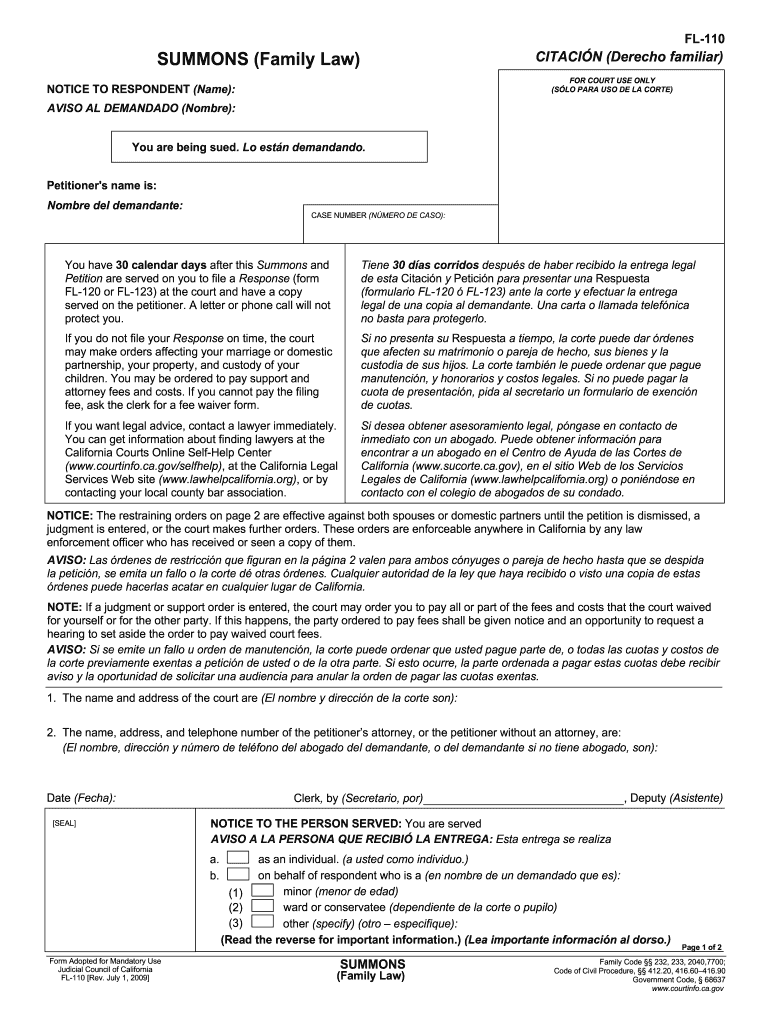
Form FL-110
This template is fully customizable. Edit the text, fill out the fields, and send it for signature. Give it a try!
What Form FL-110 Is and when it’s used
Why accurate completion matters
Using Form FL-110 ensures proper notice to the respondent, starts statutory response deadlines, and creates the court record needed for hearings. Accurate completion reduces the risk of service disputes, default-judgment complications, and clerical rejections that delay case progress.
Who typically completes and relies on Form FL-110
Petitioners, respondents, and counsel use FL-110 as the official summons to begin or respond to family law proceedings and to establish service and calendar timelines.
- Petitioner files the summons and petition to initiate the action.
- Respondent receives the summons and must meet statutory response deadlines or risk default.
- Family law attorneys prepare filings, verify service, and advise clients on procedural options.
Step-by-step: complete, file, and serve FL-110
-
01Prepare Documents: Assemble FL-110 plus any required petition or attachments.
-
02File with Clerk: Submit to county clerk for filing and receive a stamped copy.
-
03Serve Respondent: Arrange personal or substituted service consistent with local rules.
-
04File Proof: File proof of service with the court before scheduled hearings.
How the filing and service flow typically proceeds
-
Draft: Populate form fields accurately and attach supporting documents.
-
E-file or Paper: File via court e-filing portal or deliver to the clerk.
-
Service: Serve per state rules using an authorized server or process.
-
Proof of Service: Complete and file proof of service form with case number.
Recommended settings for digital preparation and e-filing
| Field | Configuration |
|---|---|
| Document Type | Summons (Family Law) — select court form FL-110 |
| Signature Method | Electronic signature allowed if county permits e-filing |
| Date Format | Use MM/DD/YYYY for all date fields to ensure court acceptance |
| Proof Upload | Attach proof of service and stamped filings as separate PDF |
Technical and integration considerations for digital FL-110 workflows
Technical considerations for digital completion, e-signature, and secure transmission when using FL-110 with court e-filing or document exchange.
- File Formats: PDF or PDF/A; preserve form fields
- Authentication: Email link or multifactor methods
- Integrations: Works with common legal platforms
In Transit:
TLS 1.2 / 1.3 encryption
At Rest:
AES-256 encryption for stored data
Audit Trail:
Detailed timestamps, IPs, and actions
Certifications:
SOC 2 Type II, ISO 27001
Regulatory Support:
ESIGN, UETA, 21 CFR Part 11
HIPAA:
BAA available for protected health information
Key legal risks and consequences of errors
Default Judgment:
May be entered if respondent does not respond
Service Defect:
Improper service can void proceedings
Clerical Rejection:
Incorrect filing details may be rejected
Delay in Relief:
Hearing dates and orders delayed
Perjury Risk:
False statements expose to sanctions
Privacy Exposure:
Personal data misfiled without protections
Common preparation pitfalls to avoid
- Incorrect party names or misspellings cause service failures and delays, often requiring amended filings or supplemental notices to correct the record.
- Failing to serve the respondent per statutory methods leads the court to dismiss or to reset hearings until proper service is completed.
- Missing case numbers, unsigned filings, or wrong court locations can cause clerical rejection and require re-filing with additional fees and time.
- Assuming e-signatures are accepted without checking local court or county e-filing rules may result in non-acceptance and process interruption.
eSignature vendor pricing snapshot for preparing and signing FL-110
| signNow | DocuSign | Adobe Sign | PandaDoc | HelloSign | |
|---|---|---|---|---|---|
| Starting Price | $8/user/mo | $15/user/mo | $14/user/mo | $19/user/mo | $15/user/mo |
| Free Trial | 7-day free trial | Varies | Varies | Varies | Varies |
| Bulk Send | Yes | Yes | Yes | Yes | No |
| Audit Trail | Yes | Yes | Yes | Yes | Yes |
| HIPAA Compliant | Yes | Yes | Yes | No | No |
| Envelope Cap | No cap | 100 envelopes/user/year | Varies | Varies | Varies |
Frequently asked questions about Form FL-110
-
Can FL-110 be e-signed?
Yes in most cases. Federal ESIGN (15 U.S.C. ch. 96) and state UETA laws permit electronic signatures when the court and local e-filing rules accept them; always confirm county-specific e-filing and signature acceptance policies first.
-
What happens if respondent does not respond?
If the respondent fails to respond within the statutory period, the petitioner may seek default; courts may enter default judgment following procedural steps. Local rules govern timelines and filing requirements to obtain default relief.
-
How must FL-110 be served?
Service must comply with state statutes and local rules—typically personal service by a nonparty adult, substituted service, or other authorized methods. Always file the required proof-of-service document after completing service.
-
Is notarization required for FL-110?
No, summons forms themselves generally do not require notarization, but associated declarations or proof-of-service affidavits may require notarization in some jurisdictions; verify with the county clerk.
-
How do I correct errors after filing?
File an amended or supplemental form per court procedures and include a declaration explaining the correction. Some errors may require re-filing or a court order to correct the public record.
-
Where to confirm local filing rules?
Consult the county court website, local rules, or the clerk's office. Court self-help centers and published local guides identify e-filing availability, service methods, fee schedules, and specific FL-110 instructions.
be ready to get more
Join over 28 million airSlate SignNow users