Establishing secure connection…Loading editor…Preparing document…

Partnership Amendment

This template is fully customizable. Edit the text, fill out the fields, and send it for signature. Give it a try!
Partnership Amendment

What a Partnership Amendment Is and When it Applies

A Partnership Amendment is a written change to an existing partnership agreement that alters terms such as ownership percentages, management rights, capital contributions, profit distribution, or the admission or withdrawal of partners. It records mutual agreement among partners and clarifies updated responsibilities. Depending on entity type (general partnership, limited partnership, or LLC taxed as a partnership), an amendment may be an internal contract amendment, a filing with the state Secretary of State, or both.

Why Amending the Partnership Agreement Matters

Updating the partnership agreement preserves operational clarity, reduces future disputes, and documents partners’ consent to changed economics or governance. Properly executed amendments protect tax reporting accuracy, maintain enforceability, and—when required—satisfy state filing rules and public-record obligations.

Why Amending the Partnership Agreement Matters

Who Typically Prepares and Signs a Partnership Amendment

After execution, copies are circulated to partners and retained with corporate records; file with the Secretary of State only when entity law requires.

  • General and limited partners who change capital or management rights and must document consent and new terms.
  • Corporate counsel or outside attorneys who draft precise amendment language and confirm compliance with governing documents and state law.
  • CPAs and tax advisors who ensure amendments reflect accurate tax treatment and prepare updated K-1 or reporting guidance.

Core Elements Every Professional Partnership Amendment Should Include

A clear, well-structured amendment identifies the governing agreement, specifies precise changes, sets the effective date, documents approvals, and states governing law to prevent ambiguity and support enforceability.

Preamble

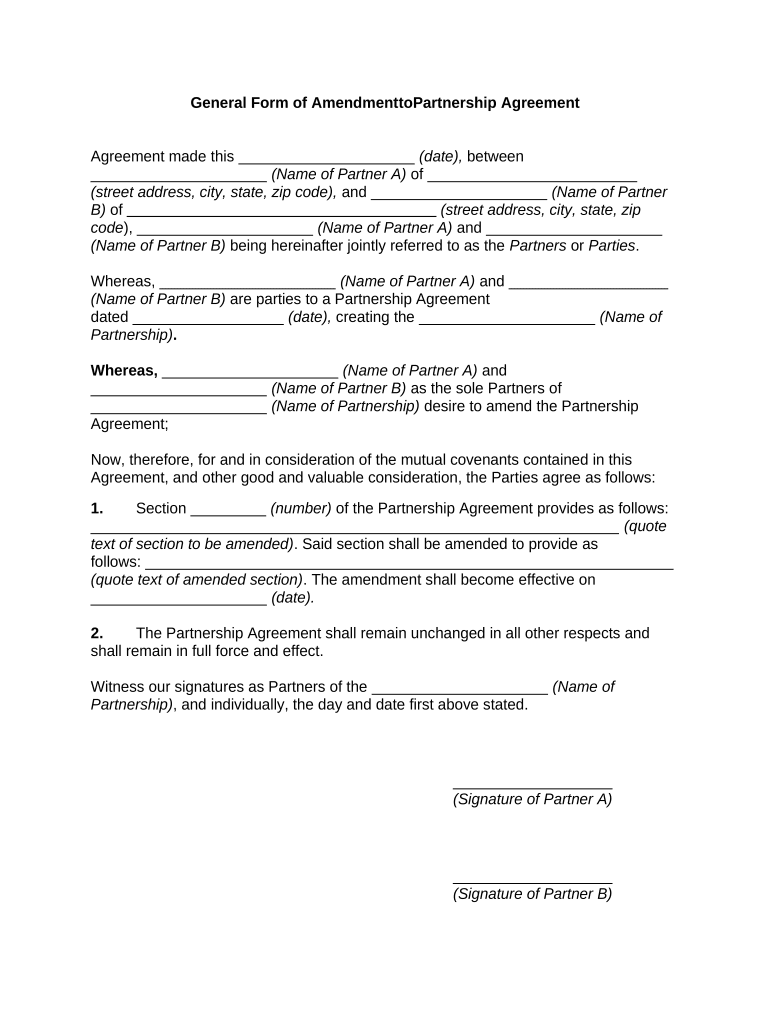
Identify the original partnership agreement by name and execution date and state that the document is an amendment to that agreement.
Amended Provisions

Specify exactly which sections, paragraphs, or exhibits are amended, providing original text and replacement language or clearly marked deletions.

Effective Date

State the date when the amendment takes effect and whether it applies retroactively, prospectively, or upon a triggering event.

Consideration

If the amendment changes economic rights, describe consideration, payments, or capital adjustments in precise dollar amounts or schedules.

Approval Language

Record the partner votes or written consents required under the original agreement and confirm the amendment satisfies those thresholds.

Governing Law

Name the state law that governs interpretation and enforcement and include signature blocks for all required parties.

Step-by-Step: Prepare, Approve, and Execute an Amendment

Follow a defined sequence to ensure valid approval, correct execution, and complete recordkeeping for the amended agreement.

  • 01
    Draft Amendment: Prepare revision showing prior and new language for review.
  • 02
    Review & Counsel: Have legal and tax advisors review proposed changes.
  • 03
    Obtain Approvals: Collect partner votes or written consents as required.
  • 04
    Execute & Distribute: Sign, date, provide copies, and file if state law requires.

Configuring an Online Amendment Workflow

Set simple, auditable steps in your eSignature platform to manage routing, signer authentication, and storage for the amendment.

Field Configuration
Template Name Use consistent naming for version control
Signer Authentication Email plus SMS code or higher as needed
Routing Order Define signer sequence or allow parallel signing
Storage Location Designate secure repository and retention policy

Where to Send Executed Amendments and How They Travel

After execution, circulate copies to stakeholders, update internal records, and complete any external filings required by entity type or state.

  • Partners: Distribute signed copies to all partners and retained counsel.
  • Company Records: File fully executed amendment in the corporate or partnership minute book.
  • Secretary of State: If entity law requires, submit amendment or statement to the state filing office.
  • Tax Advisor: Provide amended terms to tax preparer for reporting updates.

Digital Signing and File Formats to Support

Confirm the platform retains a tamper-evident audit trail, exports signed PDFs for permanent storage, and fits your existing integrations and compliance needs.

  • Supported Formats: PDF and Word (DOCX) for editable and locked final copies
  • Integrations: Connectors for storage and ERP systems ease recordkeeping
  • Authentication: Email, SMS, and higher-assurance methods available

Timing Considerations and Typical Deadlines

Timelines vary by partnership type and jurisdiction; act promptly to record approvals, file required forms, and reflect changes on tax documents.

Effective Date Entry:

Determine if amendment is retroactive or effective on signing.

State Filing Promptness:

File required state forms as soon as partners approve amendments.

Tax Reporting Cycle:

Provide amended details to preparers before next Schedule K-1 issuance.

Internal Record Update:

Update minute book and capitalization tables within 30 days.

Third-Party Notices:

Notify lenders or registrants per contractual notice periods.

Common Preparation Mistakes to Avoid

  • Leaving vague language about rights or consideration that later causes disputes or tax uncertainty.
  • Failing to follow approval thresholds in the original partnership agreement, which can nullify the amendment.
  • Not checking whether state law requires a filing or specific form for the entity type.
  • Omitting updated signature blocks or failing to get all required partner signatures and consents.

Practical Risks and Consequences of an Incorrect Amendment

Invalid Amendment: May be unenforceable without proper approvals
Tax Misreporting: Incorrect partner allocations can trigger IRS adjustments
Operational Disputes: Ambiguous terms increase litigation risk
Loss of Protections: Failure to file may affect limited liability status
Contractual Breach: Third-party consents may be required to avoid defaults
Financial Penalties: Late filings or reporting errors can incur fines

How Organizations Use Partnership Amendments in Practice

Real-world examples show how amendments record ownership changes, governance updates, and operational adjustments while preserving continuity.

Optica Ventures (Example)

A small investment firm needed to formalize a new capital contribution

  • Partners documented exact percentages and payment schedule
  • The amendment clarified profit allocations and eliminated later disputes by aligning tax reporting and bank records.

Martin Properties (Example)

A real estate partnership changed management structure to streamline decisions

  • The partners added majority management authority language
  • Executing a signed amendment allowed the partnership to present clear authority to lenders and property managers.

Essential Data Elements to Include for Record Integrity

Parties' Legal Names: Full entity or individual names
Amendment Date: MM/DD/YYYY effective date
Revised Clauses: Exact replacement text
Signatures: Printed name, title, date
Notary Block: If locally required
Record Location: Minute book or electronic folder

eSignature Vendor Pricing and Feature Snapshot for Partnership Amendments

Compare starting prices and core features for common eSignature vendors used to execute legal amendments; signNow appears first per the comparison format.

signNow DocuSign Adobe Sign PandaDoc HelloSign
Starting Price $8/user/mo $15/user/mo $14/user/mo $19/user/mo $15/user/mo
Free Trial 7-day free trial Varies by vendor Varies by vendor Varies by vendor Varies by vendor
Bulk Send Yes Yes Yes Yes No
Audit Trail Yes Yes Yes Yes Yes
HIPAA Compliant Yes Yes Yes No No

Frequently Asked Questions About Partnership Amendments

Answers to common questions cover electronic signatures, who may sign, filing requirements, and correcting errors to help you avoid common pitfalls.


Need help? Contact support

be ready to get more
Join over 28 million airSlate SignNow users