Establishing secure connection…Loading editor…Preparing document…

Corporate Resolutions

This template is fully customizable. Edit the text, fill out the fields, and send it for signature. Give it a try!
Corporate Resolutions

What Corporate Resolutions Are and Why They Matter

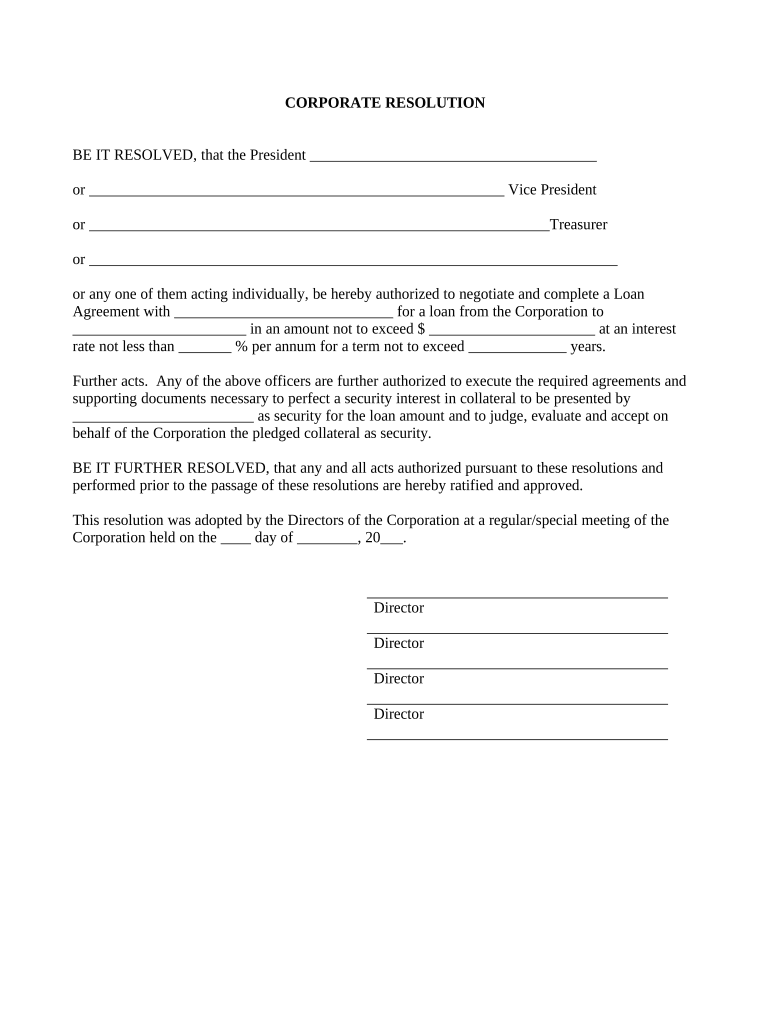
Corporate resolutions are formal written records of decisions approved by a corporation's board of directors or shareholders that authorize actions, delegate authority, or set corporate policy. They document matters such as officer appointments, opening bank accounts, approving contracts, authorizing loans, adopting bylaws amendments, or executing major transactions. Resolutions provide an official corporate record used by banks, counterparties, and regulators to verify authority and corporate intent. For compliance and practical reliability, resolutions should state the action, identify authorized signers, cite relevant dates, and be signed and recorded in the corporate minute book.

Why a Clear Corporate Resolution Protects Your Organization

Corporate resolutions create clear evidence of corporate decisions, reduce disputes over authority, and satisfy third parties such as banks and government agencies. They centralize authorization, enable delegation to officers or agents, and support regulatory and recordkeeping obligations under corporate governance rules.

Why a Clear Corporate Resolution Protects Your Organization

Who Prepares and Relies on Corporate Resolutions

Board members, corporate officers, corporate counsel, and corporate secretaries commonly prepare or approve Corporate Resolutions when formal authorization is required.

  • Board of Directors: adopt major corporate actions and delegate authority to officers and committees.
  • Corporate Officers: execute contracts, open accounts, and act on routine operational authorizations.
  • Shareholders: approve significant corporate changes like mergers, amendments, or large asset dispositions.

Primary Roles Involved with Resolutions

Board Chair

The Board Chair signs resolutions reflecting board actions, certifies meeting minutes, and may be the primary contact for banks or counterparties requesting proof of authority. Accurate, dated resolutions reduce third-party risk and clarify delegated powers for executives and agents.

Corporate Secretary

The Corporate Secretary prepares and maintains the minute book, records board resolutions, certifies corporate records to third parties, and ensures signatures and dates are properly documented to support legal and banking verifications.

Essential Elements of a Professional Corporate Resolution

A professional Corporate Resolutions document clearly identifies the action, authority, parties, effective date, scope of authorization, and any conditions or limitations.

Action

Describe the specific corporate action being authorized (for example, entering a contract, opening accounts, appointing officers or approving a transaction) and reference any related agreements or board resolutions.
Authority

Specify whether authority is exclusive or shared, any dollar limits, duration, and delegation to named officers or agents, including the extent of signing powers and restrictions on sub-delegation.

Parties

Identify the corporation by legal name and state of incorporation, and name individuals or external entities granted authority, including titles and any representative capacity.

Effective Date

State the exact date the resolution takes effect; include start and, if applicable, end or expiration dates to avoid ambiguity for third parties and internal records.

Scope

Detail limits on the authorized action, such as transaction thresholds, geographic scope, required approvals, or reporting conditions to the board or shareholders.

Signatures

Include printed names, titles, signature lines, and execution dates. Record who prepared and who witnessed or notarized the resolution when required by statute or corporate practice.

Step-by-Step: Prepare, Approve, and Record a Resolution

Follow these steps to prepare, approve, and record a Corporate Resolutions that establishes authority and documents board decisions.

  • 01
    Draft: Draft the resolution text, specifying action and limits.
  • 02
    Review: Share with counsel and officers for substantive and compliance checks.
  • 03
    Approve: Hold board or shareholder meeting; record vote and certify approval.
  • 04
    Record: File signed resolution in the minute book; provide certified copies as needed.

Digital Workflow Settings to Standardize Execution

Use a consistent digital workflow to reduce errors and speed approval, notarization, and distribution across teams.

Field Configuration
Document Type Board resolution template
Signer Authentication Email plus optional ID verification
Notarization RON or in-person as required
Storage Secure archive with audit trail

Technical Requirements for Electronic Execution

Ensure the signing platform supports role-based signing, tamper-evident audit trails, and secure document storage to meet third-party and compliance expectations.

  • Integrations: Salesforce, NetSuite, Google Workspace supported.
  • Formats: PDF, DOCX, HTML, Excel accepted.
  • Security: AES-256 at rest; TLS 1.2/1.3 in transit.

Typical Routing for a Corporate Resolution

Typical routing covers drafting, board approval, signature collection, and distribution to stakeholders and external parties such as banks and counterparties.

  • Upload: Attach finalized resolution PDF to the corporate records system.
  • Assign: Assign signing roles to officers or authorized agents.
  • Sign: Collect signatures and dates; notarize if required.
  • Distribute: Send certified copies to banks, lenders, and internal records.

Timing Considerations and Lead Times

Key timing considerations for preparing, approving, notarizing, and distributing Corporate Resolutions, including meeting notice periods and bank processing lead times.

Required Board Meeting Notice Periods:

Follow corporate bylaws; common practice is 7–30 days notice depending on bylaws and state law.

Prompt Recording of Signature Dates:

Enter execution dates on resolution and certify in the minute book immediately after signing.

Bank Processing and Third-Party Verification:

Allow multiple business days for banks to verify corporate authority and request certified copies.

Scheduling Windows for Notarization or RON Sessions:

Book notary or RON in advance; RON sessions may require identity proofing steps.

Timelines for Distribution to Internal and External Stakeholders:

Provide certified copies to banks, lenders, and internal compliance within business days after execution.

Milestone Sequence from Draft to Distribution

A sequential milestone list clarifies steps from drafting to certification and distribution so stakeholders know when actions occur.

01

Draft Resolution

Prepare text, cite authority, and attach supporting documents.

02

Board Vote

Record vote results and include motion language in minutes.

03

Execute and Notarize

Collect signatures and notarize, or schedule RON per state requirements.

04

Record and Distribute

File in minute book and send certified copies to necessary parties.

Compare eSignature Vendor Pricing and Key Capabilities

Comparison of common eSignature plan features and starting prices to help IT and procurement evaluate vendor suitability for Corporate Resolutions workflows.

signNow DocuSign Adobe Sign PandaDoc HelloSign
Starting Price $8/user/mo $15/user/mo $14/user/mo $19/user/mo $15/user/mo
Free Trial 7-day free trial Verify vendor pricing and trial terms Verify vendor pricing and trial terms Verify vendor pricing and trial terms Verify vendor pricing and trial terms
Bulk Send Yes, plan-dependent Yes Yes Yes Varies by plan
Audit Trail Yes Yes Yes Yes Yes
HIPAA Compliant Yes Yes Yes No No
Envelope Cap No envelope cap 100 envelopes/user/year Varies by plan Varies by plan Varies by plan

Common Preparation Mistakes to Avoid

  • Using informal notes rather than signed resolutions, which creates uncertainty for banks and third parties and may lead to delays or rejection when proving authority.
  • Failing to identify signatory titles or limits, producing resolutions that grant ambiguous or excessive authority beyond intended corporate governance limits.
  • Omitting dates, not recording the adoption vote, or neglecting to file the resolution in the minute book, weakening evidentiary value.
  • Assuming electronic copies suffice without confirming third-party acceptance, notarization requirements, or consumer consent obligations under ESIGN for certain transactions.

Consequences of Inaccurate or Missing Resolutions

Third-Party Refusal: Banks may refuse transactions
Contract Invalidity: Counterparties may question authority
Operational Delay: Execution of agreements delayed
Regulatory Noncompliance: Violations of recordkeeping obligations
Tax Reporting Issues: Incorrect authority may affect filings
Litigation Exposure: Increased risk of legal disputes

Real-World Examples of Resolution Use

The following case examples illustrate how different organizations use Corporate Resolutions to authorize actions and satisfy counterparties.

Optica Ventures

Optica Ventures standardized resolutions to document investment approvals and officer authority, creating consistent records for counterparties and financial institutions.

  • This enabled remote signing with clear roles.
  • Certified copies and clear signatory names reduced delays during account openings and improved confidence when third parties requested proof of board authorization, cutting administrative follow-up and accelerating transaction timelines for every deal.

Martin Properties

Martin Properties used Corporate Resolutions to authorize property closings and delegate closing authority to a designated officer, avoiding repeated board approvals for routine transactions.

  • Delegation reduced closing delays and legal review cycles.
  • By recording delegation limits and expiration dates in the resolution, the company provided lenders and escrow agents with definitive authority records, decreased document rework, and maintained compliance with state recording and notary requirements.

Practical Tips for Accurate, Efficient Resolutions

Practical tips to ensure Corporate Resolutions are accurate, enforceable, and accepted by third parties and regulators.

Use standardized templates reviewed by counsel
Adopt consistent, lawyer-reviewed templates that include required fields, recital language, and signature blocks. Standardization reduces drafting errors, speeds approvals, and simplifies certified copy requests from banks or other third parties.
Specify dollar, time, and scope limits clearly
Avoid vague language. Define precise authority, monetary thresholds, expiration dates, and reporting obligations so signers and third parties understand the permitted actions and constraints.
Confirm acceptance by banks and counterparties early
Before finalizing format or notarization method, ask banks, title companies, and counterparties what they require for certified copies, notarization, or e-signature acceptance to avoid rework and delays.
Maintain a complete and indexed minute book
Record the resolution, meeting minutes, voting records, and certified copies. An organized minute book supports audits, satisfies due diligence requests, and provides authoritative evidence of corporate action for lenders and regulators.

Frequently Asked Questions About Corporate Resolutions

Common questions address how to prepare, validate, and sign Corporate Resolutions, plus notarization, retention, and how to correct errors.


Need help? Contact support

be ready to get more
Join over 28 million airSlate SignNow users