Establishing secure connection…Loading editor…Preparing document…

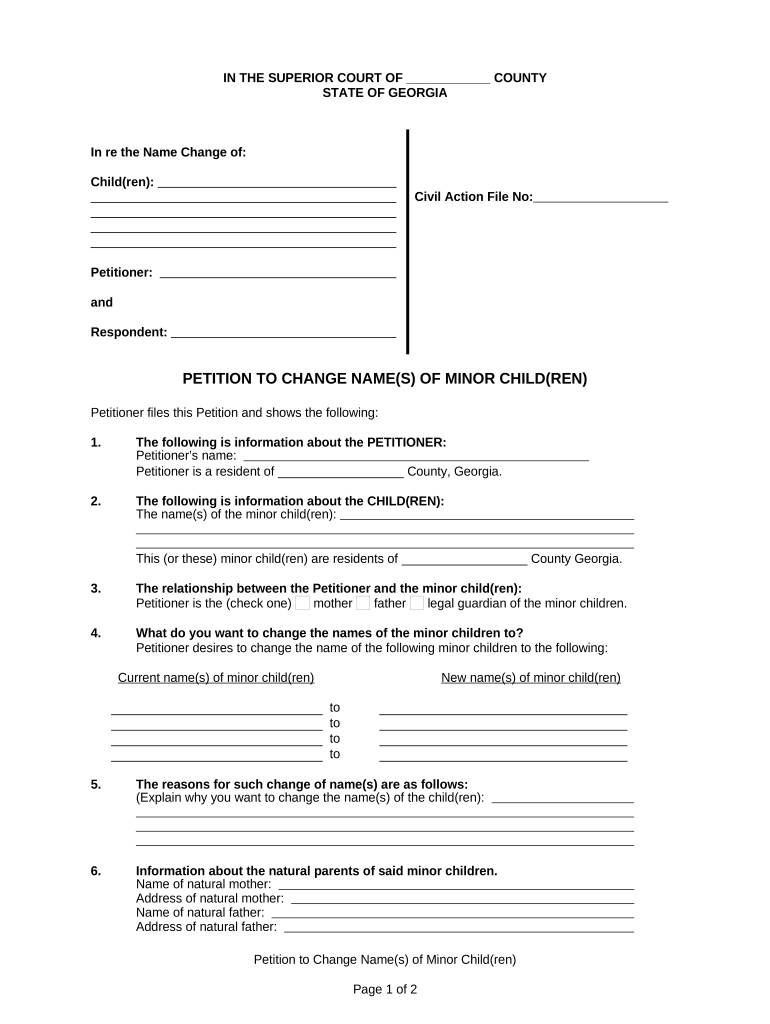
Georgia Change of Name for Minor

This template is fully customizable. Edit the text, fill out the fields, and send it for signature. Give it a try!
Georgia Change of Name for Minor

What the Georgia Change of Name for Minor Is

Georgia Change of Name for Minor is the court petition and supporting documentation filed in a Georgia superior court to legally change a child's name. The process typically requires a verified petition from a parent or guardian, supporting documents such as a birth certificate and custody orders, possible notice or background checks depending on local rules, and attendance at a hearing. When the judge signs a certified order the new name becomes legally effective and can be used to update Social Security, passport, DMV, school, and medical records.

Why a Court Order Matters for a Minor’s Identity

A certified court order creates authoritative proof of a child's new legal name, enabling consistent updates across government and private records, clarifying identity for schools and medical providers, and reducing future disputes about parentage or guardianship.

Why a Court Order Matters for a Minor’s Identity

Who Typically Prepares and Files This Petition

Parents, guardians, and family law attorneys commonly prepare and submit a Georgia Change of Name for Minor petition to update a child's legal identity.

  • Parents or guardians who hold legal custody and seek to change a child's name on official records.
  • Adoptive parents requesting a name update after adoption finalization to align documentation and identity.
  • Court-appointed guardians or attorneys filing on behalf of minors where parental consent is unavailable or contested.

Step-by-Step: Filing a Georgia Name Change for a Minor

Follow these core steps to prepare, file, and carry a Georgia Change of Name for Minor petition through the county superior court process.

  • 01
    Prepare Petition: Complete verified petition form with minor and petitioner details.
  • 02
    Gather Documents: Attach birth certificate, custody orders, and identification copies.
  • 03
    File with Court: Submit petition to superior court clerk and pay filing fee.
  • 04
    Attend Hearing: Appear at the scheduled hearing; present reasons and consent proof.

Common Questions About Georgia Minor Name Changes

Answers to frequent issues about who files, consent requirements, electronic signatures, hearings, timelines, and updating records after a court order.


Need help? Contact support

eSignature Vendor Pricing and Feature Snapshot

Overview of pricing and core capabilities to consider when exchanging and signing petitions, consent forms, and supporting documents electronically.

signNow DocuSign Adobe Sign PandaDoc HelloSign
Starting Price $8/user/mo $15/user/mo $14/user/mo $19/user/mo $15/user/mo
Free Trial Yes, 7-day trial Varies by vendor Varies by vendor Varies by vendor Varies by vendor
Bulk Send Yes Yes Yes Yes No
Audit Trail Yes Yes Yes Yes Yes
HIPAA Compliant Yes Yes Yes No No

Essential Data Elements to Include with the Petition

Court Petition: Verified, signed petition and supporting documents.
Birth Certificate: Certified copy required for verification.
Parental Consent: Signed statements from parents or guardians.
Proof of Identity: Photo ID for petitioner and parent.
Custody Orders: Court-issued custody or guardianship documentation.
Certified Order: Judge-signed order for official record updates.

Consequences of Incomplete or Incorrect Petitions

Filing Delays: Processing postponed; hearing rescheduled.
Order Denial: Judge may deny petition.
Inaccurate Records: Mismatch across official documents.
Additional Costs: Attorney and refiling expenses.
Legal Challenges: Third-party objections or appeals.
Privacy Concerns: Unauthorized disclosure risk.

Common Preparation Errors to Avoid

  • Omitting required parental consent statements or failing to document attempts to notify absent parents can cause delays or denial at the hearing.
  • Filing in the incorrect county or using the wrong venue often results in dismissal or the need to refile with additional fees.
  • Submitting uncertified copies of required documents, missing custody orders, or incomplete exhibits commonly triggers clerk rejections or continuances.
  • Relying on nonnotarized signatures or digital signatures where the court requires wet signatures may lead to rejection of the petition.

Process Flow: From Petition to Record Updates

High-level flow of tasks and handoffs from petition preparation through obtaining certified court orders and updating official records.

  • Draft Petition: Prepare sworn petition with factual grounds.
  • Serve Notice: Provide notice to required parties per court rules.
  • Attend Hearing: Appear and present evidence before the judge.
  • Record Order: Obtain certified order and distribute copies.

Configuring an Online Workflow for Name Change Documents

Recommended workflow settings for preparing, collecting signatures, and submitting supporting documents securely through an eSignature platform.

Field Configuration
Authentication Method Email link or SMS code for signer verification
Signer Order Petitioner signs first; co‑parent signs second where required
Document Format Use PDF/A for archival and certified court copies
Notarization Enable RON or in‑person options depending on county acceptance

Technical and Integration Considerations for eFiling

Confirm that the eSignature platform supports accepted file formats, notarization modes, and retention policies before relying on it for court submissions.

  • Supported Formats: PDF, DOCX accepted for uploads
  • Integrations: Works with Google Workspace and NetSuite
  • Authentication Options: Email, SMS, and advanced verification

Timing and Typical Deadlines to Track

Key timing considerations and typical deadlines when preparing, filing, and completing a Georgia Change of Name for Minor petition across county courts.

Filing Window:

No universal deadline; file once documentation and consent are ready.

Service Period:

Provide notice to absent parents according to local rules and file proof of service.

Hearing Scheduling:

Courts schedule hearings based on docket availability; expect weeks to months.

Order Entry:

Clerk enters and certifies the order after a judge signs it.

Record Updates:

Use certified copies to update Social Security and DMV records promptly.

Key Milestones from Filing to Final Updates

Sequential milestones show core checkpoints and expected progress from petition filing through agency updates after the court order.

01

Prepare and File

Draft petition, assemble exhibits, and submit to superior court clerk.

02

Service and Notice

Serve required parties and file proof of service with the court.

03

Hearing and Ruling

Attend hearing; judge issues order granting or denying change.

04

Certification and Notifications

Obtain certified order and notify agencies to update records.

How Minor Petitions Differ from Adult Name Change Petitions

A concise comparison of procedural differences to help determine which petition type and supporting steps apply.

Criteria Minor Petition Adult Petition
Parental Consent often required not required
Publication Notice less common often required
Court Review heightened scrutiny standard review
Typical Fees $25–$50 $25–$200

Representative Scenarios for Georgia Minor Name Changes

Two practical examples show common factual patterns and how courts typically handle consent and documentation.

Custodial Parent Case

A custodial parent petitions to change a young child's surname after remarriage to match the new family name.

  • Both parents provided written, notarized consent.
  • The court reviewed custody and best interest factors, accepted the paperwork, issued a certified order, and the parent used certified copies to update Social Security and school records.

Adoption Finalization

After adoption is finalized, adoptive parents file to change the child's legal name to reflect new family identity and parentage.

  • Adoption decree and certificate attached.
  • The judge issued the order as part of the adoption record and adoptive parents used certified copies to update passport, Social Security, and medical records.

Key Roles Involved in the Name Change Process

Petitioning Parent

A parent or guardian with legal custody who files the petition, provides identity and relationship documentation, and presents evidence supporting the child's best interests. They coordinate service, attend hearings, and obtain certified copies for record updates; attorneys often assist with procedure and notice.

Court Clerk

The superior court clerk accepts filings, processes fees, issues case numbers, schedules hearings, and after the judge signs, prepares certified copies. Clerks also provide guidance on local filing requirements and acceptable document formats.

Practical Tips to Speed Processing and Reduce Errors

Applying these best practices helps avoid common rejections and shortens overall processing time.

Confirm legal names exactly match identification
Compare spellings on the birth certificate, IDs, and other documents before filing. Even small discrepancies can delay acceptance; correct source documents or attach affidavits explaining differences to prevent clerk rejections.
Obtain written parental consents in advance
Secure notarized consent from both parents when possible, or document diligent attempts to notify an absent parent; courts weigh consent heavily when evaluating petitions.
Provide certified official document copies only
Submit certified birth certificates, adoption decrees, and custody orders. Uncertified photocopies are frequently rejected and will slow processing and require refiling.
Check local court rules and fee schedules
Confirm county clerk requirements for electronic filing, notarization, publication, and exact fee amounts to avoid unexpected delays or expense.
be ready to get more
Join over 28 million airSlate SignNow users