Establishing secure connection…Loading editor…Preparing document…

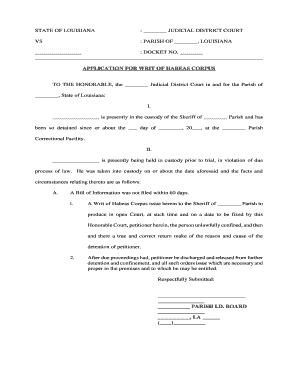
Louisiana Application for Writ of Habeas Corpus

This template is fully customizable. Edit the text, fill out the fields, and send it for signature. Give it a try!
Louisiana Application for Writ of Habeas Corpus

What the Louisiana Application for Writ of Habeas Corpus Is

The Louisiana Application for Writ of Habeas Corpus is a formal pleading asking a court to review the lawfulness of a person's detention and order release if detention is unlawful. It sets out petitioner and detainee details, factual background, legal grounds for relief, supporting exhibits, and a verification or sworn statement. The application can be filed by the detained person or by someone acting on their behalf and should conform to local court rules and filing procedures.

Why a Proper Application Matters

A carefully prepared application focuses the court on the legal defects in custody, avoids procedural dismissal, and preserves appellate rights while documenting the relief requested and the factual basis for immediate review.

Why a Proper Application Matters

Who Typically Prepares or Files This Application

Filing parties should verify local parish court rules and whether counsel or an emergency petition format is required.

  • Self-represented petitioner seeking immediate release or review of detention circumstances.
  • Criminal defense attorneys filing on behalf of a client to address unlawful custody issues.
  • Civil rights organizations or appointed counsel acting to protect constitutional or statutory rights.

Step-by-step: Completing the Louisiana Application for Writ of Habeas Corpus

Follow a clear sequence: gather facts, complete required fields, attach evidence, sign under oath, file with the correct court, and serve the custodian per local rules.

  • 01
    Gather facts: Assemble arrest records, booking info, and custody dates.
  • 02
    Complete form: Provide petitioner, detainee, custodian, and factual grounds.
  • 03
    Attach exhibits: Include orders, warrants, affidavits, or medical records.
  • 04
    File and serve: File with court and serve custodian per local procedure.

Core components to include in a professional application

A complete application organizes facts and legal claims, attaches evidence, and ends with a verification and proof of service to meet court standards.

Court Caption

Include the court name, docket area, caption style, and contact details following local filing conventions to ensure correct routing and docketing.
Statement of Facts

Set out a concise chronological account of events leading to detention, including dates, times, officers involved, and procedural steps taken.

Legal Grounds

List statutory or constitutional claims with brief legal argumentation tied to the facts; identify relief requested (release, hearing, dismissal).

Exhibit Index

Provide an indexed list of exhibits and attach copies in order; reference exhibit labels inside the narrative for clarity.

Prayer for Relief

Specify the exact remedy sought (e.g., immediate release, hearing with counsel, vacatur of order) and any temporary emergency orders requested.

Verification and Service

Include a sworn verification or affidavit and proof of service certifying that custodian and other required parties were served per court rule.

Security and compliance details to preserve evidentiary value

Encryption: AES-256 at rest
In-transit: TLS 1.2/1.3
Audit Trail: Detailed signing log
HIPAA: BAA required
ESIGN/UETA: Legal compliance
Access Control: Role-based permissions

Consequences of incorrect or incomplete applications

Dismissal: Procedural dismissal
Delay: Hearing postponed
Perjury: Sworn false statements risk sanctions
Service Failure: Return to sender
Fee Loss: Forfeited filing costs
Liability: Civil exposure possible

Common mistakes that cause rejection or delay

  • Filing in the wrong court or under incorrect caption, which can lead to dismissal or transfer delays and lost time to secure emergency relief.
  • Incomplete factual narrative that fails to link custody to the legal deficiency, leaving the judge without a clear basis for relief.
  • Omitting required exhibits, such as arrest reports or warrants, which prevents adjudication on the merits and triggers requests for supplementation.
  • Failure to properly verify, notarize, or provide proof of service, often causing clerk-level rejections or return for correction.

How filing and service typically proceed

An organized workflow reduces errors: prepare petition, add exhibits, obtain verification, file with clerk, and serve the custodian and interested parties.

  • Draft petition: Assemble factual and legal sections
  • Attach evidence: Exhibits labeled and referenced
  • Verify & sign: Swear under oath; notarize if required
  • File & serve: File with clerk; serve custodian

Configuring a digital workflow for this application

When using e-filing or e-signature tools, set clear authentication, file formats, and retention policies aligned with court and privacy rules.

Field Configuration
Signer Authentication Email plus SMS code recommended for signer verification
File Format PDF/A preferred for long-term preservation
Notarization Use RON or in-person notary where state permits
Retention Policy Retain originals per applicable legal retention periods

Technical considerations for eSubmission and eSigning

signNow supports standard integrations and secure document handling, including audit trails and HIPAA-capable workflows when a BAA is in place.

  • Integrations: Salesforce, NetSuite, Google Workspace
  • File types: PDF, DOCX, HTML supported
  • Authentication: Email, SMS, KBA options

Timing and statutory limits to watch for

Timeliness rules vary by jurisdiction; federal habeas petitions have a specific statute of limitation, while state petitions require prompt filing under local rules.

Federal limitation:

One-year AEDPA limit (28 U.S.C. §2244(d)(1))

State practice:

File promptly; local rules vary by parish

Emergency relief:

Request immediate hearing for ongoing detention

Service timing:

Serve custodian promptly to avoid defects

Appeals window:

Preserve appellate rights by timely filings

eSignature vendor comparison for filing and signing

Compare basic pricing and feature availability for eSignature platforms commonly used to assemble and sign legal filings; signNow appears first to align with integration and compliance details below.

signNow DocuSign Adobe Sign PandaDoc HelloSign
Starting Price $8/user/mo $15/user/mo $14/user/mo $19/user/mo $15/user/mo
Free Trial 7-day free trial Varies Varies Varies Varies
Bulk Send Yes Yes Yes Yes No
Audit Trail Yes Yes Yes Yes Yes
HIPAA Compliant Yes Yes Yes No No
Envelope Cap No cap 100 envelopes/user/year Varies Varies Varies

Practical tips for accurate and efficient completion

Adopt standardized templates, checklist workflows, and proofing steps to reduce rejections and accelerate judicial consideration.

Use clear captions
Follow local caption formats and include docket numbers or related case identifiers when available.
Reference exhibits
Cite exhibit labels in the narrative and attach a cover index for clerk convenience.
Confirm service
Include a sworn proof of service that meets parish requirements and show manner and date of service.
Preserve originals
Keep signed originals, notarizations, and correspondence in secure storage for the recommended retention period.

Frequently asked questions about the Louisiana Application for Writ of Habeas Corpus

Answers to common procedural and technical questions when preparing, signing, and filing a writ application in Louisiana and related contexts.


Need help? Contact support

be ready to get more
Join over 28 million airSlate SignNow users