Establishing secure connection…Loading editor…Preparing document…

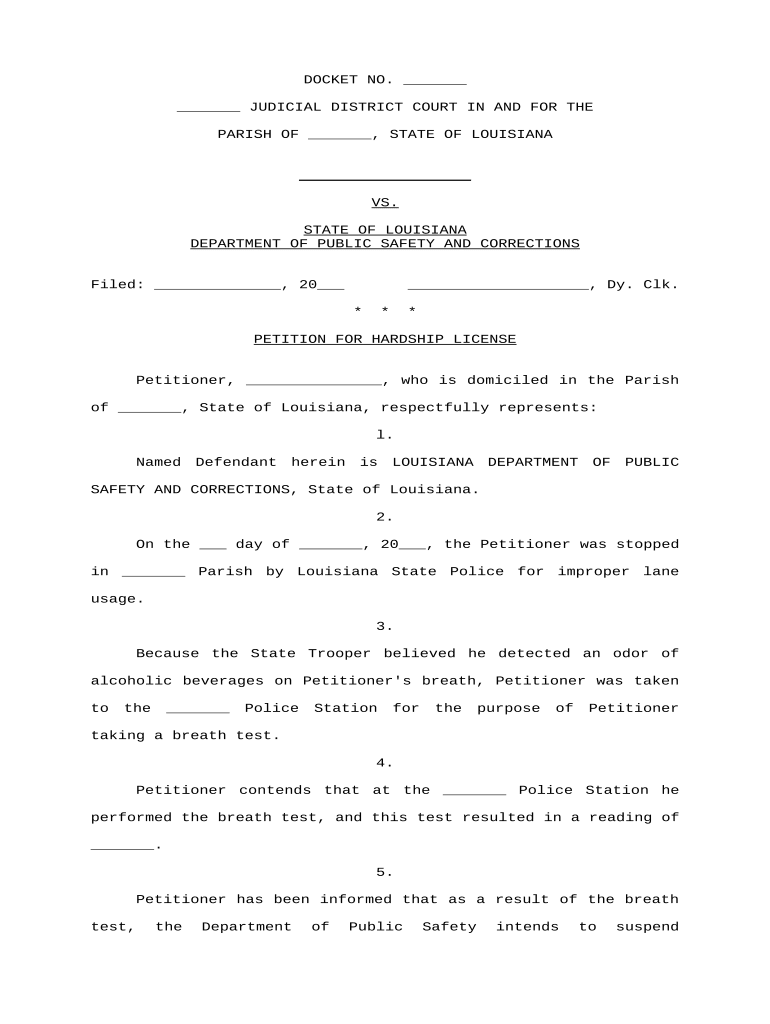
Hardship License

This template is fully customizable. Edit the text, fill out the fields, and send it for signature. Give it a try!
Hardship License

What a Hardship License Is and when it applies

A Hardship License is a restricted driving privilege issued by a state motor vehicle agency that permits limited vehicle operation during a suspension or revocation period for essential purposes such as work, school, medical care, or court attendance. Eligibility, allowable hours, geographic limits, and documentation vary by state and case type; many jurisdictions require a formal application, supporting documentation, and sometimes an administrative hearing. Electronic submission and eSignatures are commonly accepted under U.S. electronic-signature law (ESIGN Act, 15 U.S.C. ch. 96) and state UETA statutes, subject to the state DMV’s procedural rules.

Why applying correctly matters

A properly completed Hardship License application preserves mobility for essential activities, reduces income disruption, and shortens administrative processing. Accurate forms and verifiable supporting documents help avoid delays, denials, or extended suspensions by meeting DMV evidentiary and procedural requirements.

Why applying correctly matters

Who typically completes a Hardship License application

Applicants and third parties complete this form when limited driving privileges are needed during a suspension; common filers include individuals, employers, and attorneys.

  • Individuals: Applicants provide identity, suspension details, and proof of hardship such as employment or medical appointments.
  • Employers: Employers sometimes supply employment verification letters or schedules to support work-related driving requests.
  • Attorneys or Representatives: Legal counsel files on behalf of clients and may handle hearings or appeals.

Core components of a professional Hardship License application

A complete application combines identity verification, suspension information, a clear hardship statement, supporting documentation, a defined restricted-driving plan, and signed attestations. Each element supports the agency’s assessment of necessity and public safety.

Applicant Identity

Full legal name, date of birth, driver license number, and government-issued ID details. Consistent identity data avoids processing delays and supports any required background checks.
Suspension Details

State case or citation numbers, effective suspension dates, and reasons for suspension. Accurate suspension references let the DMV match your application to the correct administrative record.

Hardship Statement

A concise declaration of why limited driving is essential (work, medical, school), specifying hours, days, and destinations. Clear scope helps the agency define permitted travel windows.

Supporting Documents

Employer letters, medical appointment confirmations, school enrollment records, or court orders. Dated, signed documents demonstrating ongoing need strengthen the application's credibility.

Restricted Plan

A proposed schedule and route limits (for example, commute to a single work site), vehicle details, and any proposed monitoring conditions such as ignition interlock.

Signatures & Attestations

Applicant and any certifying parties must sign and date the application. When allowed, an electronic signature with audit trail satisfies signature requirements under ESIGN/UETA.

Step-by-step: Fill and submit a Hardship License application

Follow these steps in sequence to complete the application and minimize processing delays.

  • 01
    Gather records: Collect ID, suspension notice, employer/medical proofs.
  • 02
    Complete form: Enter accurate fields and attach documents.
  • 03
    Sign and authenticate: Sign in person or use a compliant eSignature method.
  • 04
    Submit to DMV: File by mail, in person, or through the DMV portal as allowed.

How to set up an online submission workflow

Design a simple digital workflow that captures data, collects attachments, secures signatures, and routes to the correct DMV or legal contact.

Field Configuration
Identity fields Required, auto-validate against ID image
Document uploads PDF/JPG accepted, limit 10 MB per file
Signature method Email link + audit trail or SMS code
Routing Auto-route to DMV intake or attorney

Where to file and how the submission flows

Submissions follow a predictable path: intake, verification, review, and decision. Knowing each destination reduces rework and omission errors.

  • Intake: Applicant uploads or delivers the packet.
  • Verification: DMV confirms identity and suspension details.
  • Review: Evidence and hardship are evaluated for necessity.
  • Decision: Agency issues approval, denial, or requests hearing.

Technical options for electronic submission and signing

Use a platform that accepts standard file formats, supports eSignature audit trails, and can authenticate signers per DMV requirements.

  • File formats: PDF, DOCX, JPG accepted
  • Authentication: Email, SMS, or KBA
  • Audit trail: Timestamps and IP logged

Key timing considerations and common deadlines

Deadlines and processing windows vary by state; start early to allow for authentication, review, and any required hearings that could affect driving privileges.

Submission timeline:

File as soon as hardship need arises

Processing time:

Varies by state — days to weeks

Hearing notice:

If required, scheduled within state timelines

Interim relief:

Temporary permits may be granted in some states

Appeal deadlines:

Follow state administrative appeal time limits

Typical processing milestones for a Hardship License

A sequential milestone view helps applicants anticipate next steps and comply with agency timelines.

01

Application Filed

Intake and initial validation of submitted documents.

02

Verification Complete

DMV or agency confirms identity and suspension record match.

03

Review or Hearing

Agency evaluates hardship evidence or conducts a hearing.

04

Decision Issued

Approval with restrictions, denial, or conditional relief.

Common mistakes that delay or invalidate applications

  • Incomplete identity details or mismatched names between the application and government ID cause verification failures and processing delays.
  • Missing or undated supporting documents (employment letters, medical confirmations) lead agencies to request supplemental evidence or deny the claim.
  • Using an unverified or unauthenticated signature method can result in the agency rejecting the electronic submission for lack of signer attribution.
  • Failing to propose a clear, limited driving plan (hours, routes, permitted destinations) often prompts the DMV to deny the application on public-safety grounds.

Penalties and risks for incorrect or fraudulent submissions

Application Denial: Resubmission required
Extended Suspension: Suspension may be lengthened
Fines: Civil monetary penalties possible
Criminal Charges: False statements may be prosecuted
Vehicle Impoundment: Unauthorized driving risks impoundment
Insurance Impact: Rates may increase after violations

Information commonly required on the form

Full name: As on license
License number: State-issued identifier
DOB: MM/DD/YYYY
Suspension cause: Brief reason
Hardship reason: Work/medical/school
Attachments: Employer or medical proof

Realistic scenarios where a Hardship License is used

These examples show common, lawful uses of a restricted license and how supporting evidence typically appears in an application.

Working Parent Scenario

A single parent must commute to a fixed job site daily; employer letter confirms schedule and duties.

  • Employer letter confirms full-time schedule and inability to telework.
  • The DMV reviews the employment verification, issues a time-limited restricted license for commute hours, and requires renewal or reproof when restrictions expire.

Medical Treatment Scenario

An applicant needs regular specialty treatment outside public transit availability; medical appointment records document recurring visits.

  • Medical records and provider statements show ongoing treatment and lack of alternatives.
  • The agency may grant a restricted license for medical travel only, specifying providers, routes, and proof on future reviews.

eSignature vendor pricing and capability snapshot

Comparison of starting prices and common capability differences relevant when you need eSigning for official applications and document routing. Ensure vendor compliance with ESIGN/UETA and any applicable industry standards before use.

signNow DocuSign Adobe Sign PandaDoc HelloSign
Starting Price $8/user/mo $15/user/mo $14/user/mo $19/user/mo $15/user/mo
Free Trial 7-day free trial No No Yes, limited Yes, limited
Bulk Send Yes Yes Yes Yes No
Audit Trail Yes Yes Yes Yes Yes
HIPAA Compliant Yes Yes Yes No No
Envelope Cap No cap 100 envelopes/user/year Varies by plan Varies by plan Varies by plan

Frequently asked questions about Hardship License applications

Answers to common issues applicants encounter when completing, signing, and submitting a Hardship License application, including eSignature and documentation concerns.


Need help? Contact support

be ready to get more
Join over 28 million airSlate SignNow users