Establishing secure connection…Loading editor…Preparing document…

Hawaii Order of Notice

This template is fully customizable. Edit the text, fill out the fields, and send it for signature. Give it a try!
Hawaii Order of Notice

What the Hawaii Order of Notice is and when it applies

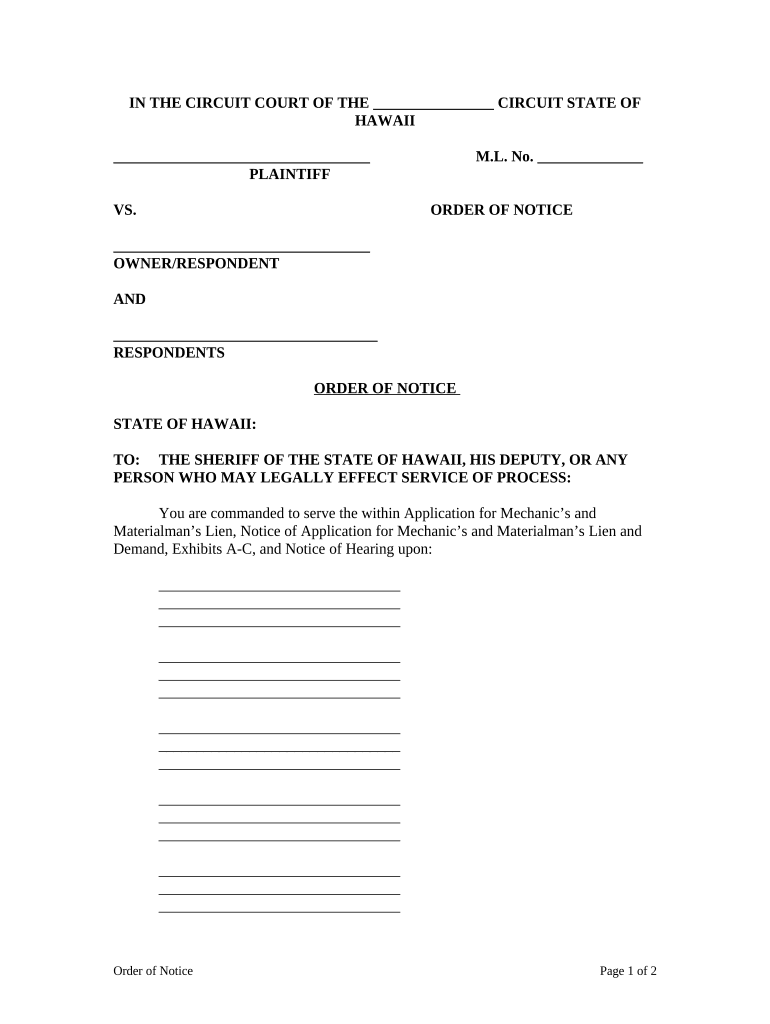
The Hawaii Order of Notice is a formal legal document used to notify identified parties of a pending action or requirement under Hawaii law. It may be issued by courts, government agencies, landlords, or other authorized parties to start a procedural clock, set a response deadline, or provide statutorily required disclosure. The form records who was notified, the method of service, the date of service, and the nature of the action. Proper completion ensures parties receive required information and preserves procedural rights during administrative or judicial processes.

Why accuracy and timeliness matter for the Hawaii Order of Notice

A correctly completed Hawaii Order of Notice establishes legal notice, preserves procedural rights, and avoids delays or court rejection. Electronic completion and delivery follow the ESIGN Act (15 U.S.C. ch. 96, 2000) and state law when parties consent.

Why accuracy and timeliness matter for the Hawaii Order of Notice

Who prepares and receives a Hawaii Order of Notice

Recipients are individuals or entities named in the order; accurate contact data and documented delivery reduce the risk of later challenges.

  • Court clerks and judges — prepare orders for service and record proof of notice.
  • Landlords and property managers — notify tenants for lease violations or termination.
  • Government agencies — issue administrative notices and hearing invitations.

Step-by-step: preparing and delivering the Hawaii Order of Notice

Follow these steps to complete, authenticate, and document service to maintain enforceability and defendability.

  • 01
    Prepare: Populate case details, recipient data, and service instructions accurately.
  • 02
    Authorize: Obtain required internal approvals or judicial signature before service.
  • 03
    Serve: Deliver using the selected method and record proof of delivery.
  • 04
    Document: File proof of service or affidavit with the issuing authority promptly.

Common online workflow settings for e-submission

Configure the digital workflow to match legal requirements for authentication, recordkeeping, and distribution.

Field Configuration
Authentication Email link, SMS code, or KBA per risk level
Signer Order Sequential or parallel routing as required
Retention Auto-save signed copies and audit trail
Reminders Automatic reminder schedule and escalation

How digital completion and service typically work

Electronic workflows replicate the paper chain: create, place fields, authenticate, send, sign, and retain a certified record.

  • Create: Upload template and add required fields.
  • Authenticate: Choose authentication appropriate to legal risk.
  • Send: Deliver via secure link or certified email.
  • Record: Store signed PDF and audit log for evidence.

Platform capabilities to support the Hawaii Order of Notice

Confirm the provider supports ESIGN/UETA compliance and offers exportable audit trails and tamper-evident signed documents for long-term records.

  • File formats: PDF, DOCX supported
  • Integrations: Connects to common CRMs
  • Authentication: Email, SMS, KBA

Security and compliance elements to include

Encryption in transit: TLS 1.2/1.3
Encryption at rest: AES-256
Audit trail: Timestamped events and IP
HIPAA readiness: BAA available
Regulatory standards: ESIGN and UETA compliant
Certifications: SOC 2 Type II, ISO 27001

Key risks and potential consequences of errors

Service failure: Notice may be invalidated
Missed deadline: Loss of procedural rights
Incorrect recipient: Enforcement delays
Insufficient proof: Court may reject filing
Privacy breach: HIPAA or data violation risk
Unclear authentication: Signature attribution challenged

Common mistakes to avoid when preparing the Hawaii Order of Notice

  • Entering incomplete addresses or P.O. boxes where statutory service requires a physical address — this can lead to returned service and missed deadlines.
  • Using informal names or initials rather than legal names; name mismatches often trigger motions to quash service or delays in processing.
  • Failing to document the method and date of service with evidence (tracking number, affidavit, or electronic audit trail), which weakens enforcement efforts.
  • Assuming electronic service is acceptable without confirming statutory or court rules; certain actions still require in-person or certified methods.

Typical timelines and expected processing steps

Deadlines for response, cure, or appearance depend on the underlying authority or statute; document the service date carefully.

Start of Response Period:

Begins on the service date shown on the order

Filing Proof of Service:

File with court or agency promptly after service

Statutory Response Deadlines:

Vary by action; check governing statute

Extension Requests:

File before deadline if permitted

Enforcement Actions:

May follow after missed response period

Key processing milestones after issuance

Use this milestone sequence to track progress from preparation through final recordation.

01

Preparation Completed

Document is finalized and authorized for service.

02

Service Performed

Notice is delivered using selected method and proof recorded.

03

Proof Filed

Affidavit or certificate of service submitted to authority.

04

Review or Enforcement

Authority reviews responses and takes follow-up action as needed.

How eSignature vendors compare for managing the Hawaii Order of Notice

Compare common plan features that matter for authoritative notices: starting price, trial availability, bulk send, audit trail, HIPAA support, and envelope limits.

signNow DocuSign Adobe Sign PandaDoc HelloSign
Starting Price $8/user/mo $15/user/mo $14/user/mo $19/user/mo $15/user/mo
Free Trial 7-day free trial No No Yes, limited Yes, limited
Bulk Send Yes Yes Yes Yes No
Audit Trail Yes Yes Yes Yes Yes
HIPAA Compliant Yes Yes Yes No No

Real-world examples showing correct use and benefits

These short case arcs illustrate practical outcomes when notices are prepared and delivered correctly.

Optica Ventures LLC — COO

The interface is simple and easy-to-use for our team; more importantly, it is just as easy for our customers.

  • Implementation simplified tenant and vendor acknowledgments across multiple properties.
  • Resulting records reduced follow-up disputes by providing clear served dates and auditable proofs for legal and administrative review.

Martin Properties — Founder

I can process and execute all of these documents online with 100% compliance and built-in security.

  • Mobile and offline signing enabled on-site service documentation.
  • That capability shortened vacancy turnaround and provided immediate proof to courts and contractors when required.

Frequently asked questions about the Hawaii Order of Notice

Answers to common procedural, legal, and technical questions about completing, serving, and preserving a Hawaii Order of Notice.


Need help? Contact support

be ready to get more
Join over 28 million airSlate SignNow users