Establishing secure connection…Loading editor…Preparing document…

New Mexico Heirship Affidavit

This template is fully customizable. Edit the text, fill out the fields, and send it for signature. Give it a try!
New Mexico Heirship Affidavit

What the New Mexico Heirship Affidavit Is

A New Mexico Heirship Affidavit is a sworn statement used to identify heirs and establish title when a decedent’s estate has not been probated or when formal probate is impractical. It summarizes family relationships, lists surviving relatives, and describes property interests so that a county recording office, title company, or other holder of property records can recognize successor rights without a full probate proceeding. The affidavit must be accurate, notarized, and typically supported by documentary evidence or credible witness testimony to be accepted by third parties.

Why an Heirship Affidavit Matters in New Mexico

A properly prepared affidavit can simplify transfer of small estates, speed access to bank accounts or real property, and reduce the time and expense of formal probate when state law and third parties will accept the affidavit as evidence of ownership.

Why an Heirship Affidavit Matters in New Mexico

Who Commonly Prepares or Relies on an Heirship Affidavit

Typical users include family members of a decedent, county clerks, title and escrow officers, and attorneys handling small or unprobated estates.

  • Family members and personal representatives providing sworn heir information to transfer property
  • Title companies and escrow agents verifying chain of title for real estate transactions
  • Estate and probate attorneys preparing affidavits to avoid full probate on low-value estates

Step-by-Step: Filling Out the New Mexico Heirship Affidavit

Complete the affidavit in order, attach required evidence, obtain notarization, and present to the recorder or title company that requested it.

  • 01
    Prepare documents: Collect death certificate, deeds, and ID for each signer.
  • 02
    Complete affidavit: Enter accurate names, relationships, and property descriptions.
  • 03
    Obtain notarization: Sign before a notary public and include required witness statements.
  • 04
    Submit to recipient: File with county or provide to title company per their requirements.

Core Elements to Include in a Professional Affidavit

A strong affidavit is clear, supported by documentation, and shows the signer's knowledge and the basis for statements about heirs and property.

Affidavit Caption

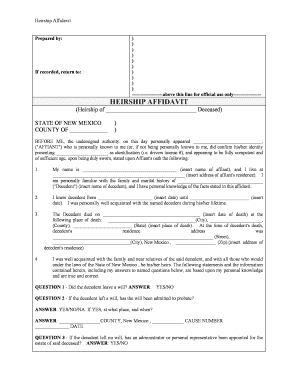
Identify the document as a Heirship Affidavit, list the decedent’s full legal name, last known residence, and county to situate the record clearly.
Statement of Facts

Provide concise, chronological facts about family relationships and events that establish heirship, including births, marriages, and prior divorces if relevant.

Property Schedule

Itemize real and personal property claimed by heirs with legal descriptions or account numbers to allow precise identification by third parties.

Attestation Clause

Include a sworn statement that the affiant believes the information to be true under penalty of perjury and specify the applicable jurisdiction.

Notarial Section

Provide space for notary acknowledgement, date, and seal; include any required witness signature lines per local practice.

Supporting Attachments

Attach death certificate, marriage records, and copies of deeds or title documents that corroborate the assertions in the affidavit.

Essential Data Elements to Record

Decedent Details: Full legal name, DOB, last residence
Death Certificate: Certified copy or clear photocopy
Heir Identifiers: Full names and relationships
Property Identifiers: Parcel number or legal description
Affiant Identity: Affiant name and contact information
Notary Data: Notary name, commission, seal

Consequences of Errors or False Statements

Perjury Liability: Criminal exposure for knowingly false statements
Title Rejection: Title companies may refuse transfers
Civil Disputes: Heir challenges and litigation risk
Financial Penalties: Court-ordered restitution possible
Delay in Transfer: Property access delayed for beneficiaries
Tax and Reporting: Potential IRS record issues; consult IRC rules

Common Preparation Mistakes to Avoid

  • Using nicknames or initials instead of full legal names, which can lead to identity mismatches and title rejections.
  • Failing to attach a certified death certificate or relevant deeds, leaving assertions unsupported by primary documents.
  • Omitting clear legal descriptions for real property; vague or partial descriptions often force additional title searches.
  • Neglecting to confirm whether the county recorder or title company accepts heirship affidavits for the specific asset type.

Where to File or Present an Heirship Affidavit

Routes vary by purpose: county recording for real property, financial institutions for accounts, or title/escrow for closings.

  • County Recorder: Record to update public land records
  • Title Company: Provide for property closings and insurance
  • Banks/Depositories: Submit to release funds or close accounts
  • Estate Counsel: Retain for dispute resolution or probate avoidance

How to Complete and Share the Affidavit Online

Configure a digital workflow that collects signatures, attachments, and notarization confirmations to streamline acceptance by recipients.

Field Configuration
Signature Fields Require signer name, signature, and date
Attachment Field Allow upload of death certificate and deeds
Authentication Use email + SMS or stronger options
Notary Integration Support RON or in-person notary workflows

Digital Signing and eSubmission Considerations

Verify the receiving party accepts electronic signatures, uploaded documents, and any remote notarization method you plan to use.

  • File Formats: PDF or DOCX accepted by most title companies
  • Integrations: Works with CRM and cloud storage systems
  • Authentication: Email, SMS OTP, or advanced signer ID

Timing Expectations and Typical Processing Steps

There is no universal statutory deadline for filing an heirship affidavit; timeliness is driven by recipient needs and the urgency of asset transfer.

Prepare Documents:

Gather within days of learning of decedent’s death to avoid delays

Notarization:

Obtain prior to submission; scheduling varies by notary availability

Recorder Review:

County offices may process in 1–4 weeks depending on workload

Title Company Turnaround:

Escrow acceptance can take 3–10 business days after submission

Bank Processing:

Institutions may take 7–30 days to release funds after review

eSignature Vendor Pricing Snapshot for Heirship Affidavit Workflows

Compare typical starting prices and core capabilities for common eSignature providers used to collect signatures and notarizations for affidavits.

signNow DocuSign Adobe Sign PandaDoc HelloSign
Starting Price $8/user/mo $15/user/mo $14/user/mo $19/user/mo $15/user/mo
Free Trial Yes, 7-day trial No No Yes, limited Yes, limited
Bulk Send Yes Yes Yes Yes No
Audit Trail Yes Yes Yes Yes Yes
HIPAA Compliant Yes Yes Yes No No

Frequently Asked Questions About New Mexico Heirship Affidavits

Answers to common questions about preparation, notarization, acceptance, and electronic signing of heirship affidavits in New Mexico.


Need help? Contact support

be ready to get more
Join over 28 million airSlate SignNow users