Establishing secure connection…Loading editor…Preparing document…

Complaint for Temporary Restraining Order

This template is fully customizable. Edit the text, fill out the fields, and send it for signature. Give it a try!
Complaint for Temporary Restraining Order

What a Complaint for Temporary Restraining Order Is

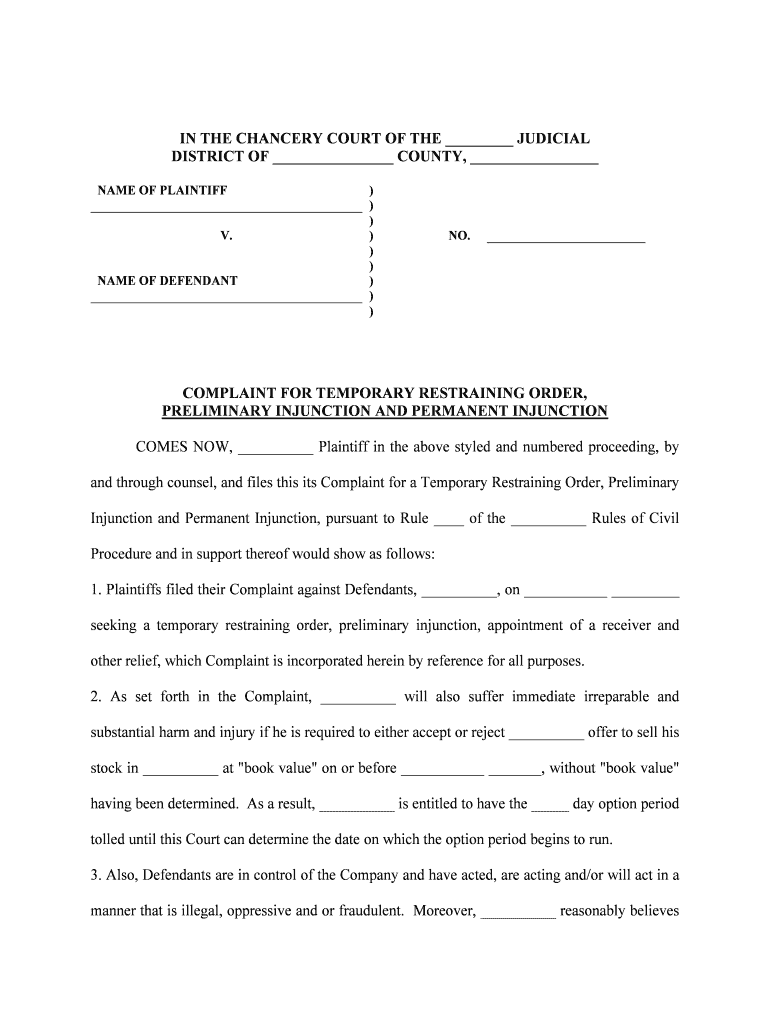
A Complaint for Temporary Restraining Order is a sworn pleading filed in civil court asking a judge to grant immediate, short-term relief to preserve the status quo before a full hearing can occur. The complaint describes the parties, the facts showing irreparable harm or likelihood of success on the merits, and the specific temporary relief requested. Courts generally require evidence and legal grounds to justify an ex parte order. Because rules differ by jurisdiction, the complaint must follow local court forms and procedural requirements to be accepted and considered by the court.

Why this Complaint Matters

A properly prepared complaint can obtain prompt court protection to prevent immediate harm, preserve evidence, and set the schedule for a preliminary injunction hearing.

Why this Complaint Matters

Who Prepares and Uses This Complaint

Typical filers include private plaintiffs, small businesses, and attorneys seeking time-sensitive court relief.

  • Individuals alleging immediate threat to safety, property, or contractual rights, often seeking temporary restraining orders ex parte.
  • Small businesses or commercial parties facing imminent asset seizure, IP infringement, or contract breaches that require swift court intervention.
  • Civil litigators and their staff who draft pleadings, gather supporting affidavits, and coordinate urgent filing and service.

Primary Signers and Filing Parties

Plaintiff

A person or entity alleging immediate harm; must provide factual statements and sign the complaint under penalty of perjury. Accuracy matters because courts evaluate credibility and may sanction false statements.

Attorney

A licensed attorney may prepare and sign the complaint on behalf of a represented plaintiff; counsel coordinates evidence, ex parte requests, and compliance with local emergency rules.

Core Parts of a Strong Complaint for Temporary Restraining Order

A professional complaint organizes facts and legal argument to support an emergency order and to give the court a clear, verifiable basis for immediate relief.

Caption

Court name, case number (if known), party names, and document title; correct caption ensures court processing and proper assignment to a judge.
Jurisdictional Statement

Short statement citing the court's authority to hear the matter and the statutory or equitable basis for temporary relief under applicable state or federal law.

Statement of Facts

Chronological, specific facts establishing the imminent harm, dates, locations, and actions by the defendant that justify emergency relief.

Legal Claims

Concise legal causes of action tied to facts and the standard for a TRO, such as likelihood of success, irreparable harm, balance of equities, and public interest.

Requested Relief

Precise, enforceable orders sought (e.g., prohibiting contact, preserving property, securing documents) with proposed duration and terms.

Supporting Evidence

Affidavits, declarations, exhibits, and any emergency declarations detailing witness statements, documents, photos, or logs that corroborate urgent need.

Required Information and Common Data Elements

Plaintiff Name: Full legal name
Defendant Name: Full legal name
Case Caption: Court title and docket info
Relief Requested: Specific order language
Factual Basis: Concise harm timeline
Supporting Exhibits: Numbered evidence list

Step-by-Step: Preparing and Filing the Complaint

Follow these steps to prepare a complaint that meets emergency standards and local filing rules.

  • 01
    Gather Evidence: Collect documents, photos, witnesses, and logs supporting imminent harm.
  • 02
    Draft Complaint: Write a concise pleading including facts, claims, and exact relief requested.
  • 03
    Prepare Affidavit: Attach a sworn affidavit or declaration establishing urgency and truth under penalty of perjury.
  • 04
    File and Serve: Submit to the clerk per local emergency procedures and effect service consistent with rules.

Customizing an Online TRO Complaint Workflow

When using an online editor, configure fields and routing to mirror court filing and service steps.

Field Configuration
Plaintiff/Defendant Fields Required, single-line, auto-validate
Date Fields MM/DD/YYYY format
Evidence Attachments Allow PDF, JPG; label by exhibit number
Signature Routing Enable attorney signature and timestamp

Where to File and How the Complaint Moves Through Court

Filing routes vary; emergency complaints typically go to the county or federal district clerk's office that has jurisdiction over the dispute.

  • Clerk Submission: File with the clerk either in person or via the court's e-filing system.
  • Ex Parte Review: Judge or staff may review filings for immediate temporary relief.
  • Scheduling: Court sets a preliminary hearing or order duration and provides service instructions.
  • Service: Plaintiff must serve the defendant according to local civil procedure rules.

Digital Signing and eSubmission Considerations

Electronic tools can streamline drafting and internal approvals but do not replace court filing rules for ex parte motions.

  • eSign Use: Useful for attorney-client approvals
  • Court Filings: Follow court-specific e-filing rules
  • Authenticity: Retain audit trail and signer identity

Key Timeframes and Deadlines to Watch

Time sensitivity drives TRO practice; observe court-imposed deadlines for emergency review, service, and preliminary hearings.

Emergency Review Window:

Clerk or judge may review filings immediately upon submission.

Ex Parte Duration:

Temporary orders often last a short preset period until a hearing is held.

Hearing Scheduling:

Courts typically schedule a preliminary hearing within days to weeks.

Service Deadline:

Service must follow local rules promptly after filing or within the time ordered.

Appeal Timing:

Any emergency order may be subject to expedited appellate procedures per jurisdiction.

Typical Case Milestones from Filing to Hearing

This sequence outlines common milestones after a TRO complaint is submitted.

01

Filing Submitted

Clerk receives complaint and supporting affidavit for emergency consideration.

02

Judicial Review

Judge evaluates urgency and may issue ex parte relief if standards are met.

03

Service of Process

Plaintiff effects service on the defendant as ordered by the court.

04

Preliminary Hearing

Court holds a hearing to decide whether to convert TRO into a preliminary injunction.

Common Mistakes to Avoid When Preparing the Complaint

  • Insufficient factual detail: vague timelines or missing dates weaken claims of imminent harm and may cause denial of ex parte relief.
  • Failure to attach evidence: omitting sworn affidavits, exhibits, or logs that corroborate immediate danger reduces credibility.
  • Improper service assumptions: assuming informal notice is sufficient can result in dismissal or delayed relief.
  • Overbroad requests: asking for sweeping injunctions without narrow, specific terms risks rejection or later narrowing by the court.

Penalties and Risks of Errors in Emergency Filings

Denial of Relief: Court may refuse TRO
Sanctions: Potential monetary or case-management sanctions
Perjury Risk: False statements can lead to criminal exposure
Delay: Incorrect filings delay protection
Service Defect: Improper service may void orders
Appeal Exposure: Orders can be quickly appealed

Representative Use Cases

Real-world examples show how complaints and supporting affidavits are assembled and used in different scenarios.

Workplace Harassment

An employee documents repeated threats and submits time-stamped messages as exhibits

  • Plaintiff requests a no-contact TRO to prevent further harassment
  • The court issued a short-term order pending a full hearing; the supporting evidence was central to the judge's finding of immediate risk.

IP Misappropriation

A small tech firm captures internal logs showing rapid exfiltration of source code

  • The complaint seeks an emergency freeze on the defendant's access to servers
  • The TRO preserved key evidence and prevented further distribution while the parties prepared for the preliminary injunction hearing.

Practical Tips for Accuracy and Speed

Follow these best practices to improve the likelihood of prompt court action and to reduce procedural delays.

Be Precise
Use exact dates, locations, and language to demonstrate immediacy and limit ambiguity in requested orders.
Attach Proof
Include sworn affidavits and labeled exhibits that directly corroborate the facts in the complaint.
Check Local Rules
Confirm ex parte procedures, allowable service methods, and any required forms with the court clerk before filing.
Document Service
Preserve proof of service and any attempted service to show compliance with court directives.

Comparing eSignature Options for Preparing and Routing TRO Documents

When choosing an eSignature provider for drafting, approvals, and internal sign-off, compare pricing, bulk send, audit trails, and HIPAA capabilities.

signNow DocuSign Adobe Sign PandaDoc HelloSign
Starting Price $8/user/mo $15/user/mo $14/user/mo $19/user/mo $15/user/mo
Free Trial 7-day free trial Varies by vendor Varies by vendor Varies by vendor Varies by vendor
Bulk Send Yes Yes Yes Yes No
Audit Trail Yes Yes Yes Yes Yes
HIPAA Compliant Yes Yes Yes No No
Envelope Cap No cap 100 envelopes/user/year Varies by plan Varies by plan Varies by plan

Frequently Asked Questions About TRO Complaints

Common questions about e-signatures, filing, and service for complaints seeking temporary restraining orders.


Need help? Contact support

be ready to get more
Join over 28 million airSlate SignNow users