Establishing secure connection…Loading editor…Preparing document…

Idaho Certificate of Trust

This template is fully customizable. Edit the text, fill out the fields, and send it for signature. Give it a try!
Idaho Certificate of Trust

What the Idaho Certificate of Trust Is and when it’s used

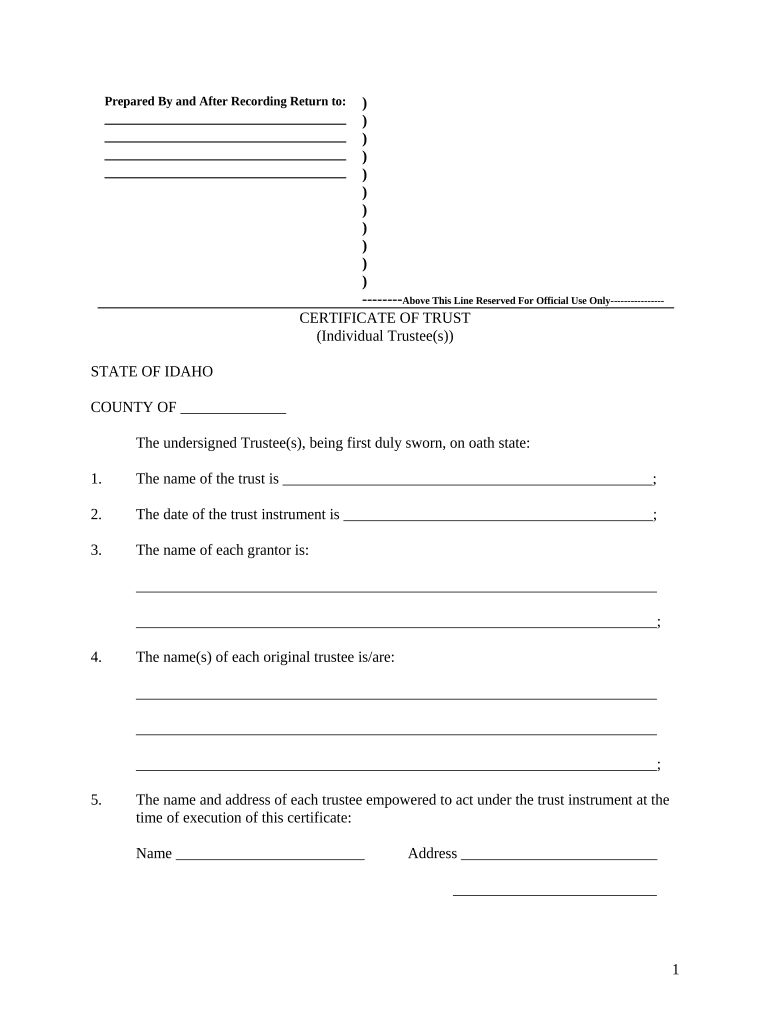
An Idaho Certificate of Trust is a concise, transferrable summary of a trust’s existence and basic trustee powers used to prove authority without revealing the trust instrument itself. It typically includes the trust name, date, trustee identity, and a statement of the trustee’s power to act. The certificate is provided to banks, title companies, and other third parties that need proof of trust authority for transactions such as real estate closings, account administration, or asset transfers, without exposing confidential trust terms.

Why a Certificate of Trust matters for trust administration

A Certificate of Trust allows trustees to demonstrate authority quickly while keeping the trust’s private terms confidential, reducing friction with financial institutions and title companies.

Why a Certificate of Trust matters for trust administration

Who typically requests or receives a Certificate of Trust

Common recipients include banks, title companies, and counterparties that require proof of trustee authority but not full trust details.

  • Trustees and successor trustees needing to access accounts or close real estate transactions.
  • Banks and financial institutions verifying signature authority for account changes.
  • Title companies and escrow agents confirming authority during property transfers.

The certificate is a practical document for third parties who must rely on the trustee’s authority without reviewing the full trust instrument.

Stepwise process to complete a Certificate of Trust

Follow these sequential steps to prepare, authenticate, and deliver the certificate for acceptance.

  • 01
    Prepare document: Gather the trust name, date, and trustee details from the trust instrument.
  • 02
    Draft certificate: Populate required fields with exact names and dates to match original documents.
  • 03
    Authenticate: Have the trustee sign before a notary or use an accepted RON process if allowed.
  • 04
    Deliver: Provide the executed certificate to the requesting bank, title company, or other party.

How to route and track the certificate in a digital workflow

Suggested configuration for online completion and secure delivery to third parties.

Field Configuration
Document type PDF/A or secure PDF compatible with e-sign standards
Signer authentication Email link with SMS code or stronger MFA for trustee identity
Notarization Enable RON where permitted or plan in-person notarization
Recipient delivery Send signed copy plus certificate of completion to requestor

Where to send the completed Certificate of Trust

Common submission destinations and what they need from you.

  • Bank or custodian: Provide executed certificate to update accounts or authorize transactions.
  • Title company: Deliver certificate at closing to establish trustee authority for deeds.
  • Escrow agent: Include certificate with closing documentation to enable disbursements.
  • Other counterparties: Provide the certificate to vendors, brokers, or insurers that request proof of authority.

Digital signing and technical considerations

Use a signing platform that supports notarization workflows, strong audit trails, and common file formats.

  • File formats: PDF, Word DOCX, and PDF/A are widely accepted
  • Integrations: Connectors to CRM and cloud storage ease delivery
  • Authentication: SMS, email link, or KBA depending on risk profile

Ensure the chosen platform preserves timestamps and provides a verifiable certificate of completion matching ESIGN/UETA requirements.

Essential data fields found on an Idaho Certificate of Trust

Trust name: Exact legal name
Execution date: Original trust date
Trustee identity: Full legal name
Trust powers: Scope of authority
Record location: Where original trust is held
Notary block: Acknowledgement details

What a professionally prepared certificate includes

A professional certificate balances clarity with privacy: include only the facts third parties need to rely on trustee authority.

Concise identity

Trust name and date stated clearly so institutions can match records without reviewing the trust instrument itself.
Authority statement

Explicit language describing trustee powers to sign, sell, encumber, or manage assets as relevant to the transaction.

Trust instrument location

Reference the custodian or county where the original trust is kept for verification if required.

Successor naming

Identify successor trustees or state 'none named' to prevent future disputes during transactions.

Signature and date

Trustee signature with printed name and execution date for clarity and recordkeeping.

Notarial acknowledgement

Notary block or RON attestation to authenticate the trustee’s signature when requested by third parties.

Common mistakes to avoid when preparing a Certificate of Trust

  • Using a trust name variant that does not exactly match the trust instrument, causing institutional rejection or delays.
  • Omitting the trustee’s printed name or title, which complicates identity verification for banks and title agents.
  • Failing to notarize when the recipient expects a notarized acknowledgement, resulting in refusal to accept the document.
  • Providing excessive trust detail that undermines privacy and defeats the purpose of a certificate.

Risks and potential consequences of an incorrect certificate

Transaction delay: Closings or disbursements can be postponed
Account refusal: Banks may refuse to accept authority
Title problems: Property transfers may be delayed or rescinded
Liability exposure: Trustee may face claims for improper transfers
Invalid acceptance: Noncompliant notarization can void reliance
Reputational risk: Counterparty distrust and client complaints

Real-world examples of Certificates of Trust in practice

Below are concise examples showing how organizations rely on a certificate to complete trust-related transactions.

Optica Ventures LLC

A venture firm needed trustee authority at a funding close to transfer an asset

  • The signed certificate allowed the trustee to authorize the transfer without disclosing investment terms
  • The certificate streamlined review by legal and banking counterparts while preserving the trust instrument’s confidentiality.

Martin Properties

A property manager required proof of trustee power to sell rental property

  • The title company accepted a notarized certificate in lieu of the full trust document
  • The closing proceeded without exposing estate planning details, reducing time to recordation and settlement.

Representative eSignature provider pricing and feature snapshot

Compare common plan-level criteria when choosing a platform for executing Certificates of Trust; signNow is listed first per vendor comparison conventions.

signNow DocuSign Adobe Sign PandaDoc HelloSign
Starting Price $8/user/mo $15/user/mo $14/user/mo $19/user/mo $15/user/mo
Free Trial 7-day trial No No Yes, limited Yes, limited
Bulk Send Yes Yes Yes Yes No
Audit Trail Yes Yes Yes Yes Yes
HIPAA Compliant Yes Yes Yes No No

Frequently asked questions about Certificates of Trust

Answers to common questions about validity, notarization, e-signing, and acceptance by banks or title companies.


Need help? Contact support

be ready to get more
Join over 28 million airSlate SignNow users