Establishing secure connection…Loading editor…Preparing document…

Sale of Copyright to Published Book

This template is fully customizable. Edit the text, fill out the fields, and send it for signature. Give it a try!
Sale of Copyright to Published Book

What a Sale of Copyright to a Published Book Covers

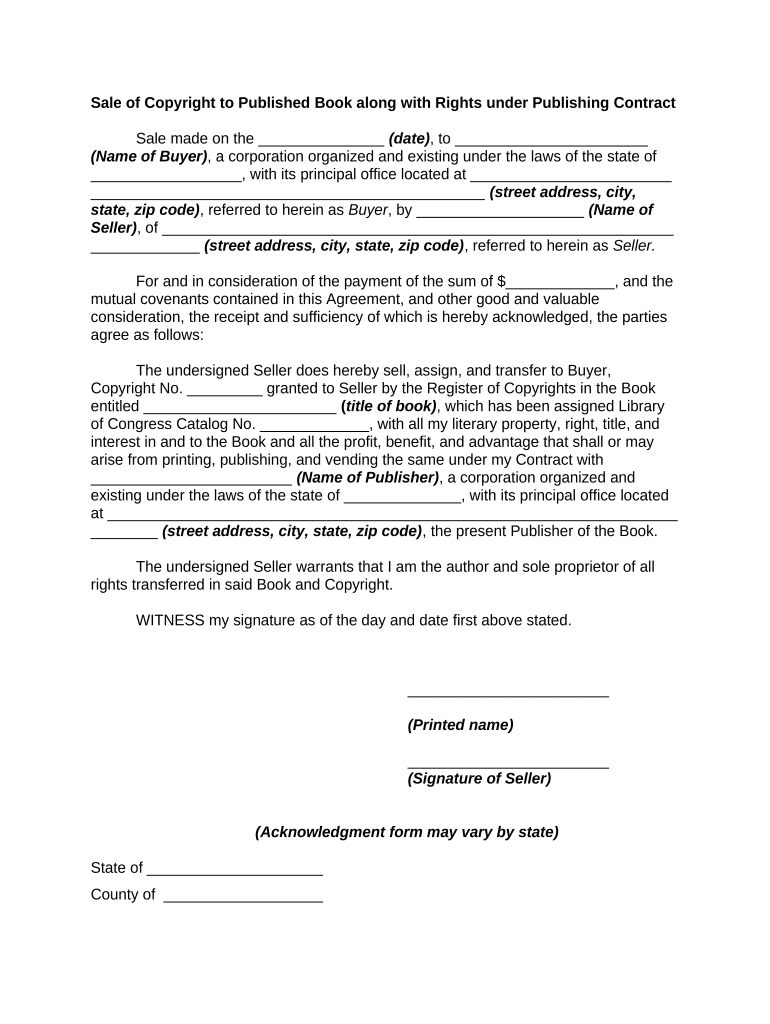
A Sale of Copyright to a Published Book is a written agreement transferring ownership of specified copyright interests from the author (or current copyright holder) to another party, typically a publisher or assignee. The document describes what rights are transferred (exclusive or nonexclusive), the scope (territory, media, and term), the consideration paid, and any retained rights or reversion conditions. It creates enforceable rights and obligations when signed by parties with authority and executed according to applicable legal formalities, and may be recorded with the U.S. Copyright Office if the parties choose.

Why a Clear Copyright Sale Agreement Matters

A precise agreement reduces future disputes by defining exactly which rights are assigned, how royalties or lump-sum payments are handled, and what reversion or moral-rights protections apply.

Why a Clear Copyright Sale Agreement Matters

Who Commonly Prepares or Signs This Agreement

Each signer should ensure they have authority to transfer rights and confirm any prior licenses or encumbrances are disclosed.

  • Independent authors seeking to assign full publication rights to a commercial publisher for distribution and marketing.
  • University presses or academic publishers acquiring rights from faculty authors for scholarly works and textbooks.
  • Literary agents negotiating assignment terms on behalf of authors while preserving specified rights.

Primary Roles Who Sign

Author

The individual or entity that originally owns the copyright. The author's signature conveys ownership interests; authors should confirm prior work-for-hire or third-party contributions before assigning rights.

Publisher

The acquiring party that will exploit the work. Publishers typically confirm the scope of rights, payment terms, and warranties before accepting assignment and executing the sale document.

Core Elements to Include in a Professional Sale Agreement

A well-drafted sale identifies the parties, describes the transferred rights, specifies consideration and payment timing, and includes warranties, reversion triggers, and dispute-resolution provisions.

Parties

Full legal names and capacity (individual, corporation, LLC), mailing addresses, and contact details for all assignor and assignee entities.
Rights Transferred

Precise description of exclusive or nonexclusive rights, formats (print, digital, audio), territory, and duration or term limits.

Consideration

Payment terms: lump sum, advance against royalties, or periodic royalties, plus timelines and withholding procedures if applicable.

Warranties

Author representations about original authorship, absence of prior exclusive grants, and authority to assign — standard indemnities follow.

Reversion

Conditions under which rights revert to the author, such as out-of-print triggers, breach, or failure to publish within a specified window.

Recording

Whether the assignment will be recorded with the U.S. Copyright Office and who bears the filing cost.

Step-by-Step: Completing a Sale of Copyright

Follow these sequential steps to prepare, finalize, and record a sale of copyright for a published book.

  • 01
    Draft: Describe parties, rights, consideration, term, and reversion conditions in clear language.
  • 02
    Review: Have legal counsel confirm warranties, prior grants, and any third-party permissions.
  • 03
    Execute: Obtain signatures from authorized signatories; include dates and printed names.
  • 04
    Record: Decide whether to record the assignment with the U.S. Copyright Office for public notice.

How to Configure an Electronic Signing Workflow

Set up fields, signer order, and authentication to ensure the agreement executes cleanly and is legally defensible.

Field Configuration
Signature Place clearly for each party; include date fields adjacent to signatures.
Initials Add initial fields on pages where terms change or important clauses appear.
Authentication Use email plus optional SMS or ID verification for stronger signer attribution.
Audit Trail Enable detailed logging: timestamps, IP addresses, and certificate of completion.

Where to Send or File the Signed Agreement

After signatures, route copies to the parties, record if desired, and archive an unalterable version for retention.

  • Assignee: Send an executed copy to the acquiring publisher's legal or rights department.
  • Assignor: Provide the author a signed copy for their records and tax reporting.
  • Copyright Office: Record the assignment if public notice or chain-of-title proof is needed.
  • Accounting: Forward payment and royalty instructions to the publisher's accounting team.

Digital Signing and File Format Considerations

Verify the platform preserves an unalterable signed PDF and stores a detailed audit trail for evidentiary use.

  • Integrations: Salesforce, Microsoft 365, NetSuite are common integration targets.
  • Formats: PDF, Word DOCX, HTML, and Excel are typically supported.
  • Security: TLS 1.2/1.3 in transit and AES-256 at rest are standard controls.

eSignature Vendor Pricing Snapshot for Executing Copyright Sales

Basic pricing and feature differences can affect per-document cost and compliance capabilities when you finalize a copyright assignment.

signNow DocuSign Adobe Sign PandaDoc HelloSign
Starting Price $8/user/mo $15/user/mo $14/user/mo $19/user/mo $15/user/mo
Free Trial 7-day free trial No No No No
Bulk Send Yes Yes Yes Yes No
Audit Trail Yes Yes Yes Yes Yes
HIPAA Compliant Yes Yes Yes No No

Consequences of an Incorrect or Incomplete Sale

Invalid Transfer: May leave ownership unclear
Financial Liability: Potential indemnity and damages
Recording Issues: Failure to record can harm chain of title
Tax Consequences: Misreported consideration can trigger IRS scrutiny
Contract Disputes: Ambiguous terms invite litigation
License Conflicts: Prior grants may survive assignment

Common Mistakes to Avoid When Preparing an Assignment

  • Using vague transfer language such as 'all rights' without defining media, territory, and duration creates ambiguity and future disputes.
  • Failing to disclose prior licenses, co-authors, or third-party contributions that may limit assignor’s ability to transfer exclusive rights.
  • Omitting a clear payment schedule or mixing royalty accounting methods can lead to missed payments and audit disagreements.
  • Not recording a voluntary assignment with the U.S. Copyright Office when chain-of-title evidence is needed for enforcement or licensing.

Practical Tips for Accurate and Efficient Completion

Adopt standard templates, verify signer authority, and preserve an unalterable record of the executed agreement to reduce friction and legal risk.

Use Plain Language
Draft clear, specific clauses for rights transferred, territories, formats, and payment terms so the parties' intent is unmistakable and enforceable.
Confirm Prior Grants
Require the author to list prior licenses and contributions to ensure the assignor actually owns the rights they are selling.
Select Governing Law
Choose a governing state law and dispute-resolution method (arbitration or court) appropriate for the parties' locations and risk tolerance.
Keep Audit Records
Retain signed copies, audit trails, and proof of delivery for at least the recommended retention period to support enforcement and accounting.

Supporting Documents and Export Options to Include

Attach or reference documents that confirm authorship, prior grants, payment history, and any required third-party permissions to support the sale.

Author Declarations

Signed statements confirming original authorship, absence of conflicting grants, and disclosure of third-party content or contributors.

Prior Licenses

Copies of any existing licenses, option agreements, or work-for-hire agreements that affect the scope of rights being conveyed.

Payment Records

Receipts or payment schedules documenting advances, royalty formulas, and accounting intervals to tie consideration to obligations.

Export Formats

Save executed documents as PDF/A for long-term storage and maintain an editable DOCX for internal records when necessary.

Real-World Examples of Copyright Assignments

Two typical scenarios illustrate how assignments are used and recorded in practice.

Independent Author Sale

A self-published author assigns worldwide print and digital rights to a small publisher for an upfront advance and royalties.

  • Advance paid upfront; royalties at 10% net receipts.
  • The assignment includes a five-year term with reversion if the work is out of print for 18 months, and the parties elect to record the assignment with the Copyright Office for chain-of-title clarity.

University Press Acquisition

A faculty author grants nonexclusive educational rights to a university press while retaining first serial rights for excerpts.

  • Nonexclusive educational license limited to course adoption.
  • The agreement specifies revenue-sharing, institutional approvals, and retention of moral rights by the author; counsel reviews to ensure compliance with institutional IP policies.

Key Dates, Filing Deadlines, and Recordkeeping Notes

Some timing and tax-related obligations arise after the sale; track payment dates, reporting requirements, and recording actions.

Effective Date Entry:

Enter the agreed effective date as MM/DD/YYYY for clarity on obligations and tax year reporting.

Payment Schedule:

Adhere to milestone or royalty payment dates specified in the agreement to avoid breach.

Tax Reporting:

Report lump-sum payments or royalties per IRS guidance; consult IRC and a tax advisor for treatment and withholding.

Recording Assignment:

Record assignment with U.S. Copyright Office when proof of chain of title is required.

Document Retention:

Retain records per federal and industry retention rules to support audits and enforcement.

Key Milestones from Draft to Recordation

A simple numbered milestone sequence helps track the agreement lifecycle and responsibilities.

01

Draft Completed

Agreement finalized and internal approvals obtained before external review.

02

Counsel Review

Legal review confirms warranties, prior grants, and tax implications.

03

Execution

All parties sign and date the agreement using authorized signatories.

04

Optional Recording

Assignment recorded with the Copyright Office if public notice or chain-of-title proof is desired.

Frequently Asked Questions About Sale of Copyright to a Published Book

Answers to common questions about formality, recording, signatures, and risks when transferring copyright.


Need help? Contact support

be ready to get more
Join over 28 million airSlate SignNow users