Establishing secure connection…Loading editor…Preparing document…

Illinois Workers Compensation

This template is fully customizable. Edit the text, fill out the fields, and send it for signature. Give it a try!
Illinois Workers Compensation

Overview of Illinois Workers Compensation

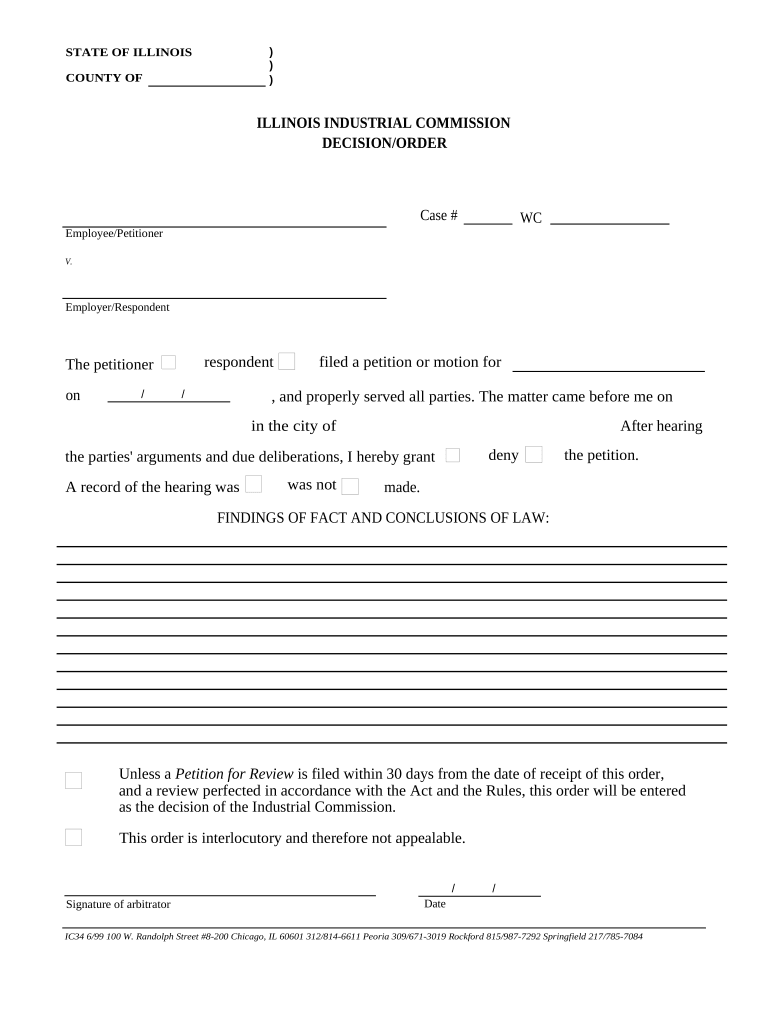
Illinois Workers Compensation is the statutory system that provides medical care, wage replacement, and vocational benefits to employees who suffer work-related injuries or occupational diseases. Administered under the Illinois Workers' Compensation Act (820 ILCS 305) and overseen by the Illinois Workers' Compensation Commission, the program defines employer liability, required reporting, and adjudication procedures. Employers generally must carry insurance or qualify as self-insured, and injured workers may file claims for benefits, medical care, temporary or permanent disability, and job retraining. The statute sets notice, filing, and appeal processes while allowing electronic records and signatures consistent with federal ESIGN and state law.

Why accurate claims matter

Workers compensation establishes predictable benefits for injured workers, limits employer liability, and speeds access to medical care and wage replacement. Proper claims reduce litigation risk and support return-to-work planning while ensuring compliance with Illinois statutes and federal e-signature standards such as ESIGN and UETA.

Why accurate claims matter

Who completes and manages these claims

Employers, human resources professionals, insurance carriers, third-party administrators, and injured employees are the primary users who prepare and manage Illinois Workers Compensation claims.

  • Employees filing first aid or lost-time claims; often provide injury details and medical authorization.
  • Employers or HR completing initial incident reports and notifying carriers within company timelines.
  • Insurers, attorneys, and third-party administrators processing benefits, submitting reserves, and handling appeals.

Core elements of a complete claim

A professional Illinois Workers Compensation claim contains clear sections for identity, incident details, medical treatment, wage information, employer actions, and signatures to support adjudication and benefits delivery.

Employer Details

Enter employer name, FEIN or tax ID, mailing and physical address, contact person, phone number, and employer's insurance carrier or self-insured status for claims routing and insurer notification.
Employee Information

Record full legal name, date of birth, home address, Social Security number or TIN, job title, hire date, and regular pay rate to establish eligibility and benefit calculations.

Injury Description

Describe the date, time, precise location, body part(s) affected, mechanism of injury, contributing work duties, and witness names to support causation and coverage decisions.

Medical Treatment

Document initial treatment facility, attending physician, diagnostic tests, subsequent referrals, hospitalizations, and dates of each visit including medication, physical therapy referrals, work restrictions, and return-to-work notes.

Wage Records

Attach payroll records, wage statements, recent pay stubs, overtime calculations, and documentation of leave and employer-paid benefits to accurately compute temporary and permanent partial disability benefits.

Signatures

All required signatures and dates from employee, employer representative, and healthcare providers must be included; electronic signatures are acceptable if they meet ESIGN and UETA criteria.

Step-by-step: preparing and submitting a claim

Follow this sequence to prepare and submit an Illinois Workers Compensation claim with complete documentation and consistent timelines.

  • 01
    Collect Information: Gather identity, incident, medical, and wage documentation.
  • 02
    Complete Forms: Populate employer, employee, and injury sections fully.
  • 03
    Submit to Carrier: Send to insurer and file required employer reports.
  • 04
    Track and Respond: Monitor claim status and provide requested documents promptly.

Configuring a digital filing workflow

Configure a digital workflow to collect signatures, attach records, route to insurers, and maintain an audit trail compliant with ESIGN and state rules.

Field Configuration
Signature Type Allow e-sign, typed or drawn, with audit trail and timestamp.
Authentication Email link plus optional SMS code or KBA for high risk.
Document Types PDF, DOCX, or JPEG; preserve originals and flattened copies.
Notifications Immediate emails to stakeholders with signed PDF attachments and audit log.

How electronic submission flows through the process

This overview shows how electronic submission moves a workers compensation claim from intake through adjudication with visibility and recordkeeping.

  • Upload: Sender uploads form and attachments to the system.
  • Place Fields: Add signature, date, and conditional fields for reviewers.
  • Assign Signers: Define signing order, recipients, and authentication methods.
  • Complete Audit: System records timestamps, IPs, and completed PDFs for audit.

Technical and security considerations for e-filing

Electronic filing and eSign require compatible formats, signer authentication, and secure storage to meet Illinois and federal rules.

  • File Formats: PDF, DOCX, XLSX supported
  • Integrations: Salesforce, NetSuite, Google Workspace
  • Security: AES-256 at rest; TLS 1.2/1.3

Key timing considerations and internal deadlines

Time limits and internal deadlines affect notice, claim filing, medical authorizations, and employer reporting; missing deadlines can jeopardize benefits or create penalties.

Report injury to employer promptly:

Notify your employer as soon as possible and follow employer reporting procedures.

Employer files report to carrier:

Employer must submit initial report and insurer claim notice per company policy.

Obtain medical authorizations and referrals timely:

Provide treatment authorizations quickly to prevent unpaid bills and service denial.

File formal claim within statutory timeframes:

Verify applicable filing period with the Commission or counsel to preserve rights.

Appeal windows and procedural deadlines vary:

Adhere to administrative appeal timelines and evidence submission requirements to avoid dismissal.

Common risks and consequences of errors

Missed Notice: May lead to denial.
Inaccurate Wages: Incorrect benefit calculation.
Missing Medical Records: Delayed or reduced payments.
False Statements: Criminal penalties possible.
Late Filing: Statute may bar claim.
Employer Penalties: Fines, stop-work orders, civil exposure.

eSignature vendor pricing and feature comparison

Compare baseline pricing and key plan features for common e-signature vendors with signNow listed first for parity.

signNow DocuSign Adobe Sign PandaDoc HelloSign
Starting Price $8/user/mo $15/user/mo $14/user/mo $19/user/mo $15/user/mo
Free Trial 7-day free trial, no credit card required Varies by vendor Varies by vendor Varies by vendor Varies by vendor
Bulk Send Yes Yes Yes Yes No
Audit Trail Yes Yes Yes Yes Yes
HIPAA Compliant Yes Yes Yes No No
Envelope Cap No cap 100 envelopes/user/year Varies by plan Varies by plan Varies by plan

Frequently asked questions

Answers to frequent practical questions about preparing, signing, and submitting Illinois Workers Compensation claims, including electronic signatures and document retention guidance.


Need help? Contact support

be ready to get more
Join over 28 million airSlate SignNow users