Claimant Identity
Full legal name and contact details for the subcontractor or supplier asserting the lien.
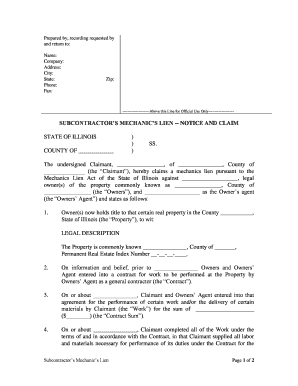
Filing the notice and claim preserves a statutory remedy to recover unpaid sums, places prospective purchasers and lenders on notice, and strengthens bargaining position for collection without immediate litigation.

These forms are used by subcontractors, material suppliers, equipment lessors, and specialty contractors working on improvements to real property who have not been paid in full.
Proper use ensures lien rights are preserved under Illinois lien law and informs owners, lenders, and general contractors of outstanding claims.
| Field | Configuration |
|---|---|
| Signers | Claimant signs first; optional witness or notary fields next |
| Attachments | Attach invoices, delivery tickets, and contract exhibits |
| Notifications | Auto-send completed copy to owner, contractor, and counsel |
| Archive | Save PDF/A and audit trail in secure storage |
Full legal name and contact details for the subcontractor or supplier asserting the lien.
Street address, parcel or legal description, and county where improvement is located.
Concise description of labor, services, or materials provided on the project.
Unpaid balance with precise dollar amount and statement of any offsets or payments received.
Dates when work commenced and was completed or last furnished to establish lien period.
Claimant signature, printed name, and signature date; notarization if state or county requires it.
Include the subcontract, purchase orders, and any signed change orders showing agreed work and rates.
Provide invoices, remittance records, and statements of account showing unpaid balances.
Attach delivery tickets, material receipts, and labor records that tie work to the property.
Include demand letters, email threads, or notices reflecting attempts to collect prior to filing.
Choose software that supports secure signing, PDF/A export, audit trails, and storage encryption.
Ensure the chosen platform provides an unalterable audit trail and preserves a certified copy suitable for court or title review.
| signNow | DocuSign | Adobe Sign | PandaDoc | HelloSign | |
|---|---|---|---|---|---|
| Starting Price | $8/user/mo | $15/user/mo | $14/user/mo | $19/user/mo | $15/user/mo |
| Free Trial | 7-day free trial | Varies by plan | Varies by plan | Varies by plan | Varies by plan |
| Bulk Send | Yes | Yes | Yes | Yes | Varies |
| Audit Trail | Yes | Yes | Yes | Yes | Yes |
| HIPAA Compliant | Yes | Yes | Yes | No | No |
Record the final date labor or materials were furnished — it starts the statutory clock
File the claim within the statutory period (commonly two years for civil actions in Illinois)
Serve owner and contractor per statute immediately after recording where required
If enforcing, initiate foreclosure action before the lien expires per state law
Keep copies until title clearing and potential appeals are final
Assemble contracts, invoices, delivery records, and correspondence
Draft the notice and claim, verifying property and party details
Record the claim with the county recorder where the property is located
Serve parties and pursue resolution or foreclosure if payment is not obtained
A subcontractor supplied cabinetry for a home renovation and remained unpaid for 90 days
A materials supplier delivered concrete but the general contractor withheld payment due to a dispute
The claimant is usually an officer or authorized representative of the subcontracting firm who can attest to amounts owed and sign under penalty of perjury; include printed name and title.
An attorney may prepare or review the claim and, where required, execute filings or affidavits; counsel involvement is common for high-value or contested liens.