Establishing secure connection…Loading editor…Preparing document…

Income Withholding Child Order

This template is fully customizable. Edit the text, fill out the fields, and send it for signature. Give it a try!
Income Withholding Child Order

What an Income Withholding Child Order Does

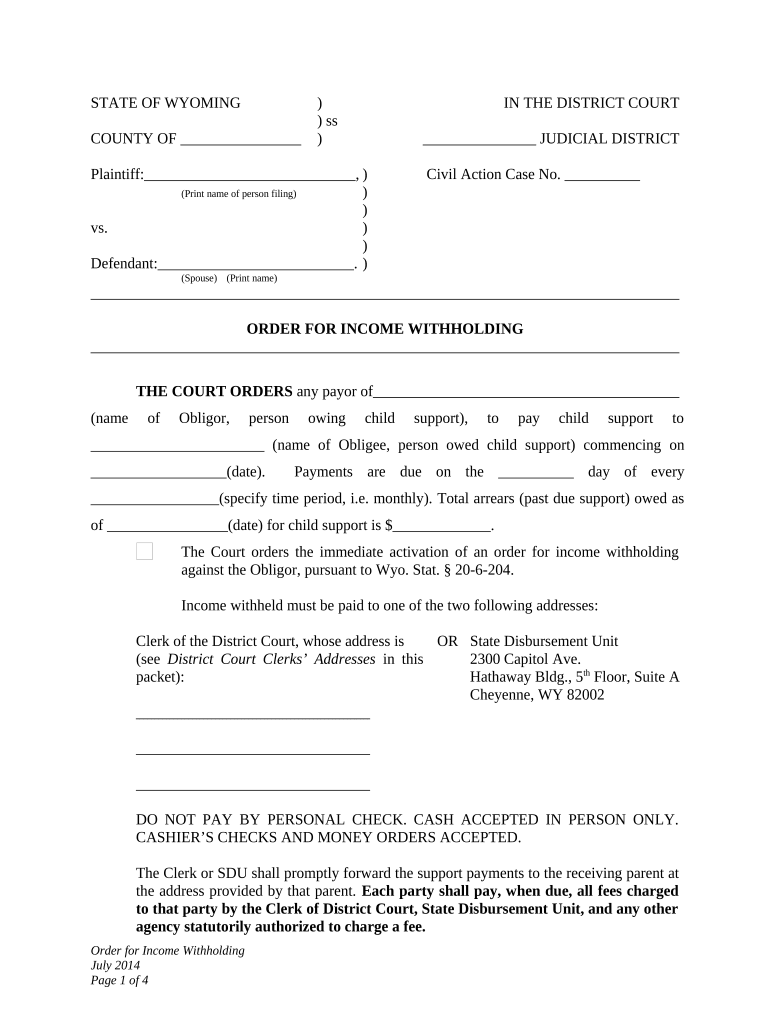
An Income Withholding Child Order is a court-issued directive that requires an employer, payer, or benefits administrator to withhold a portion of an employee's wages or payments and forward those funds for child support. The order identifies the obligor (payor), obligee (recipient), case number, withholding amount or percentage, and the effective date. It replaces ad hoc collection methods by creating a predictable payment stream enforceable by contempt, income withholding remedies, and administrative enforcement at the state level. Employers receive service copies and remit payments to the designated child support agency or payee as instructed.

Why courts and parents rely on this order

Income Withholding Child Orders centralize collection, reduce missed or late payments, and create a direct legal path for employers to remit support. They minimize enforcement costs and provide employers with a clear compliance process under state family law.

Why courts and parents rely on this order

Who completes and relies on an Income Withholding Child Order

The form involves several parties who each have distinct responsibilities and interests in ensuring correct completion and service.

  • Court clerks and judges: Prepare and enter orders; manage docket and service instructions for employers.
  • Obligees and custodial parents: Receive payments and confirm accuracy of amounts and remittance method.
  • Employers and payroll administrators: Implement withholding, remit funds, and report payments to the designated agency.

Step-by-step: preparing and serving the order

Follow a consistent sequence: draft or obtain the signed order, confirm employer details, serve the employer, and monitor initial remittance for accuracy.

  • 01
    Obtain signed order: Ensure the court signs or enters the order before service.
  • 02
    Verify employer info: Confirm employer name, EIN, and payroll contact before sending.
  • 03
    Serve employer: Deliver the order per state rules — certified mail or electronic service if authorized.
  • 04
    Confirm withholding: Check first payroll to verify correct deduction and remittance.

Common questions and quick answers

Answers to frequent issues when completing, serving, or enforcing an Income Withholding Child Order.


Need help? Contact support

Core elements found in a professional Income Withholding Child Order

A complete order contains structured sections for court identification, parties, withholding instructions, remittance routing, and administrative controls to support employer compliance and agency reconciliation.

Court header

Court name, county, case number, judge or clerk signature block, and date — provides legal authority and identifies the controlling jurisdiction for enforcement.
Party details

Full legal names, addresses, and identifying numbers for the obligor, obligee, and employer; accurate data is essential for matching payroll systems and routing payments.

Withholding terms

Clear specification of the withholding amount or percentage, priority ranking among obligations, frequency, and any caps required by law or the order itself.

Remittance instructions

Designated payee or state disbursement unit name, mailing or electronic routing details, and required reporting references to ensure correct deposit and accounting.

Employer directions

Practical steps for payroll: start date, how to calculate disposable earnings, contact for questions, and where to send withheld funds or reports.

Enforcement language

Statements describing penalties for noncompliance, contempt authority, and references to applicable state statutes and administrative remedies.

Fields that must always be present

Case number: Unique court ID
Obligor name: Legal name as on payroll
Employer details: Name, EIN, address
Withholding amount: Dollar or percent
Effective date: MM/DD/YYYY start
Remittance address: Payee or agency info

Consequences of incorrect or incomplete orders

Delayed payments: Missed support
Employer liability: Fines or penalties
Enforcement actions: Contempt proceedings
Credit issues: Collections or liens
Administrative cost: Increased agency workload
Incorrect payee: Funds misapplied

Common preparation errors to avoid

  • Using incomplete employer information, which can prevent payroll matching and delay withholding and remittance.
  • Failing to specify whether the amount is a flat dollar, percentage, or subject to legal maximums and priority rules.
  • Not verifying the effective date against the employer's payroll cycle, causing the first deduction to be missed or applied incorrectly.
  • Serving the wrong party or using improper service methods that do not meet state rules and thus impair enforcement options.

Typical processing flow after a court signs the order

After entry, the order moves from the court to the employer and child support agency; each step includes confirmation, implementation, and monitoring for payment accuracy.

  • Entry: Court signs and files the order.
  • Service: Employer and agency receive the order.
  • Implementation: Payroll applies withholding per order.
  • Reconciliation: Payments are reported and reconciled by the agency.

Digital workflow configuration for eSubmission

Set up a simple sequence to create, assign, and deliver the order electronically while capturing an audit trail for service and enforcement.

Field Configuration
Document source Upload court-signed PDF or generate from case management
Signers Judge/clerk signature and optional agency approval
Delivery method Certified mail, electronic service, or agency portal
Audit record Capture timestamp, IP, and recipient confirmation

Electronic filing and eSignature considerations

Determine whether your jurisdiction accepts electronic service, e-signed court orders, and remote notarization before using digital workflows.

  • Authentication: Email, SMS code, or stronger KBA options
  • Formats: Accepts PDF, PDF/A, and Word formats
  • Integrations: Works with case management and payroll systems

Timing and common deadlines to track

Observe service timing, employer implementation windows, and reporting periods to avoid missed payments or enforcement complications.

Service to employer:

Serve per state rules before withholding begins

Start of withholding:

Typically begins on the first payroll after effective date

Employer response window:

Employer must acknowledge or implement within payroll cycle

Reporting schedule:

Monthly or per-pay-period remittance schedules vary

Dispute timeframe:

Obligor must seek court relief to change withholding

Key milestones from entry to first remittance

Use a milestone view to track entry, service, employer processing, and confirmation of the first withheld payment.

01

Court entry

Order is signed and filed by the court.

02

Service on employer

Employer receives and acknowledges the order.

03

Payroll implementation

Withholding begins in the next payroll cycle.

04

First remittance

Agency or payee receives and reconciles funds.

eSignature vendor comparison for filing and serving orders

Core vendor pricing and capability differences relevant to high-volume document filing, secure eSigning, and integrations used when preparing Income Withholding Child Orders.

signNow DocuSign Adobe Sign PandaDoc HelloSign
Starting Price $8/user/mo $15/user/mo $14/user/mo $19/user/mo $15/user/mo
Free Trial 7-day free trial, no credit card Varies Varies Varies Varies
Bulk Send Yes (Business Premium) Yes Yes Yes No
Audit Trail Yes Yes Yes Yes Yes
HIPAA Compliant Yes (BAA available) Yes Yes No No
Envelope Cap No envelope cap 100 envelopes/user/year Varies by plan Varies by plan Varies by plan

Real-world examples of digital signing for court and payroll paperwork

Organizations use eSignature platforms to reduce turnaround time and maintain an audit trail when issuing court-directed payroll orders.

Optica Ventures (Brian Fitzgibbons)

Optica moved routine court and payroll forms online to speed processing and reduce manual handling.

  • They integrated signature workflows with their operations.
  • "The interface is simple and easy-to-use for our team; more importantly, it is just as easy for our customers."

Fertility Centers of Illinois (John Butler)

Clinical and administrative teams digitized signed authorizations and payroll directives to ensure reliable remittance.

  • The API connected with backend systems.
  • "The airSlate SignNow team has been exceptional, responsive, the API has been great, and we're extremely happy that we chose airSlate SignNow as a company."

be ready to get more
Join over 28 million airSlate SignNow users