Establishing secure connection…Loading editor…Preparing document…

Indemnification Agreement

This template is fully customizable. Edit the text, fill out the fields, and send it for signature. Give it a try!
Indemnification Agreement

What an Indemnification Agreement Is and when it applies

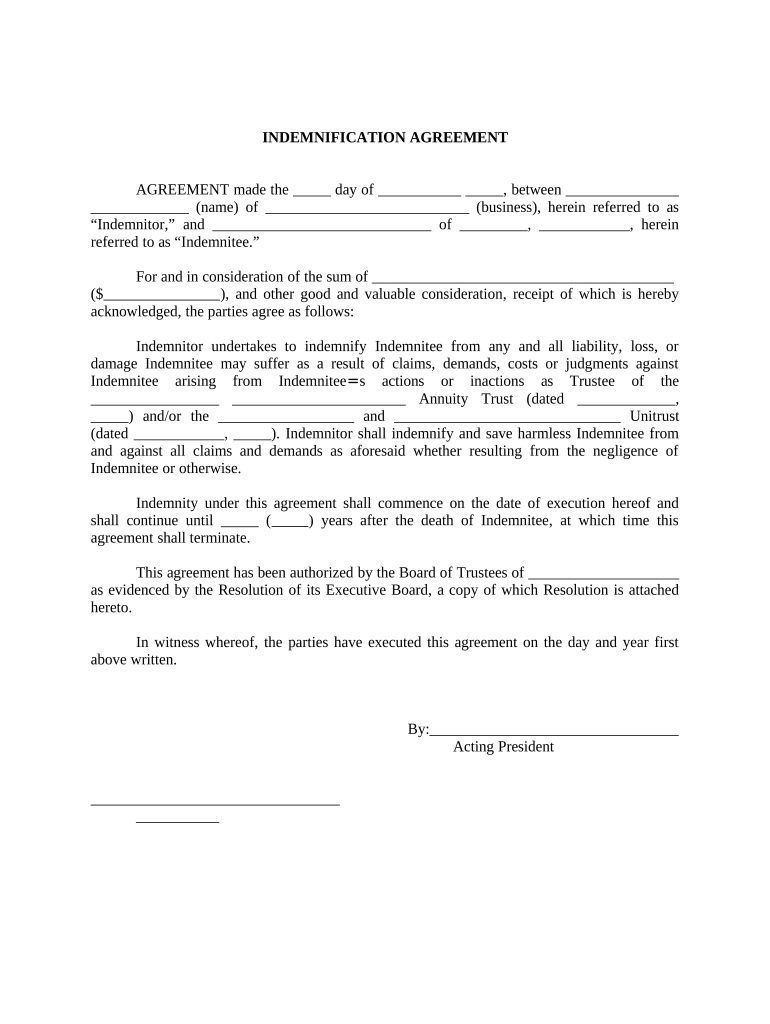
An Indemnification Agreement is a contract in which one party (the indemnitor) agrees to compensate or hold harmless another party (the indemnitee) from specified losses, claims, liabilities, or expenses arising from defined events. These agreements allocate financial responsibility for third-party claims, legal defense costs, and damages tied to actions or omissions described in the contract. Common uses include commercial contracts, service agreements, leases, and M&A documents. Clear scope, caps, and exclusions in the indemnity language determine practical exposure and enforceability between the parties.

Why a clear Indemnification Agreement matters

A well-drafted Indemnification Agreement defines who pays for what risk, reduces dispute ambiguity, and provides a contractual basis for cost recovery. It helps parties price risk, allocate liability, and set procedural steps for claims and defense.

Why a clear Indemnification Agreement matters

Who typically prepares and signs this agreement

Common users include contracting parties, general counsel, procurement teams, and project managers who need predictable risk allocation.

  • Vendors and service providers: Sellers often offer limited indemnities tied to performance or IP infringement.
  • Buyers and customers: Buyers seek broad indemnities for third-party claims and product defects.
  • Landlords and tenants: Lease indemnities assign responsibility for property damage and tenant actions.

Who signs on behalf of each party

Authorized Officer

A corporate officer or company signatory with delegated authority should sign indemnities. Confirm board, bylaw, or internal approval levels before execution to avoid contested authority.

Authorized Individual

For sole proprietors or small businesses, the owner or manager with contracting authority signs. Retain documentary evidence of signature authority when entering material indemnities.

Core elements to include in a professional Indemnification Agreement

Include precise language for scope, exclusions, defense control, limits, notice procedures, and survival to make the indemnity operational and enforceable.

Scope

Define covered claims, parties protected, and triggering events so obligations are specific rather than open-ended.
Exclusions

List exclusions such as willful misconduct, gross negligence, or preexisting claims to limit unintended exposure.

Defense Control

State whether the indemnitor may control defense and settlement and set requirements for indemnitee consent to settlements.

Monetary Limits

Specify caps, baskets, or deductibles and whether insurance proceeds reduce exposure; be explicit about joint and several liability.

Notice & Claims

Require prompt written notice, cooperation, and documentation of claims to preserve indemnitor rights and defenses.

Survival & Term

Clarify how long the indemnity survives termination and whether it continues after expiration for latent claims.

Step-by-step: completing the Indemnification Agreement

Follow these sequential actions to complete the agreement accurately and reduce later disputes.

  • 01
    Gather details: Collect legal names, addresses, and relevant contract references.
  • 02
    Define scope: Specify which claims and parties are covered and any exceptions.
  • 03
    Set limits: Decide caps, deductibles, and insurance offsets.
  • 04
    Sign and date: Ensure authorized signers sign with dates and retain a copy.

Where to send and how claims flow under the agreement

Understand the routing for notices, defense, and indemnity payments so both parties comply with procedural requirements.

  • Notice to Indemnitor: Send written claim notice to the address listed in the agreement.
  • Defense Assignment: Indemnitor may assume defense subject to consent and reservation rights.
  • Settlement Process: Require written consent before settling claims affecting indemnitee rights.
  • Payment & Reimbursement: Indemnitor reimburses documented defense costs and settlement amounts per terms.

How to set up an online signing workflow for an indemnity

Configure signature fields, witness or notary steps, and automated notifications to enforce notice and execution requirements.

Field Configuration
Signature Block Mandatory signature, printed name, title, and date fields
Notary/Witness Add conditional notary section if state law or parties require it
Claim Notice Field Include dedicated contact and delivery method fields
Attachments Allow exhibit uploads for schedules and insurance certificates

Digital signing considerations and integrations

Integrations with CRM, cloud storage, and contract repositories reduce manual routing and preserve executory evidence for claims and audits.

  • Audit Trail: Capture IP, timestamp, and action log
  • Authentication: Offer email, SMS, or advanced methods
  • Integrations: Connect with CRM and storage systems

How an Indemnification Agreement compares to similar documents

Compare common notice and liability tools so you can choose the correct instrument for your transaction.

Document Indemnification Agreement Liability Waiver
Enforceability contractual duty often limited by statute
Scope third-party claims & defense primary claimant releases
Typical Signers businesses and counterparties individual consumers
Notarization rarely required rarely required

Key timelines, deadlines, and response expectations

Timelines in the indemnity control notice, defense, and reimbursement obligations; adhere strictly to stated windows.

Effective Date:

Triggers when obligations begin; set as MM/DD/YYYY

Notice Period:

Require prompt written notice, commonly 10–30 days

Defense Acceptance:

Indemnitor typically has 10–30 days to assume defense

Claim Documentation:

Require contemporaneous invoices and proof of costs

Survival Period:

State how long indemnity survives termination

Common drafting mistakes to avoid

  • Vague scope language that fails to identify covered claim types or triggering events, leaving uncertainty during disputes.
  • Failing to address defense control and settlement consent, which can result in parallel counsel and settlement conflicts.
  • Omitting caps, baskets, or insurance offsets that cause unlimited exposure and unexpected financial liability.
  • Neglecting notice and cooperation requirements, which can invalidate reimbursement claims or impair the indemnitor’s defenses.

Risks and consequences of poorly prepared indemnities

Unlimited Liability: Potentially catastrophic exposure
Defense Costs: High legal expenses if not capped
Insurance Gaps: Policy exclusions can leave uncovered losses
Enforcement Disputes: Protracted litigation risk
Regulatory Issues: State law limits on waivers
Reputational Harm: Publicized claims damage credibility

Sample eSignature vendor comparison for executing an Indemnification Agreement

Compare core plan features and compliance attributes that affect executing and storing signed indemnities; signNow appears first as the specified vendor column.

signNow DocuSign Adobe Sign PandaDoc HelloSign
Starting Price $8/user/mo $15/user/mo $14/user/mo $19/user/mo $15/user/mo
Free Trial 7-day free trial, no credit card Varies Varies Varies Varies
Bulk Send Yes Yes Yes Yes No
Audit Trail Yes Yes Yes Yes Yes
HIPAA Compliant Yes Yes Yes No No

Frequently asked questions about Indemnification Agreements

Answers to common questions about enforceability, e-signatures, revocation, and signature authority for indemnities.


Need help? Contact support

be ready to get more
Join over 28 million airSlate SignNow users