Establishing secure connection…Loading editor…Preparing document…

Wyoming Initial Disclosures in Divorce Proceedings

This template is fully customizable. Edit the text, fill out the fields, and send it for signature. Give it a try!
Wyoming Initial Disclosures in Divorce Proceedings

What Wyoming initial disclosures in divorce proceedings cover

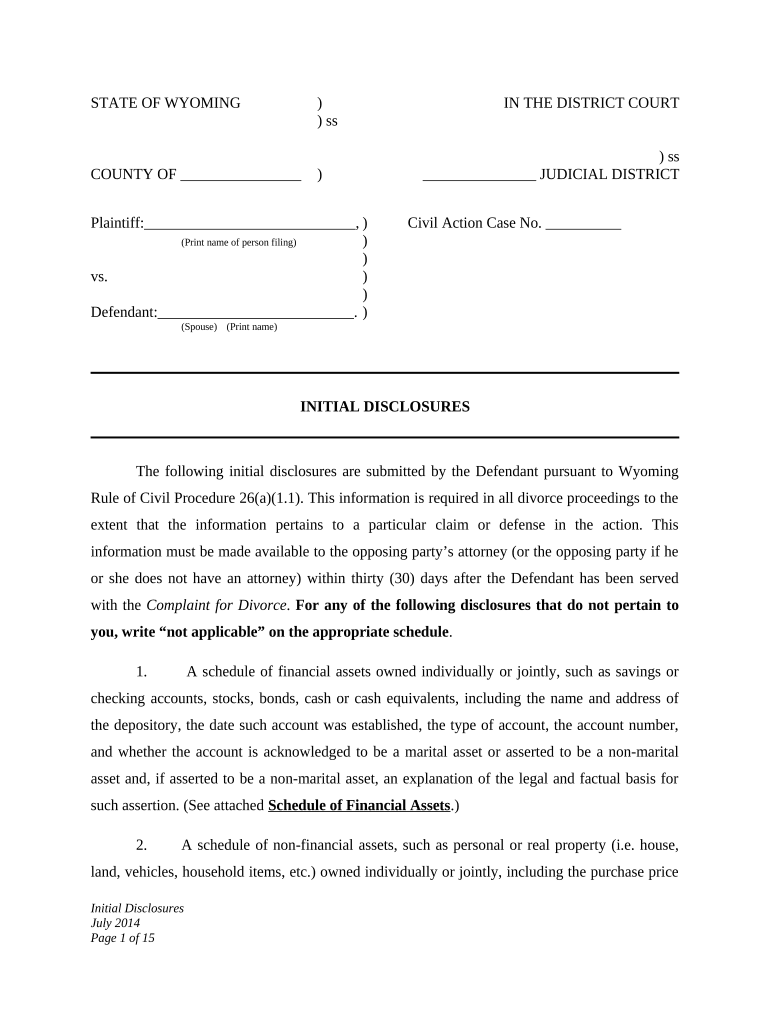
Wyoming initial disclosures in divorce proceedings are the set of documents and statements that parties exchange early in a family law case to identify assets, liabilities, income, expenses, and relevant documents. These disclosures typically include financial affidavits, asset inventories, bank statements, tax returns, retirement account summaries, and information about debts and monthly living costs. The purpose is to reduce surprise, speed negotiation, and provide the court and opposing party with a factual baseline for temporary orders, custody proposals, and equitable division discussions.

Why timely, accurate initial disclosures matter

Providing complete initial disclosures narrows issues, limits discovery disputes, and supports fair temporary orders and settlement. Courts expect parties to be transparent; failing to disclose can delay proceedings and increase legal costs.

Why timely, accurate initial disclosures matter

Who prepares and relies on these disclosures

Both parties in a divorce, their attorneys, financial specialists, and the presiding judge rely on initial disclosures to set interim arrangements and guide settlement discussions.

  • Self-represented litigants who must disclose financials and documents to the opposing party and the court.
  • Family law attorneys who prepare, review, and negotiate disclosures on behalf of clients.
  • Forensic accountants or parenting evaluators who use disclosed records to assess assets or household income.

Accurate disclosures reduce contested hearings, support mediation, and form the basis for proposed property division, support calculations, and custody-related evaluations.

Step-by-step: preparing your initial disclosures

Follow these core steps to assemble and exchange disclosures efficiently.

  • 01
    Gather documents: Collect tax returns, pay stubs, and account statements.
  • 02
    Complete forms: Fill each field accurately and attach schedules.
  • 03
    Review with counsel: Have an attorney check omissions or errors.
  • 04
    Serve and file: Exchange with the opposing party and file per local rules.

How exchange and filing typically proceed

Initial disclosures move from preparation to service, and then to court submission when required by local procedure.

  • Prepare disclosure packet: Assemble signed forms and supporting documents.
  • Exchange with opposing party: Deliver by agreed method or as ordered by the court.
  • File with clerk when required: File originals or certificates per local court rules.
  • Update as needed: Supplement disclosures if facts materially change.

Digital workflow settings to streamline disclosures

Configure a repeatable online workflow to collect, verify, and share disclosures securely.

Document upload PDF, DOCX accepted; ensure searchable PDFs for records.
Field validation Require MM/DD/YYYY for dates and numeric formats for amounts.
Signer authentication Use email link or SMS code for basic verification.
Audit trail Capture timestamps, IP addresses, and signer actions.
Retention policy Set automatic archival per your retention schedule.

Technical and platform considerations for e-submission

Choose a platform that supports secure upload, audit trails, and industry-standard encryption for family law documents.

  • File formats: PDF, DOCX supported
  • Integrations: Works with cloud storage and case management
  • Authentication: Email, SMS, or stronger methods

Confirm the court accepts electronic filings and follow local rules for certificates of service and sealed exhibits before relying on digital submission.

Core elements to include in a professional initial disclosure package

A complete disclosure package organizes financial facts, supporting records, and sworn statements so the court and opposing party can evaluate interim and final remedies.

Cover statement

Signed declaration identifying the parties, case number, and a short summary of what the disclosure package contains and the time period covered.
Income schedules

Detailed listing of earned wages, bonuses, self-employment income, unemployment, and other income sources with supporting pay stubs or profit-and-loss statements attached.

Asset inventory

List and describe bank accounts, investments, retirement plans, vehicles, real estate, and business interests with current valuations or recent statements.

Debt summary

Outstanding mortgages, loans, credit card balances, and other liabilities including creditor names and monthly payment obligations.

Monthly budget

Itemized household income and expenses to support temporary support and child-related calculations, with receipts where feasible.

Supporting exhibits

Attach recent tax returns, bank/credit statements, retirement summaries, appraisal reports, and signed authorizations for financial records as applicable.

Supporting documents commonly required alongside disclosures

Courts commonly expect specified documents as part of or attached to initial disclosures to verify reported figures and streamline adjudication.

Recent tax returns

Federal and state tax returns for the most recent one to three years, including all schedules, to confirm income and deductions.

Bank and brokerage statements

Statements covering the disclosure period; include account numbers (last four digits) and current balances for liquidity and asset tracing.

Pay stubs and employment letters

Recent pay stubs showing year-to-date earnings and employer verification of wages, benefits, and deduction details.

Retirement and benefit summaries

401(k), IRA, pension plan statements and the plan administrators’ contact information for valuation and division analysis.

Timing considerations and common scheduling expectations

Court timelines for initial disclosures vary by county and judge; understand local rules and the scheduling order for precise deadlines.

At case filing:

Provide any financial affidavit or preliminary disclosures required at the time of filing.

Before temporary hearings:

Exchange documents needed to support requests for temporary orders.

At scheduling conference:

Confirm disclosure deadlines and discovery plans with the court.

On supplementation:

Update disclosures when material financial changes occur.

Per local rule:

Follow judge-specific orders for exact submission dates.

Milestones in the disclosure and case-preparation timeline

Typical milestone sequence from initial assembly to final review and supplement.

01

Assemble documentation

Compile records and create organized schedules for each asset and liability.

02

Exchange with opposing counsel

Serve disclosures and supporting exhibits per agreed or ordered method.

03

File required forms

Submit affidavits or certificates to the clerk if the court requires local filing.

04

Supplement if needed

Provide updated information when financial facts materially change.

Common pitfalls to avoid when preparing disclosures

  • Incomplete schedules that omit small accounts or recent transactions, creating credibility issues and later disputes.
  • Failing to attach supporting documents such as tax returns and statements, which prompts motions to compel and delays.
  • Using inconsistent figures across forms and testimony, undermining credibility and causing recalculation requests.
  • Late exchanges or failure to supplement material changes, which can trigger sanctions or evidentiary limitations.

Consequences of incorrect or withheld disclosures

Court sanctions: Monetary penalties possible
Evidentiary limits: Excluded evidence or testimony
Contempt: Risk of contempt proceedings
Adverse inferences: Court may infer concealment
Increased costs: Additional attorney and forensic fees
Impact on settlement: Weakened negotiation position

Security and privacy safeguards to protect disclosure data

Encryption: TLS 1.2/1.3 in transit
Data at rest: AES-256 encryption
Audit trail: Timestamps and IP logging
Access controls: Role-based user permissions
HIPAA readiness: BAA available upon request
Retention options: Configurable archival and export

eSignature vendor comparison for processing disclosure packets

A concise comparison of common eSignature vendors and key plan features relevant to processing sensitive family law disclosures.

signNow DocuSign Adobe Sign PandaDoc HelloSign
Starting Price $8/user/mo $15/user/mo $14/user/mo $19/user/mo $15/user/mo
Free Trial 7-day trial Varies by plan Varies by plan Varies by plan Varies by plan
Bulk Send Yes Yes Yes Yes No
Audit Trail Yes Yes Yes Yes Yes
HIPAA Compliant Yes Yes Yes No No
Envelope Cap No cap 100 envelopes/user/year Varies by plan Varies by plan Varies by plan

Frequently asked questions about Wyoming initial disclosures

Practical answers to common procedural and technical questions about preparing, serving, and storing initial disclosures.


Need help? Contact support

be ready to get more
Join over 28 million airSlate SignNow users