Establishing secure connection…Loading editor…Preparing document…

Injunction Template

This template is fully customizable. Edit the text, fill out the fields, and send it for signature. Give it a try!
Injunction Template

What an Injunction Template Is and When It Applies

An Injunction Template is a standardized court filing used to request a temporary restraining order, preliminary injunction, or permanent injunction from a court. The template organizes the case caption, party identification, jurisdictional facts, legal basis, specific relief requested, supporting affidavits or exhibits, and a signature block for counsel or a pro se litigant. Users adapt language to state or federal local rules and attach verified evidence. The template does not replace legal advice; courts review the substance and supporting proof when deciding emergency or equitable relief.

Why a Clear Injunction Template Matters

A well-formed Injunction Template focuses the court on required facts, legal standards, and precise relief so judges can assess urgency and irreparable harm. Clear structure reduces administrative rejection and helps meet local filing rules.

Why a Clear Injunction Template Matters

Who Typically Prepares and Uses This Template

Lawyers, court clerks, corporate legal teams, and self-represented litigants prepare injunction filings to preserve rights while litigation proceeds.

  • Plaintiff attorneys who need immediate equitable relief in civil disputes or intellectual property matters.
  • Corporate counsel managing emergency injunctions to stop harm to business operations or proprietary information.
  • Self-represented parties filing ex parte restraining orders in family, employment, or small-business disputes.

Confirm local court formatting, signature, and service rules before filing; many jurisdictions require specific forms or supporting declarations.

Step-by-step: Completing the Injunction Template

Follow these procedural steps to prepare a complete injunction filing and avoid common administrative defects.

  • 01
    Draft: Populate caption, parties, factual summary, and requested relief with precise dates and events.
  • 02
    Attach evidence: Include sworn declarations and exhibits that corroborate irreparable harm and likelihood of success.
  • 03
    Check local rules: Confirm formatting, filing method, and any required filing fee or form number.
  • 04
    File and serve: File with clerk and serve opposing parties per court rule; retain proof of service.

Core parts of a professional Injunction Template

A reliable template groups legal and factual elements so the court can quickly evaluate emergency relief; adapt each section to local practice rules.

Caption

Court caption identifies jurisdiction, case number, and party designations; it anchors the filing and must match existing case documents.
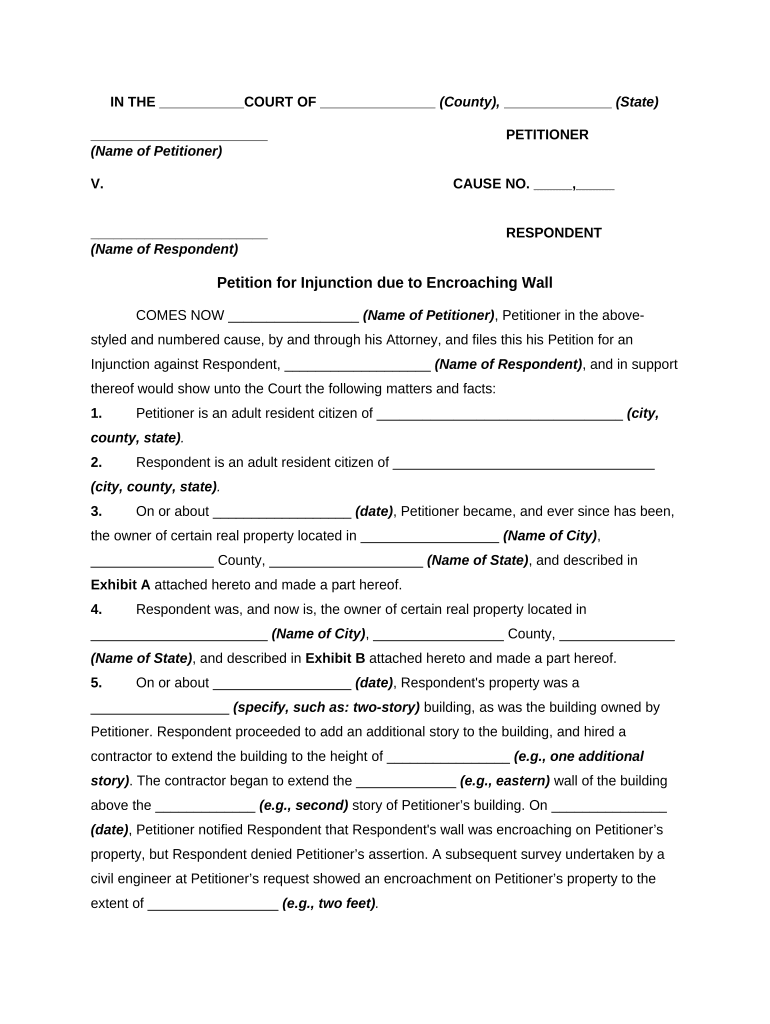
Statement of Facts

Concise factual narrative with specific dates and events that demonstrates immediate and irreparable harm; reference sworn exhibits and declarations.

Legal Grounds

Cite controlling statutes or case law and explain how standard tests (likelihood of success, irreparable harm, balance of hardships, public interest) are met.

Requested Orders

Precisely state the temporary, preliminary, or permanent relief sought, including temporal scope, geographic limits, and any proposed bond conditions.

Supporting Evidence

List attached declarations, exhibits, expert reports, and affidavits with exhibit labels for quick judicial review and record-building.

Service and Notice

Describe how notice will be effected (personal service, email if allowed) and include proposed orders for emergency ex parte procedures if applicable.

Required information fields to include

Parties: Plaintiff and defendant
Court: Court name and county
Case No.: Existing docket number
Relief: Specific injunctive request
Legal Basis: Statute or case law
Exhibits: List of attachments

Where to file and how the filing moves through court channels

Understand the routing steps after filing so hearings and service comply with court rules and timelines.

  • File with clerk: Submit via e-filing portal or in-person at the court clerk's office per local procedure.
  • Request hearing: Schedule or request a hearing date; for ex parte relief include an emergency calendar request.
  • Serve opposing party: Effect service consistent with court rules and file proof of service immediately afterward.
  • Attend hearing: Present declarations and argument; be prepared to identify exhibits and witnesses.

Electronic filing and eSubmission considerations

Many courts accept e-filed motions and PDF exhibits; confirm local e-filing formats and required authentication before submitting online.

  • File Formats: PDF/A or court-specified PDF
  • Authentication: User credentials or e-filing account
  • Integrations: Supports document systems and case management

When using an eSignature or e-filing platform, preserve a full audit trail, timestamps, and attached exhibits to meet evidentiary requirements.

Customizing the template for online completion

Map each template field to the e-filing or eSignature workflow to ensure consistent data capture and required signer steps.

Field Configuration
Case Caption Auto-fill from case management or manual entry
Signature Block Enable signer name, date, and firm fields
Exhibit Upload Restrict file types to PDF and label exhibits
Authentication Use email + SMS code or stronger methods

Typical timing and filing expectations to track

Timelines for injunctions vary by court and procedure; confirm local rules for emergency hearings, proposed orders, and service deadlines.

Emergency Relief:

Ex parte TROs are assessed on emergency showing and local calendar availability.

Preliminary Hearing:

Court sets preliminary injunction hearing date per its scheduling rules.

Proof of Service:

File proof of service promptly after serving opposing parties to avoid continuances.

Response Time:

Opposing party response windows are set by court rules; vary by jurisdiction.

Bond or Security:

Courts may require a bond; amount and timing are court-determined.

Key milestones from drafting to hearing

Track these stages so filings and proof of service align with hearing availability and local rules.

01

Draft and review

Prepare motion, declarations, and exhibits with clear exhibit labels and sworn statements.

02

File with court

Submit via e-file or clerk's office and obtain a stamped filed copy or confirmation.

03

Serve parties

Complete personal or substitute service as required and file proof of service.

04

Appear at hearing

Present argument and affidavits; be ready to address bond and scope of relief.

Common mistakes to avoid when preparing an injunction

  • Submitting unsupported factual assertions without sworn declarations or exhibits undermines credibility before the court.
  • Failing to follow local formatting and filing rules can lead to administrative rejection or delayed hearings.
  • Overbroad relief requests without precise scope invite denial or narrowing by the court at hearing.
  • Incomplete proof of service or incorrect service method frequently causes continuances and procedural setbacks.

Consequences of an incorrect or misleading filing

Sanctions: Monetary or case-management sanctions
Denial of Relief: Injunction request can be denied
Perjury Risk: False affidavits may trigger criminal penalties
Delay: Procedural defects cause continuances
Bond Exposure: Court-ordered bond may be required
Appeal Risk: Adverse evidentiary rulings can complicate appeals

Who can sign the Injunction Template

Plaintiff Attorney

An attorney of record signs the motion and certifies factual assertions under penalty of law; include bar number and firm contact details for service and clerk communication.

Pro Se Litigant

A self-represented party may sign their own filing but must meet the same verification and service obligations; courts may scrutinize factual assertions more closely.

Representative eSignature vendor comparison for filing and signing documents

This comparison shows common plan features and starting prices; verify vendor terms and plan specifics directly before purchase.

signNow DocuSign Adobe Sign PandaDoc HelloSign
Starting Price $8/user/mo $15/user/mo $14/user/mo $19/user/mo $15/user/mo
Free Trial 7-day free trial Free trial available Free trial available Free trial available Free trial available
Bulk Send Yes Yes Yes Yes No
Audit Trail Yes Yes Yes Yes Yes
HIPAA Compliant Yes Yes Yes No No
Envelope Cap No cap 100 envelopes/user/year Varies Varies Varies

FAQs and troubleshooting for common Injunction Template issues

Answers to frequent questions about execution, electronic signatures, filing, and corrections to help avoid delays.


Need help? Contact support

be ready to get more
Join over 28 million airSlate SignNow users