Establishing secure connection…Loading editor…Preparing document…

Nevada Plaintiff's First Set of Interrogatories

This template is fully customizable. Edit the text, fill out the fields, and send it for signature. Give it a try!
Nevada Plaintiff's First Set of Interrogatories

What the Nevada Plaintiff's First Set of Interrogatories Is

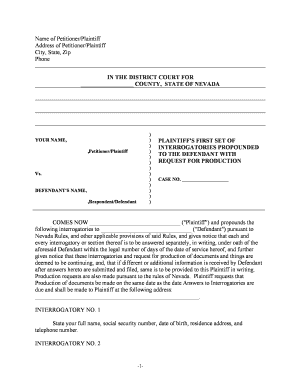
The Nevada Plaintiff's First Set of Interrogatories is a written discovery device used by a plaintiff to ask the opposing party a series of numbered questions about facts, claims, witnesses, documents, and damages. In Nevada civil practice these are served under the court's discovery rules and typically require sworn answers or objections. Interrogatories help narrow disputed issues, preserve testimony, and identify documents for production. The set is usually paired with requests for production and admissions and must be served and verified according to procedural and local court requirements.

Why plaintiff interrogatories matter in Nevada cases

Interrogatories let the plaintiff obtain targeted, written responses that clarify facts and limit surprise at trial while creating a record of the opposing party's positions.

Why plaintiff interrogatories matter in Nevada cases

Who typically prepares and serves these interrogatories

Lead attorneys, paralegals, and experienced litigants commonly draft and serve the plaintiff's first interrogatories.

  • Plaintiff's counsel preparing case-specific factual and damages questions for the defense to answer under oath.
  • Litigants in pro se situations who follow local rules and court forms to serve the opposing party directly.
  • Paralegals assembling exhibits, exhibit lists, and document references to support each interrogatory's scope.

Serve and verify the interrogatories as required by Nevada court rules and any local practice requirements to avoid waiver or procedural objections.

Step-by-step: preparing and serving the first interrogatories

Follow these sequential steps to create, serve, and follow up on the plaintiff's first set of interrogatories.

  • 01
    Draft questions: Create concise, numbered questions tailored to your claims.
  • 02
    Attach exhibits: Include and label supporting documents referenced in questions.
  • 03
    Review objections: Anticipate common objections and narrow overly broad phrasing.
  • 04
    Serve and file: Serve the opponent per rule and file proof of service with court.

Typical components included in a professional plaintiff's first interrogatories packet

A comprehensive set groups the cover sheet, numbered questions, exhibit index, verification, service proof, and instructions so responses are clear and admissible.

Cover Sheet

Contains the case caption, court and case number, names of parties, and a brief title stating it is Plaintiff's First Set of Interrogatories.
Instructions

Defines terms, time periods, document definition, and rules for producing information and documents responsive to the interrogatories.

Numbered Interrogatories

The substantive questions themselves, each numbered and focused on facts, witnesses, damages, insurance, and document custody.

Exhibit Index

Lists and labels attachments referenced by interrogatory number to ensure answers can point to specific exhibits.

Verification Block

Signed under penalty of perjury by the responding party or an authorized corporate representative, certifying accuracy of answers.

Proof of Service

Affidavit or certificate showing the date, method, and recipient of service to establish running of response deadlines.

Required information typically entered on the form

Case Caption: Plaintiff v. Defendant
Case Number: Court docket number
Party Names: Full legal names
Service Details: Method and date
Verification: Signer name and date
Exhibit List: Exhibit labels

Consequences and procedural risks of errors

Waiver of Objections: Possible
Sanctions: Monetary or evidentiary
Deemed Admissions: Risk exists
Motion Practice: May be required
Delay: Case timeline affected
Missing Evidence: Evidentiary gap

Common drafting and service mistakes to avoid

  • Overbroad or compound questions that invite objections and force unnecessary motion practice rather than targeted answers.
  • Failing to define terms or time frames clearly, which leads to disputes about the scope of responsive information.
  • Not attaching or labeling exhibits properly so responses cannot point to specific documents or produce inconsistent exhibits.
  • Serving interrogatories without following local rules for service method or filing a proof of service, which can affect deadlines.

How serving and responding typically works in practice

This outlines the usual flow from drafting through response to meet-and-confer or motion practice, highlighting where documentation matters most.

  • Draft and finalize: Prepare questions with factual specificity.
  • Serve opposing party: Use permitted service methods and retain proof.
  • Receive answers: Defendant provides signed responses or objections.
  • Follow up: Request clarifications or seek court intervention if needed.

Setting up an online workflow for drafting and delivering interrogatories

Use a standard workflow to convert a Word/PDF interrogatory packet to an e-delivery and capture proof of transmission.

Field Configuration
Document Upload PDF or DOCX upload with exhibits attached
Signature Fields Place verification signature and date fields
Recipient Routing Specify counsel emails and order for delivery
Audit Capture Enable timestamp, IP, and delivery receipts

Comparing eSignature vendors for serving and receiving sworn interrogatory verifications

Basic capability and price comparisons for common eSignature platforms; signNow appears first per vendor listing conventions.

signNow DocuSign Adobe Sign PandaDoc HelloSign
Starting Price $8/user/mo $15/user/mo $14/user/mo $19/user/mo $15/user/mo
Free Trial 7-day free trial, no CC No No Yes, limited Yes, limited
Bulk Send Yes Yes Yes Yes No
Audit Trail Yes Yes Yes Yes Yes
HIPAA Compliant Yes Yes Yes No No

Key deadlines and timing expectations for interrogatories

Track service date, response deadline, and follow-up windows to preserve rights and avoid waiver.

Service Date:

The date responses run from; document proof of service

Response Deadline:

Typically 30 days from service absent a different rule

Extension Requests:

Parties may stipulate or seek court-ordered extensions

Meet-and-Confer:

Engage promptly to resolve disputes before motion practice

Motion Timing:

Bring discovery motions promptly after meet-and-confer

Major milestones from service to resolution

A clear timeline helps manage follow-up and possible motion practice if responses are late or deficient.

01

Complaint Filed

Case initiation and start of discovery planning.

02

Interrogatories Served

Plaintiff serves set and files proof of service.

03

Responses Due

Defendant must answer or object within the deadline.

04

Dispute Resolution

Meet-and-confer or file motion to compel if responses deficient.

Frequently asked questions about Nevada plaintiff interrogatories

Answers to common procedural and practical questions about drafting, serving, responding, and enforcing interrogatories in Nevada civil cases.


Need help? Contact support

be ready to get more
Join over 28 million airSlate SignNow users