Establishing secure connection…Loading editor…Preparing document…

Joint Tenant Deed

This template is fully customizable. Edit the text, fill out the fields, and send it for signature. Give it a try!
Joint Tenant Deed

What a Joint Tenant Deed Is and when it applies

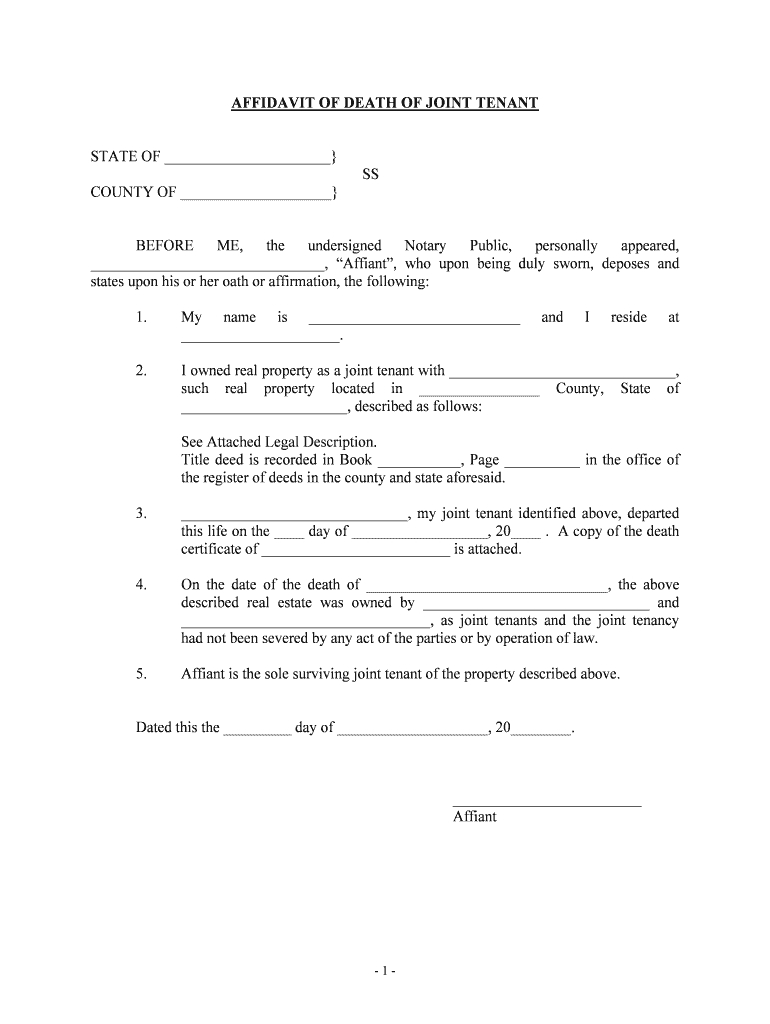
A Joint Tenant Deed is a conveyance that vests real property in two or more persons as joint tenants with right of survivorship. On execution and recording, title is held jointly; when one owner dies, ownership passes automatically to surviving joint tenants without probate. The deed typically contains a granting clause, a clear survivorship statement, a full legal property description, and a notary acknowledgment. It differs from a tenancy in common by the survivorship feature and requires careful drafting and proper recording to ensure enforceability under state recording statutes.

Why a Joint Tenant Deed matters for ownership and succession

A properly drafted Joint Tenant Deed simplifies post-death transfer by avoiding probate, clarifies present ownership shares, and provides continuity of title. It is frequently used by co-owners who want an immediate survivorship mechanism, but it also affects estate planning, creditor exposure, and tax reporting, so confirm consequences with counsel or a title professional.

Why a Joint Tenant Deed matters for ownership and succession

Who commonly prepares or signs a Joint Tenant Deed

This deed is used by individuals and professionals when joint ownership with survivorship is desired.

  • Individual co-owners seeking survivorship and probate avoidance
  • Real estate attorneys and title officers preparing conveyances
  • Lenders, trustees, or estate planners reviewing ownership impacts

Primary parties and their roles

Grantor / Conveyor

The person or entity transferring property. Must sign the deed exactly as their legal name and appear before a notary for the acknowledgement; incorrect grantor identity can void recording or create title defects and complicate later transfers.

Grantee / Joint Tenant

The person(s) receiving title as joint tenants. Each grantee should confirm name spelling and address. Survivorship language creates immediate rights; grantees should understand tax and creditor implications before accepting the conveyance.

Core elements to include in a professional Joint Tenant Deed

A complete Joint Tenant Deed contains specific clauses and elements to ensure the grant conveys the intended interests and records cleanly with the county recorder.

Granting Clause

Clear transfer language stating the grantor conveys the specified estate to named grantees; avoids ambiguous terms that could change interest type.
Survivorship Language

Explicit statement that grantees hold as joint tenants with right of survivorship to avoid probate and confirm automatic vesting on death.

Legal Description

Full metes-and-bounds or recorded lot and block description. A tax parcel number alone is insufficient for recording in many counties.

Consideration Clause

Statement of consideration (e.g., nominal sum or love and affection) required by some jurisdictions to support the conveyance.

Notary Acknowledgment

Proper notary block with signature and seal to meet recording office requirements; remote notarization accepted where state law permits.

Recording Block

Space for county recorder use that preserves chain-of-title clarity and lists recording information once the deed is filed.

Essential data fields required on the deed

Grantor name: Full legal name
Grantee names: Full legal names
Property description: Complete legal description
Consideration: Dollar amount or phrase
Date: MM/DD/YYYY
Notary block: Acknowledgment and seal

Step-by-step: completing and recording a Joint Tenant Deed

Follow a clear sequence to execute, notarize, and record a Joint Tenant Deed to ensure title passes and recording offices accept the instrument.

  • 01
    Prepare deed: Draft deed with full legal description and survivorship clause.
  • 02
    Sign before notary: Grantor signs in notary presence; include capacity if signing for an entity.
  • 03
    Record deed: Submit to county recorder where property is located and pay fees.
  • 04
    Confirm title: Obtain recorded copy and notify title insurer or mortgagee as required.

Where the deed goes after signing

After execution, the chain of custody is straightforward: notarize, record, and distribute copies so the public record reflects the new joint tenancy.

  • Notary: Acknowledge signature and affix seal per state rules.
  • County recorder: File deed in the recorder’s office where the property is located.
  • Title company: Update title records and issue amended title report if requested.
  • Parties: Provide recorded copies to grantees and keep originals safe.

Digital workflow settings for completing a Joint Tenant Deed

Use consistent online field placement, signer order, and authentication to reduce errors and meet state evidence requirements.

Field Configuration
Grantor signature Require signer authentication and notary placement
Grantee names Textbox with exact name validation
Legal description Long-text field, copy/paste only
Notary block Reserved read-only area for notarization

Digital signing and eSubmission considerations

Verify the eSignature platform supports notarization workflows, secure authentication, and produces a tamper-evident signed PDF.

  • Authentication: Email, SMS code, or stronger KBA where required
  • Notarization support: Remote online notarization (RON) where state law permits
  • File formats: PDF output with audit trail and timestamps

Maintain the recorded original per state requirements; keep digital audit trails as lawful reproductions under ESIGN and UETA when permitted.

Timing and processing expectations

Timelines depend on notarization, county recorder backlog, and whether RON or in-person signing is used.

Signing date:

Sign on the date entered in MM/DD/YYYY format

Notary timeframe:

Complete acknowledgement at signing session

Recording time:

County processing 1–10 business days typical

Fee payment:

Pay recording and transfer tax fees on submission

Title update:

Title company updates within days of recording

Key milestones from draft to recorded instrument

Track these numbered milestones to ensure a clean transfer and public record update.

01

Draft prepared

Deed drafted with legal description and survivorship clause

02

Execution and notarization

Grantor signs and notary attaches acknowledgement

03

Recordation submitted

Deed and fees delivered to county recorder

04

Recorded copy returned

Recorded instrument returned and distributed to parties

Common mistakes to avoid when preparing a Joint Tenant Deed

  • Using a street address instead of the full legal description can lead to rejection by the recorder and create title ambiguity.
  • Omitting explicit survivorship language risks creating a tenancy in common instead of joint tenancy and defeats probate-avoidance goals.
  • Signing before notarization, or using the wrong notary procedure for your state, can invalidate the acknowledgment and block recording.
  • Failing to check mortgages or creditor rights may trigger lender due-on-sale clauses or leave liens attached to the property.

Consequences of errors or improper execution

Recording rejection: Deed returned
Title defect: Insurance issues
Probate exposure: No survivorship effect
Lien exposure: Creditors attach
Tax implications: Transfer tax due
Legal dispute: Quiet title actions

eSignature vendor comparison for executing and notarizing deeds

Select an eSignature platform that supports notarization, audit trails, and secure PDF output. The table summarizes typical vendor pricing and capability differences.

signNow DocuSign Adobe Sign PandaDoc HelloSign
Starting Price $8/user/mo $15/user/mo $14/user/mo $19/user/mo $15/user/mo
Free Trial 7-day free trial Varies by vendor Varies by vendor Varies by vendor Varies by vendor
Bulk Send Yes (Business Premium) Yes Yes Yes No
Audit Trail Yes Yes Yes Yes Yes
HIPAA Compliant Yes Yes Yes No No
Envelope Cap No cap 100 envelopes/user/year Varies Varies Varies

Frequently asked questions about Joint Tenant Deeds

Common questions address eSign validity, notarization, witness rules, survivorship effects, and how to revoke or update deeds.


Need help? Contact support

be ready to get more
Join over 28 million airSlate SignNow users