Case Caption
Complete court caption with case number, court name, and correct county ensures the document is filed in proper venue and accepted by the clerk.
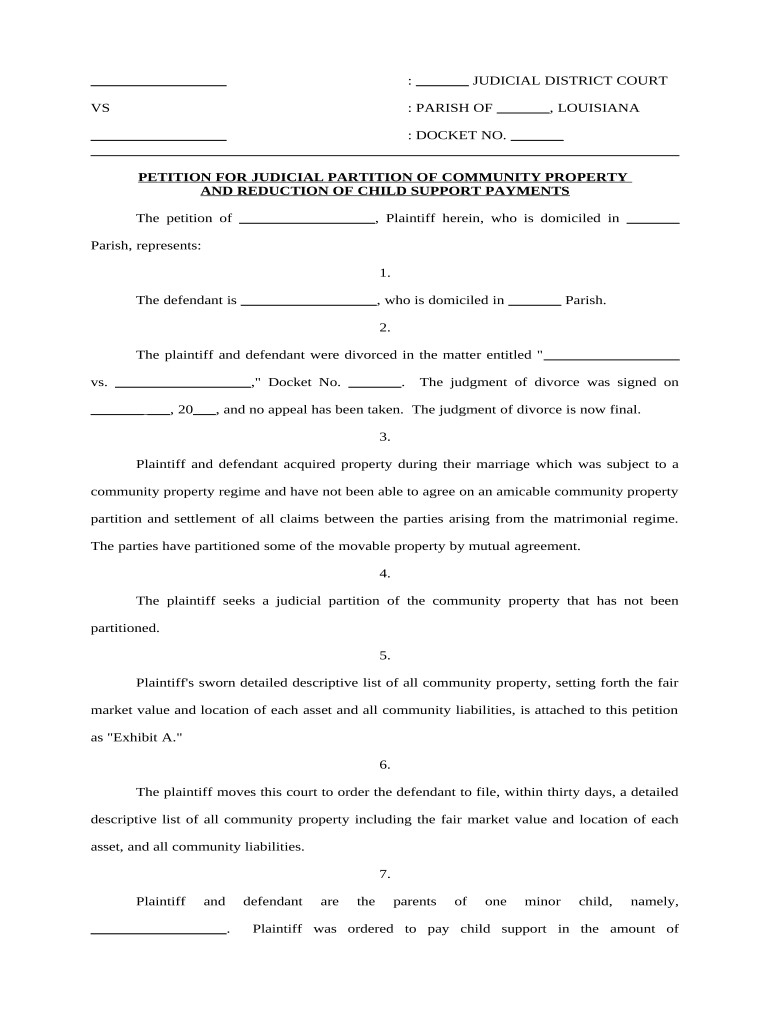
A judicial partition secures a legally enforceable resolution where negotiation fails. It clears title issues, provides an orderly valuation and distribution, and creates a recorded court order that third parties and title companies can rely on.

Common users include individuals and professionals directly affected by co-owned property disputes. Use this guide to determine relevance to your role.
The procedural responsibilities vary by role: owners initiate or respond; attorneys draft and file documents; third parties verify the court decree for post-judgment transactions.
An owner who brings the partition action or a co-owner who must sign settlement documents; may need to verify identity and provide title evidence in court.
The clerk accepts filings and the judge issues the decree; court personnel authenticate the filed record and enter the final judgment that affects property title.
Complete court caption with case number, court name, and correct county ensures the document is filed in proper venue and accepted by the clerk.
Full legal names and capacities for each plaintiff and defendant, including heirs or trustees, plus contact addresses for service of process and notices.
Accurate street address and the full legal description or metes-and-bounds text taken from the deed or county recorder to avoid ambiguity in the judgment.
Recent appraisal or agreed valuation attached as evidence to support equitable distribution, proposed sale price, or allocation of divided parcels.
Clear statement whether partition in kind, partition by sale, or other remedy is requested, including any suggested allocation formula or sale terms.
Draft proposed order or decree with recording instructions, conveyance language, and distribution mechanics to allow immediate post-judgment recording.
| Step | Platform Setting | Action required | Recommended option |
|---|---|
| Upload Complaint | PDF or DOCX accepted; ensure searchable text |
| Place Signature Fields | Add signature, date, and initials where required |
| Authentication | Use email or SMS code; use KBA for higher assurance |
| Audit Trail | Enable timestamps, IP logging, and full activity history |
Ensure your chosen platform supports the file formats, integrations, and signer authentication required for legal filings and notarizations.
For RON or notarization, choose a provider that supports audio-video recording, tamper-evident PDFs, and proper journal retention to meet state notary rules.
Choose tools that support common integrations and produce legally acceptable signed outputs for court and recorder acceptance.
Ensure the chosen solution can attach an audit trail, support notarization workflows (including RON), and export tamper-evident signed PDFs suitable for recording.
Immediate upon submission to the clerk
Within the deadline set by state civil rules
Court sets schedule for valuations and disclosures
Scheduled after pleadings and discovery are complete
Occurs following hearing or upon agreed consent decree
A sibling co-owner filed for partition after failed buyout negotiations.
Two business partners disagreed on parcel division and use of rental income.